Most lean marketing teams lose Q1 before it starts. They spend January planning while competitors are already launching. The fix isn't working harder. It's walking into the new year with a campaign ready to deploy, not a strategy ready to discuss. This post breaks down why that happens, what "ready to launch" actually looks like, and how our GTM Campaign Kit can get you there before December ends.
The January Planning Trap (And How Lean Teams Avoid It)
Here's how Q1 usually starts.
New goals have landed and leadership already wants more pipeline, faster growth, and bigger numbers. Same story, new year. Your team nods along in the kickoff meeting, then spends the next two weeks figuring out what that actually means for your campaigns.
There are positioning discussions. ICP debates. A shared doc that becomes three shared docs. Someone suggests a messaging workshop. By the time you've aligned on what to say, to whom, and where, it's February. Your first campaign goes live mid-month, and suddenly Q1 is half over before you've learned anything.
This is the January planning trap. And if you're running marketing with two or three people, it's a death spiral.
Small teams can't afford slow starts
Big marketing orgs absorb January. They have campaigns already in flight, agencies on retainer, content queued up from Q4. A slow first few weeks barely registers.
You don't have that buffer. Every week spent planning is a week you're not in market. And for lean teams, the math is brutal. Fewer campaigns means fewer at-bats, fewer learnings, and a slower feedback loop that compounds all quarter.
The whole point of being small is that you can move fast. But most small teams don't, because they're stuck doing the same planning work as teams three times their size, just with fewer people to do it.
The difference between planning and being ready
There's a distinction most teams miss. Planning is not the same as preparation. Planning is internal. It's the strategy deck, the brainstorm, the alignment meeting. It feels productive because you're making decisions. But planning doesn't generate pipeline. Campaigns do.
Preparedness means you're actually ready to launch. You have positioning that's tied to real buyer pain. You know who you're targeting and why. You have content drafted, not outlined. Drafted. You have a calendar that tells you what's going live, when, and where.
Most teams finish January with a plan. The teams that win Q1 finish December with a campaign ready to deploy.
What "ready to launch" actually looks like
If you want to start Q1 in execution mode instead of planning mode, here's what you need walking into January.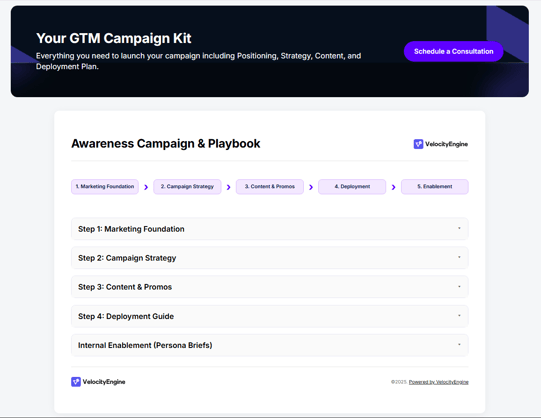
Positioning and messaging. Not a brand guide, but campaign-level messaging. What's the hook? What pain are you pressing on? What's the buyer walking away believing?
ICP and buying committee. Who are you targeting, and who's involved in the decision? For a technical product, this might be a VP who owns the budget, a team lead who's evaluating whether it fits their workflow, and an individual developer who'll actually use it daily. Each one is asking different questions. Your content needs to speak to all of them.
Content mapped to the funnel. At minimum, you need one top-of-funnel asset (a blog, guide, or POV piece), one promo to drive traffic (LinkedIn, paid, or email), and a sense of what comes next. You're not building a library. You're building a launch sequence.
A channel strategy and calendar. Where does this go live? In what order? What's the cadence? A campaign without a deployment plan is just a folder of docs.
If you have those pieces, you can launch the first week of January. If you don't, you're spending January building them.
The shortcut
Most lean teams know what "ready" looks like. They just don't have the time to get there. December is already packed. The holidays eat a week. And the work that takes the longest (positioning, personas, content) is exactly the work that's hardest to rush.
So you start January behind, and you stay behind.
We created the GTM Campaign Kit to solve that problem in 24 hours.
You send us your company details. We deliver a custom-built campaign foundation that covers the full "ready to launch" checklist: campaign positioning and messaging, ICP and buying committee definition, two persona briefs tailored to your buyers, a full blog post ready to publish, LinkedIn promo copy, a deployment calendar, and a channel guide. Plus previews of a second blog, eBook, one-pager, and account page.
Not a template. Not a generic framework you fill in. Built for your company, your market, your buyers. The kind of work that normally takes two or three weeks of internal alignment, delivered in a day.
As Jeff Cox, Director of Global Content Marketing at vLex, put it: "After seeing the outputs, I was genuinely impressed. It wasn't just the core content that helped us expand our thought leadership. It was the wraparound content as well: the personas, the social copy, and the paid copy."
Now is the window
The teams that win Q1 aren't grinding through January planning. They're launching while everyone else is still aligning.
Right now, while things are quieter, while the calendar isn't yet packed with kickoff meetings and pipeline reviews, is when you set yourself up to start fast.
The GTM Campaign Kit is available until December 31. Get yours, and walk into January with a campaign ready to go live. Not a strategy ready to discuss.