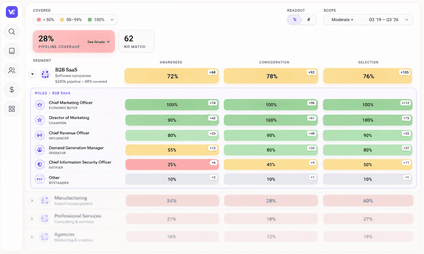
Coverage against the plan is not one measurement. It is five.
Once a team accepts that content coverage should map to the revenue plan, the next question is how to read it. Most teams read it in one direction. Enough content for the priority segment. Enough at the top of the funnel. Each reading is true on its own, and each one hides what the others would catch.
Coverage maps across five dimensions, and the plan is the reference point for every one of them. A gap in any single dimension is pipeline the plan is quietly counting on and the content is not there to support. A library that looks full against one dimension can be thin against another, and the thin one is usually where a deal walks through.
The Five Dimensions of Coverage
Each dimension answers the same question from a different angle. Content covered against what? The answer is, the revenue plan.
-
- Segment, the markets the plan counts on. The plan names the industries the pipeline has to come from and how much each one owes. A market the plan leans on for a third of the number, with an empty shelf behind it, is exposure the plan cannot see on its own. The industry-agnostic library is the trap here, one general version of everything serves no segment well, and the segments the plan depends on most are the ones that need their own language most.
- Persona, the buyers who move the number. The plan does not convert without the buyers who move the deal, and a committee does not read as one person. A segment can look covered and still be blank for the buyer who controls the decision. This is where averages lie most. Seventy percent coverage can mean full for the easy persona and empty for the hard one.
- Funnel stage, where the plan needs conversion. A pipeline target is conversion math, carrying assumptions about how buyers move from a problem to a decision. Most teams are heavy at the top, where awareness content is easy to produce, and thin at the bottom, where selection content takes real work. That shape starves the stage closest to a closed deal, the stage the plan relies on to convert.
- Product, what the plan is selling. Coverage measures whether each line the plan sells has content behind it, rather than only the flagship everyone defaults to. A second or third product carrying real pipeline can sit nearly invisible while attention pools around the headline offering.
- Channel, where the pipeline has to come from. A strong asset on the wrong channel reaches no one the plan is counting on. Coverage measures whether the content lives where the buyer looks. This gap hides easily, because the content exists somewhere, it just does not exist where the plan needs it.
- Segment, the markets the plan counts on. The plan names the industries the pipeline has to come from and how much each one owes. A market the plan leans on for a third of the number, with an empty shelf behind it, is exposure the plan cannot see on its own. The industry-agnostic library is the trap here, one general version of everything serves no segment well, and the segments the plan depends on most are the ones that need their own language most.
Read All Five at Once
Read any one dimension alone and the library can look fine. The single-direction read is what lets a gap hide in plain sight, full against the angle you checked, empty against the one you did not.
"A gap in any single dimension is pipeline the plan is quietly counting on, and the content is not there to support it."
Read all five against the revenue plan and the real picture shows up, the segment owed a third of the number with nothing for its economic buyer, the product carrying pipeline with no content behind it, the channel the plan depends on and the team forgot. Coverage against the plan is five questions asked at once, and the answer is where the next content decision should start.