One VelocityEngine.
Every client. No prompt library to maintain.
For the agency owner whose margin gets squeezed every time a client asks for more output at less spend, and the strategy director keeping four brands from blurring into one another. VelocityEngine is the multi-tenant operating system that lets your agency carry more clients without losing brand integrity.
Why agencies are losing margin to in-house AI
The billable hour is getting harder to defend. The agencies that scale fastest build a system.
YOUR CLIENTS ARE RUNNING AI IN-HOUSE NOW
Every B2B marketing client your agency serves has Claude, ChatGPT, and three other AI tools open. They’re producing content in-house, then asking: what value-add are you bringing? The answer can’t be “better prompts.”

ONE FOUNDATION PER CLIENT DOESN’T SCALE
Every client has their own brand voice, positioning, ICPs. You rebuild that scaffold for each one, by hand, before any campaign ships. A senior chunk of every engagement goes to foundation-build before a single campaign moves.
A CONTENT AUDIT IS ARDUOUS, TIME-CONSUMING, AND A POINT IN TIME
You spend hours analyzing your clients' content to tell them what campaigns and content they need. This needs to be a living view you own, so your strategy stays visible and your retainer stays defensible.

THE REPORTING LAYER IS THE DELIVERABLE
Your client doesn’t pay for content. They pay for outcomes they can report up. If your agency can’t show what shipped against the plan, segment by segment, week by week, the retainer is at risk every renewal cycle.
Every Role Gets What It Needs
Demand Generation Campaigns
The Challenge
Demand generation is a numbers game. You need consistent campaign velocity: landing pages, email sequences, lead nurturing tracks, paid creative, follow-up workflows. Most teams manage these across five different tools (HubSpot, email platform, design tool, social tool, analytics). Every handoff creates lag. Every tool change breaks continuity.
- Campaign design is siloed from email workflow
- Landing page specs don't match email template design
- Lead handoff to sales requires manual data entry
- Campaign performance data lives in six different dashboards
Who it’s for

+
Your 2-person demand gen team produces at the output of a 15-person team.
“We're hitting 3x the lead volume with the same team because the system handles coordination instead of us doing it manually.”
How VelocityEngine Solves It

Standardized Foundations
Email specs, landing page specs, ad copy specs, lead scoring rules, all in one place

Operationalized Design
Landing page layouts, email templates, ad creative—all locked to brand standards
Formalized
Supply Chain
Campaign intake → design → copywriting → legal review → launch → tracking

Optimized
Content
Built-in analytics let you optimize iteratively

Systematized
Record Keeping
Every campaign documented for audits and compliance
The Result
Paysafe cut campaign-to-live time from 4-6 weeks to 11 days. FOSSID went from 1 blog/month to 5 blogs/45 minutes. Ternary saved $100K/year in freelance costs. The operating system does the work. Your team does the strategy.
Product Launch Campaigns
The Challenge
Product launches are coordinated chaos. You need messaging alignment across 15+ channels. Customer emails, sales enablement, partner announcements, event promotion, analyst briefings, press releases, social campaigns, website updates. If one channel sends mixed messaging, the whole launch looks confused.
- Messaging creeps in different directions across channels
- Launch timeline is fragile (one approval delay breaks everything)
- Sales enablement materials are never finalized until the last minute
- Post-launch, nobody can find the final approved messaging deck
Who it’s for
Go from announcement strategy to full campaign in days, not months.
“Our 15-channel launches used to take 8 weeks. Now we're moving at 3 weeks with more channels and better coordination.”
How VelocityEngine Solves It
Become the single source of truth for product launches:
Standardized Foundations
Product launch messaging framework, positioning, key benefits, competitive narrative
Formalized Supply Chain
Email launches → sales enablement → partner comms → paid campaigns → event promotion → analyst updates in parallel
Systematized Record Keeping
6 months after launch, the approved messaging deck is in VelocityEngine
The Result
Launch messaging stays consistent across all 15+ channels. Sales has enablement ready on day one. Post-launch audits show exactly what was approved, by whom, when.
Account-Based Marketing (ABM) Campaigns
The Challenge
ABM means personalization at scale. You're running 20 variations of the same campaign (one per target account). That's 20 email designs, 20 landing pages, 20 ad creative sets. Build one, use one. Build 20, and your team drowns in design and approval work.
- Building 20 variations manually is a part-time job.
- Approval workflow breaks down (20 different asset sets to track)
- Measuring ABM results requires pulling data from six different tools
- Scaling to 40 target accounts feels impossible
Who it’s for
Design once, deploy to 10 segments. One architect. Ten personalized campaigns.
“ABM used to be artisanal work. Now it's systematic. We personalize without the manual chaos.”
How VelocityEngine Solves It
The Campaign Architecture module makes ABM scale:
Operationalized Design
Build an email template once. Configure 20 account-specific variations in the system.
Formalized Supply Chain
Batch approval: approve the master template, all 20 variations inherit approval automatically
Optimized Content
Built-in reporting shows account-by-account engagement and ROI.
The Result
Lytho went from 'we can't scale ABM to 10 target segments' to shipping 150 assets across 10 segments in 3 months. ABM stops being boutique and becomes a core pillar.
Thought Leadership Campaigns
The Challenge
Thought leadership lives in content: blogs, whitepapers, executive bylines, webinars, podcast appearances. Each piece takes weeks to commission, write, review, edit, design, publish, and promote. Most companies publish 1 blog/month. Bottleneck: scattered process, no templates, slow reviews.
- Content briefs are inconsistent
- Review cycles take weeks because reviewers are scattered
- Design work can't start until copy is 'final'
- Published content isn't connected to campaign promotion
Who it’s for
Publish authority content on a repeatable schedule, not a passion project cadence.
“We went from 1 whitepaper per quarter to 1 per month. The system standardized what was chaos before.”
How VelocityEngine Solves It
Standardize thought leadership workflows:
Standardized Foundations
Thought leadership brief template, review criteria, editing rules, publication standards
Operationalized Design
Design templates for blog headers, whitepaper covers, webinar slides—all on-brand
Formalized Supply Chain
Brief → outline → draft → SME review → copy edit → design → compliance → publish
Optimized Content
Built-in content performance analytics guide future strategy
The Result
FOSSID went from 1 blog/month (each taking 2 weeks) to 5 blogs shipped in 45 minutes. Thought leadership scales from passion project to repeatable business process.
Retention & Expansion Campaigns
The Challenge
Retention campaigns are complex. You're targeting existing customers with education, upsell, and renewal messaging. Every segment gets slightly different messaging. One-size-fits-all messaging underperforms. Personalized messaging at scale is operationally painful.
- Segment definitions aren't documented
- Email sequences are built separately for each segment (copy-paste nightmare)
- Success metrics vary by segment
- Playbooks don't exist (new campaigns start from scratch)
Who it’s for
Transform retention from seat-of-the-pants to documented playbook. Every segment. Every email.
“Our retention team used to start from scratch every campaign. Now they operate from playbooks. It's night and day.”
How VelocityEngine Solves It
VelocityEngine operationalizes retention at every segment:
Standardized Foundations
Thought leadership brief template, review criteria, editing rules, publication standards
Operationalized Design
Design templates for blog headers, whitepaper covers, webinar slides—all on-brand
Optimized Content
Measure churn reduction, expansion revenue, renewal rates by segment
Systematized Record Keeping
Every retention campaign documented—playbooks become institutionalized
The Result
Retention campaigns shift from seat-of-the-pants to documented playbook. Segment consistency improves. Upsell messaging becomes coordinated. Retention becomes a function of process, not personality.
Event Marketing Campaigns
The Challenge
Event marketing involves coordinated campaigns across promotion, logistics, on-site content, and follow-up. Pre-event campaigns (registration), on-site materials (agendas, speaker bios), and post-event follow-up (thank you, next event, content repurposing). Every stakeholder needs different assets from the same event.
- Registration campaign design doesn't align with landing page
- Speaker bios are different formats in different places
- On-site materials don't reference each other or share branding
- Post-event follow-up doesn't reference pre-event positioning
Who it’s for
Turn each event into a repeatable playbook. Next year, you're 3 months ahead.
“After our first event in VE, we documented everything. Second event was done in half the time because the system remembered it all.”
How VelocityEngine Solves It
VelocityEngine coordinates event campaigns across all phases:
Standardized Foundations
Event messaging, speaker positioning, sponsor recognition, attendee segments
Formalized Supply Chain
Pre-event promotion → on-site assets → attendee communication → post-event follow-up
Operationalized Design
Email templates, landing pages, on-site signage, program designs—all brand-locked
Optimized Content
Post-event analytics guide future event strategy
The Result
Events stop being ad-hoc and become repeatable playbooks. Next year's launch is faster. Content consistency improves. Events become marketing machines.
One operating system. Every client. Multi-tenant by design.
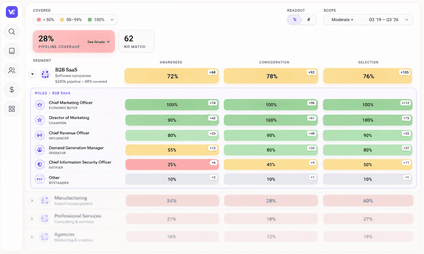
A foundation per client. A coverage view per engagement. A reporting layer your senior strategists want to share.
Foundations
Build each client’s voice, positioning, ICPs, and brand canon once. Multi-tenant from day one.
Content Audit
Each client’s coverage view per engagement. Across segments, channels, funnel stages — visible to your strategists, reportable to your clients.
Campaign Planning
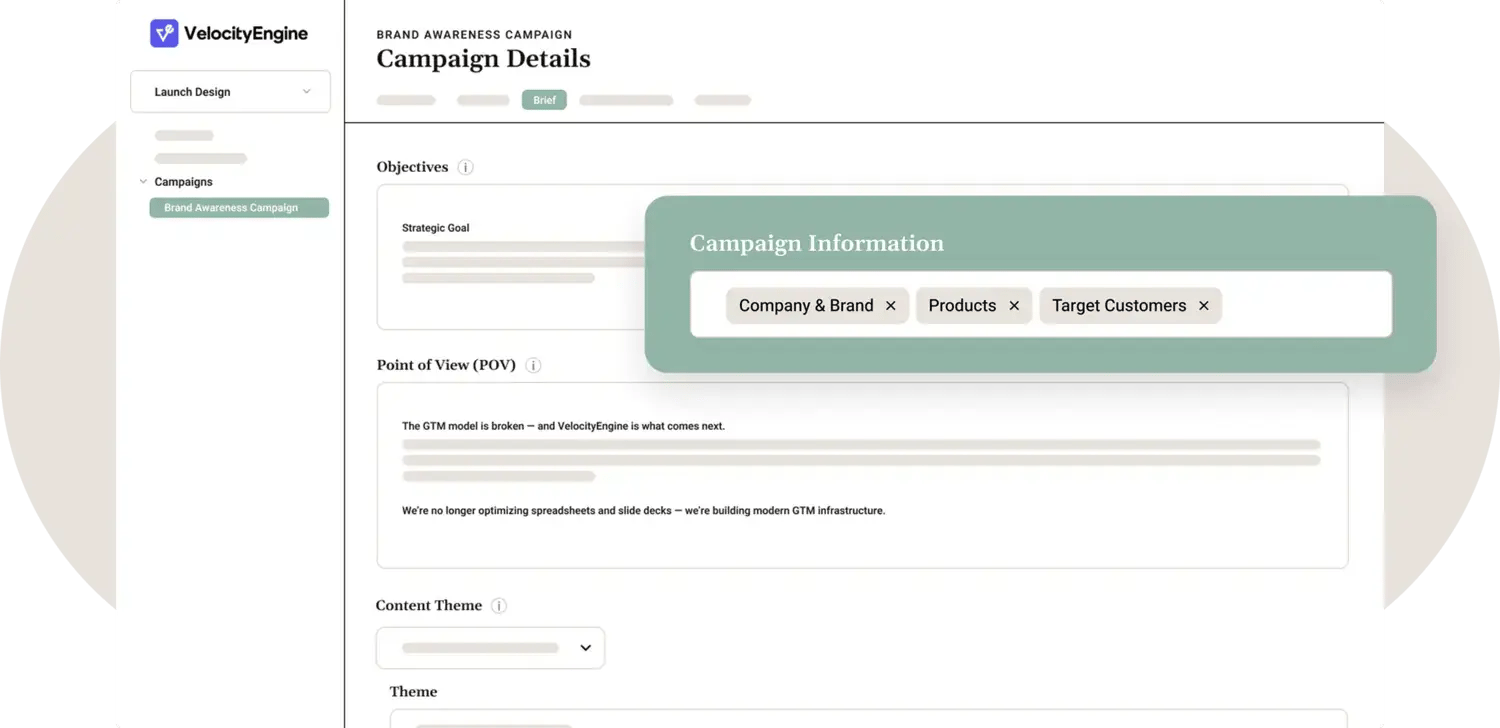
Templated campaign intake per client. Every brief inherits their foundation and the gaps the audit surfaces.
Content Creation
On-brand content per client, per voice, at the velocity their retainer requires.
Launch Coordination
Every client, every campaign, every channel in one operating record. Your senior strategists run accounts whileVelocityEngine runs the production layer.
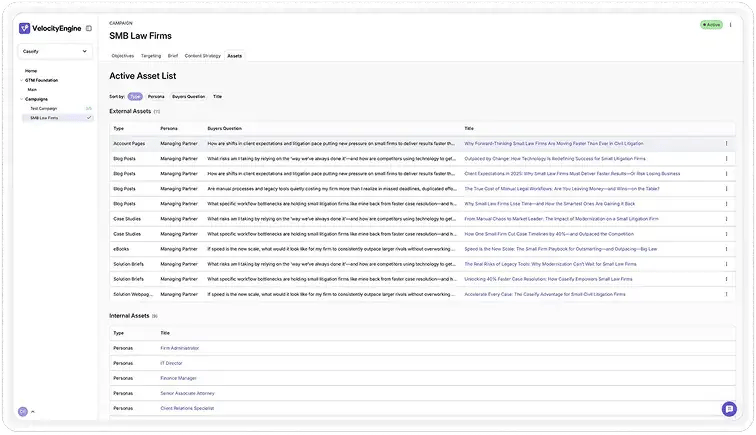
Start with a content coverage heatmap.
Run it and see what your content covers against your revenue plan, before you commit to anything.