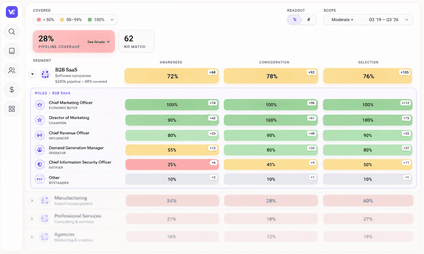
Sit in enough board meetings and you'll hear the question, how did we perform? Naturally, you'll discuss what you ran, how it did, and the pipeline you influenced.
Then the board asks something your presentation wasn't built to answer:
"Do we have sufficient content for the audience our revenue strategy is targeting, or are we only strong in certain areas?"
Nobody has created a term for that question. Until now.
Enter "content coverage" by VelocityEngine. Think of it as a content gap analysis. It measures the gaps in your content against your revenue plan relative to baselines and scores your coverage according to defined segments, personas, and funnel stages.
And it will become a board term when it hands them the information they need to make decisions about prioritizing spend and effort.
This is the last of three posts on the idea. Part one looked at what your performance data can't tell you, and part two covered why coverage has to span the entire buying journey. This one is about how it plays in the room where budget actually gets decided.
Four Things Coverage Tells You That Your Performance Dashboard Can't
Content coverage sits upstream from content performance. While they're certainly two sides of the same coin, they're distinctly different. Here are four things coverage tells you that your performance dashboards can't:
- Revenue-weighted coverage: This tells you where the money sits, not just where the empty cells are. For a lot of companies, a big chunk of their revenue plan sits in segments where they're under covered by a third. Your board can make a budget decision with that.
- Buying committee completeness: This tells you how many of the personas in your buying committee you're creating content for. Enterprises are reaching about 2 of the 5 personas they care about most. A B2B purchase now commonly involves 5 to 16 people across several functions, so a library for one role doesn't provide cover for a deal.
- Funnel-stage mix vs. GTM motion: This tells you whether your content library matches how you sell. For example, if you're sales-led, you need a lot of selection content, but if the majority of yours is awareness, that needs to be rectified. How you sell is an input into your heatmap's revenue plan, so a product-led team could have the same mix and be fine.
- Decay: This tells you which heatmap cells are populated by content that's getting old. If half your heatmap is green, but the content being scored is over a year old, perhaps it's time to refresh those assets or think about adding more.
How to Present It in a Board Meeting
Present content coverage as a complement to content performance.
First, talk about your content coverage and how you're strategically creating content to fill the gaps outlined by your heatmap.
Be sure to highlight:
- Your coverage score and what it's measured against (your revenue plan)
- Which segments carry the most revenue and if they're covered
- How many personas on the buying committee you have content for
- Where a competitor is talking to a buyer you're not
- What you're building next quarter, tied to specific cells
- What you're deliberately not building
- Which covered cells are running on old content
Why Content Coverage First?
Because it leads to strategic conversations and alignment between leadership. The heatmap provides a single point of view into your content gaps, scored against the revenue plan everyone already agreed to. Once those gaps are visible, the conversation shifts from "how did marketing do" to "do we have the content needed to support sales, drive pipeline, and hit our revenue targets?" Those are the conversations that create change.
And it sets up the rest of the meeting, making performance the natural next step.
When discussing performance, talk about what you built to fill the gaps and how it did. Performance stops being a standalone report card and becomes the proof that your content coverage strategy works.
Start with the Content Coverage Heatmap
Run it and see whether you have existing content that aligns your revenue plan so you can arrive fully armed for your next board meeting. It provides a clear, actionable entry point and facilitates strategic, cross-functional planning conversations, showing you which gaps to address before building or investing further.
Request your content coverage heatmap →
Frequently Asked Questions
What makes content coverage a board-level measurement and not just a marketing metric?
A board cares about the revenue plan, and content coverage should get evaluated against the plan. It tells you which target segments carrying the revenue have buying committee members you've never written for, and that's a GTM strategy problem, not a content output problem.
Where does the coverage target for each cell come from?
We calculate it from your revenue plan inputs, which include deal size, sales cycle, GTM strategy, and brand maturity. Each input factors into the calculation for content requirement baselines, which are then fully adjustable and customizable by you.
Isn't this what Semrush or HubSpot already do?
No, and most of our customers keep both. Semrush tells you which pages rank for which queries, so what it counts is the query and what we count is the audience. HubSpot suggests topics and answer-engine prompts at brand level from inside the CRM, and neither tool reads your content library against your own segments, buyers, and funnel stages. Profound and AirOps hit the same wall from the other side: they check whether your brand shows up in answer-engine results, and nothing can make you show up for a buyer you've written nothing for.