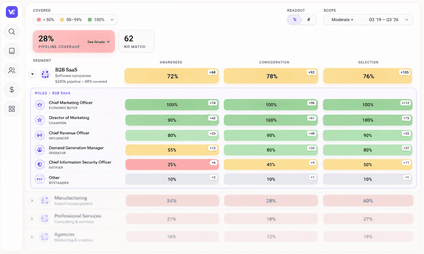
What capacity looks like when the system handles assembly.
The hours stuck in assembly are the hours your strategy work needs back.
Content directors have a particular version of the AI productivity story. The team is producing more. The drafts move faster. The brief gets turned around the same week instead of the next one. And yet the strategy work, the thinking that should make the next campaign sharper than the last one, keeps getting pushed.
There is a reason for this, and it is not a time management problem.
The tools arrived. The work stayed shaped the same way it was before the tools arrived. For a content team, this looks like more output and the same calendar. The production hours got faster. The assembly hours stayed exactly where they were.
The gap between charter and headcount
Every marketing team operates against a charter. It is the standard the work is measured against, even when no one has written it down. Leadership expects a certain campaign cadence, the pipeline needs a certain segment coverage, the calendar implies a certain production volume, and the reporting is read for a certain strategic depth. The team feels all of it as the bar to clear, whether or not anyone has named it that way.
The headcount is what the team has on Monday morning.
When the charter and the headcount line up, the work fits the week. When they do not, the team compensates. The compensation shows up as longer hours, rework, dropped strategic projects, and a calendar that keeps slipping. Most small marketing teams operate inside that gap. The gap is what makes "we are running lean" a permanent state instead of a temporary one.
A three-person team that produces like a larger team is one that closed the gap without adding people. The headcount did not change. The charter did not shrink. What changed is the work that was eating the hours.
Where the assembly labor lives
Assembly is the work that connects the tools to the campaign and the campaign to the strategy.
Rebuilding the brief every Monday because the last brief lives in someone's inbox. Reconciling two writers' AI outputs because they prompted from different mental models of the persona. Sitting in a Wednesday review meeting debating whether the email matches the landing page. Searching three folders for the approved positioning language. Onboarding a freelancer by walking them through context that should already be written down.
None of this work is visible on the calendar. None of it produces a deliverable. It is the invisible labor that connects everything else, and it scales with every new asset, every new contributor, every new campaign. For a three-person team carrying the workload of five, the assembly labor is the difference between strategy work happening and strategy work getting bumped to next quarter.
This is the gap between access and activation. The team has the tools. The work itself has not been given a shape that lets the tools compound.
What changes when the system handles assembly
A campaign operating system holds three things constant while everything else accelerates.
Start with the positioning. The value props travel with the brief, so every contributor sees the same source of truth when they sit down to write.
Define the persona once, at the system layer. The persona definition travels with the assignment, so the AI output reflects the same understanding of the audience regardless of who prompted it.
Anchor the conversion path. The conversion logic travels with the asset, so the email, the landing page, and the follow-up all point to the same next action.
When those three things are held by the system instead of by individual memory, the assembly hours collapse. The Monday brief rebuild stops happening. The Wednesday reconciliation meeting stops happening. The search-three-folders-for-positioning stops happening. The freelancer onboarding gets faster because the context is written down where the assignments live.
This is what closes the gap. The headcount stays the same. The charter still asks for what it asks for. The strategy work gets the hours back.
The vLex team, from seventy days to fourteen
Jeff Cox, Director of Global Content Marketing at vLex, runs a three-person team. Before adopting a campaign operating system, his team's production cycles ran seventy days from brief to launch. After, fourteen.
"The eighty-three percent reduction in production time is the headline. What sits underneath the number is the assembly work disappearing."
The eighty percent cost savings against agency spend is the secondary headline. Both numbers point at the same thing. Jeff's team did not start working faster. They stopped repeating themselves.
The positioning stopped getting rebuilt for every campaign. The persona definitions stopped getting re-explained. The handoffs between writers, designers, and strategists stopped breaking down at the points where context was supposed to travel. The hours that used to go into assembly went back into the work that requires human judgment, the work that decides what the next campaign should say and who it should say it to.
A team of three operating like a team of five is what that compression produces.
The capacity question worth asking
Most content directors are looking at capacity through the wrong lens. The question they ask is how much faster the team can produce. The question that matters is how much of the team's week is currently going into assembly.
If the answer is "more than half," the team is already operating like a smaller team than it is. The AI tools are not the fix. The redesign of the work around the tools is the fix.
The vLex team did not become a different team. They got their hours back from the assembly labor that was eating their strategy work. Three people. Same charter. Different shape of the week.
Capacity is a system problem before it is a headcount problem. The hours are already there. The system decides where they go.