The best marketing leaders know their content the way they know their pipeline number.
Marketing owns a number now, a real share of the pipeline the company is counting on. This is the plan's own math: X is pipeline and Y is marketing-sourced, across specific segments and buyers.
The number is clear, but what stays murky is whether the content plan can carry it. The plan lives in one place, the content lives in another, and almost nothing connects them. So a team can be fully staffed, shipping steadily, and still walk into a quarter with whole segments uncovered, without anyone seeing it until the pipeline comes up short.
The Number Lives in One Place, the Content in Another
A revenue plan is specific about what marketing owes. It sets the pipeline target, the marketing-sourced share, the average deal size, and the segments where that pipeline has to come from. Every one of those segments has buyers, and every buyer has questions that content is supposed to answer on the way to a deal.
The plan does not show whether that content exists. It shows the destination, not the road. Marketing knows what it produced last quarter and what is on the calendar for this one, and that feels like coverage. Whether it lines up with the segments and buyers the plan depends on is a separate question, and usually an unanswered one.
That space between the number and the content is where exposure hides. A segment the plan is counting on for a third of the pipeline can have almost nothing built for its economic buyer, and the team will not feel it until reps are working that segment with empty hands.
Coverage Is the Number Made Visible
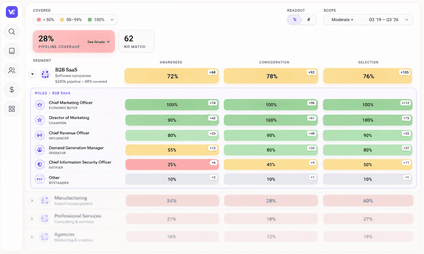
Coverage closes that space. It maps the content the team already has against the plan, across segment, persona, and funnel stage, and shows where the content is present and where it thins out.
That turns a feeling into a figure. "We seem light in that segment" becomes a specific, visible reading of where the holes sit and which buyers they leave exposed. The reading is living, it moves as the plan moves, so when the target shifts or a new segment comes into focus, the picture of what is covered shifts with it.
"The plan says where the pipeline has to come from. Coverage says whether the content is there to support it."
The value is timing. A coverage view shows the exposure while there is still room to do something about it, weeks before the quarter would have revealed it on its own.
Covered Segments Carry Pipeline Better
Coverage is pipeline capacity. A covered segment can carry deals that a thin one cannot.
A rep working a covered segment has ground to stand on. The content has framed the problem, answered the early questions, and warmed the buyer before the conversation starts. A rep working an uncovered segment starts cold, educating from scratch on the call, carrying weight that content should have carried first. The leads that marketing has moved through the funnel arrive readier than the ones a seller has to develop alone.
So coverage feeds conversion, and reach is only part of it. A segment with content across the funnel gives every downstream rep a running start. A segment with gaps asks sales to make up the difference, deal by deal, which is slower and lands less often. When the plan leans on a segment for real pipeline, thin coverage there becomes a tax on every deal in it.
Build What the Plan Needs, Not What Fills a Calendar
Once coverage is visible against the number, the production question changes. The old question is what to publish this quarter. The better one is which gaps, closed, would most help carry the plan.
That reorders the work. The thin spot in front of a buyer the plan is counting on gets built first. The asset that would round out a calendar but serve no segment in the plan waits, or never gets made. Every piece earns its place by the coverage it adds against the number, rather than by filling a slot on a schedule.
This is the discipline the revenue plan makes possible. Content stops being a stream of output measured by volume and becomes a set of deliberate moves measured by what they cover. The team produces less that serves nothing and more that carries the number it owns.
A marketing leader who owns a number should be able to see, on any given day, whether the content can carry it. Know your content the way you know your number, and you can watch yourself cover the plan instead of hoping you land it.