Every one of these paths gives you more output, but none of them gives you a a true system.
A marketing team that decides to get serious about AI usually picks one of four paths to make it real.
Each path is reasonable. Each one produces more content, faster, which is what the team set out to get. And each one tends to stall in the same place, a quarter or two in, when the team realizes that more output never turned into a systematic path to pipeline.
The stall is worth understanding before you pick a path, because the four failures rhyme or rather, have a rhythm to them. They all leave the same thing missing.
The Four Paths
Here are the four, in the order teams tend to consider them.
- Build it with your engineers. Stand up internal tooling on top of the LLM APIs and make marketing's strategy infrastructure a roadmap item.
- Hire an AI architect or an agency. Bring in a consultant or fractional team to set up the workflows, the prompt libraries, and the brand canon.
- Buy a point solution for each function. One tool for writing, one for compliance, one per slice of the work.
- Build prompts directly in Claude or ChatGPT. Skip the tools entirely and go straight to the foundation models with your own setups.
All four are reasonable answers to the same question of how a team operationalizes AI. All four leave the same thing missing.
The Accidental Architect
The DIY path is worth looking at closely, because it's the one teams fall into without deciding to. You start with a few good prompts. They work, so you build more. Soon there's a library, a set of conventions, a way the team does things, and one person who holds all of it together.
That person became the architect the team chose not to hire. The strategy now lives in their prompts and their head, undocumented and unowned by the system, because the system is them. It works right up until the day it depends on them too much.
When that person leaves, the strategy leaves with them. The prompts go stale, the conventions blur, and every remaining contributor starts building their own version again. The brand drift that the prompts were holding back becomes structural, and the team is back where it started, except now the knowledge walked out the door.
Why Each Path Stalls
The other three paths stall for reasons that rhyme with the fourth. Build-it-with-engineers stalls because marketing's strategy infrastructure never wins against the product backlog, so it ships late or half-built and then waits on engineering for every change. Hire-an-architect stalls because the strategy walks out when the contract ends, and it walks out at renewal too. Buy-a-point-solution stalls because none of the tools connect, so the team becomes the integrator, stitching together outputs from systems that each see only their own slice.
The common thread is that every path produces output without producing a system. The writing gets faster, the compliance gets handled, the prompts get sharper, and none of it adds up to a layer that knows whether the content the team is producing covers what the pipeline needs.
So the team ends up with more assets and the same question they started with. Are we covered where the revenue is supposed to come from, and nobody can answer it, because no path built the thing that would.
What the Paths Miss
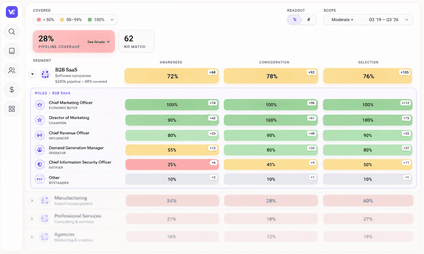
What all four paths miss is the operating layer. Coverage tied to the Revenue Plan, the view that shows whether content exists across the segments, stages, personas, products, and channels the pipeline depends on.
Output is not the constraint anymore. AI solved output. The constraint is knowing whether the output adds up to coverage, and that is a different kind of thing than a faster writing tool or a better prompt. It is the layer that connects what the team produces to the number the company committed to. All four paths are aimed at making content, so none of them builds it.
A team can run any of the four paths and still have no idea where its coverage is thin. The map is the missing piece, and more output does not draw it.
The Build vs Buy Question
This reframes the build-vs-buy decision. The real question was never which path produces content fastest, because all of them produce content. The question is whether the strategy infrastructure survives the people who built it.
A system you can operate is one where the coverage, the positioning, and the Revenue Plan live in the system itself, where they stay when the people change. A capability you own keeps working after the contractor's engagement ends or the employee with the prompt library moves on. A rented one leaves when they do.
Build or buy is the wrong frame if it's only about cost or speed. The frame that matters is permanence. Whether, a year from now, the team still has the system, or whether the system walked out with whoever built it.
Each path gives you more output. None creates a systematic path to pipeline. The choice that matters is not which tool writes fastest, it's which approach leaves you with an operating layer that's still yours when the people who set it up have moved on.