How Lytho's Marketing Team Covered Twelve Verticals and Grew Pipeline Every Week
A four-person marketing team covering twelve verticals with tailored content and growing pipeline six percent every week sounds like a staffing miracle. It was a structural decision.
Every demand gen leader has faced the segment coverage problem. The business targets multiple verticals, each with its own language, pain points, and buying triggers. Covering all of them with a small team means either producing generic content that technically applies to everyone and resonates with no one, or running a production operation so lean that quality varies wildly depending on who wrote what and when.
Lytho, the creative operations company, found a way through this with four people. Their story is worth examining because it demonstrates what happens when segment coverage becomes a system problem rather than a headcount problem.
The Segment Coverage Problem
Twelve verticals is a lot of ground to cover, and each one needs content that speaks to its specific context. A healthcare marketing director and a financial services CMO both care about campaign efficiency, but they describe the problem differently, measure success differently, and respond to different proof points. Content that treats them as the same audience wastes both their time.
The typical response is to prioritize. Pick three or four verticals, go deep there, and acknowledge the others exist while accepting that the team can't cover them all. That's a reasonable decision for a team that has to manually produce and manage every piece of content for every segment.
The cost of that prioritization is visible in pipeline. The verticals that get dedicated content produce pipeline. The verticals that get generic content produce less. The business sees the gap and asks marketing to cover more ground, marketing says they need more people, and the conversation cycles without resolving. Lytho's team broke this cycle, and the answer to how they did it is structural.
What Lytho's Team Built
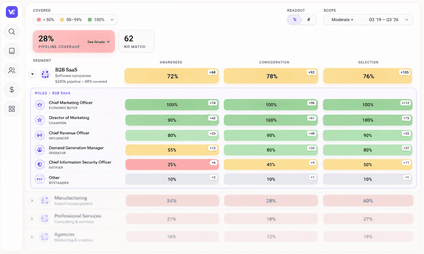
Leigh Choate, SVP of Marketing at Lytho, describes a team that operates inside a campaign system rather than assembling campaigns from individual tools and documents. The positioning for each vertical is defined in the system. The messaging matrix covers all twelve verticals with segment-specific language. The conversion paths are mapped per vertical. When a contributor sits down to produce content for the financial services segment, the strategic context for that segment is already present in their working environment.
This changes the production math entirely. The contributor doesn't need to reconstruct the financial services positioning from memory or from a deck that was last updated two quarters ago. The positioning is current, encoded, and accessible. The time that would have been spent on reconstruction goes to production instead.
Helen Baptist, who works with Lytho as a strategic advisor, described VelocityEngine as a "teammate on the org chart." That framing captures something specific about how the system functions: it holds the strategic context that a senior team member would hold, making it available to every contributor at every stage of production without requiring that senior person's time for every asset.
"150 assets across ten segments in three months, produced by four people. The system held the strategy. The team held the quality."
The results tell the rest of the story. Over three months, the team produced 150 assets across ten segments while maintaining six percent weekly pipeline growth. These results came from four people operating with the segment coverage of a team that should have been significantly larger.
Why the Pipeline Moved
The six percent weekly pipeline growth is worth understanding because it connects directly to the segment coverage argument. Pipeline grew because each vertical received content that was specific to its context rather than a flattened version of the same generic message. The financial services audience got financial services messaging. The healthcare audience got healthcare messaging. Each conversion path was designed for the vertical it served.
When every vertical gets tailored content, response rates improve across the board. Prospects in each segment see messaging that reflects their reality rather than a value proposition that could apply to any industry. Click-through rates improve because the content feels relevant. Conversion rates improve because the conversion path matches the segment's buying behavior. Pipeline grows because the content is doing its job at the segment level rather than operating at the lowest common denominator.
This is the demand gen argument for campaign structure. Pipeline growth at scale requires precise targeting, and precise targeting across twelve verticals requires a system that holds the segment definitions, messaging, and conversion logic in a form the team can execute against without rebuilding it every cycle. The alternative is a team that can only go deep in three or four verticals and leaves pipeline on the table everywhere else.
What This Means for Demand Gen Leaders
The segment coverage question that demand gen leaders face is usually framed as a resource question. How many writers do we need to cover all our verticals? How much agency budget do we need for segment-specific content? How many campaigns can we run in parallel before quality starts to slip?
Lytho's experience reframes that question. The constraint on segment coverage is structural. When the system holds the positioning, messaging, and conversion paths for every vertical, the production capacity of a small team expands because the structural overhead disappears. Each new vertical doesn't require rebuilding the foundation. The foundation already exists, and production starts from the strategy rather than reconstructing it.
For demand gen leaders evaluating their team's capacity, the question worth asking is specific: if the strategic context for every segment were already encoded and accessible to every contributor, how many more verticals could your current team cover? How much closer to full segment coverage could you get without adding headcount?
Lytho's four-person team covering twelve verticals is a structural achievement. The team was talented, and the system made the talent scale. Pipeline grew because every segment received the content it deserved, produced by a team that had the structural support to deliver it. Segment coverage is a system problem, and solving the system is how a small team operates like a large one.