What happens to a content audit after the report lands, and why the gaps it found are still open six months later
An audit can tell you where the gaps are. It cannot keep them closed.
Most B2B marketing teams have commissioned a content audit at least once. The process is familiar. Someone maps the content against the segments, the personas, the funnel stages, and the products. The gaps come back in a deck. The recommendations are sound. Everyone agrees on what should happen next.
Then six months pass, and the gaps are still there. The team has produced plenty of content in the meantime, some of it the audit would have flagged the moment it shipped. The next audit cycle begins, and the new report names the same gaps the old one did. The deck was right. Nothing moved.
This pattern has a cause, and it is structural. It is worth understanding before you commission another audit, because a second audit will not fix what the first one could not.
What Content Audit Stagnation Is
Content audit stagnation is the pattern where an audit identifies clear gaps, the recommendations are accepted, and six months later none of them have shipped. The report sits on a shelf. The team keeps producing. The gaps stay open.
It is tempting to read this as a competence problem or an effort problem. It is neither. The teams this happens to are good at their jobs and working hard. The audit landed, they read it, they agreed with it, and the work still didn't happen. That tells you the cause sits underneath the people, in the way the work is structured.
An audit is a diagnostic. It tells you the state of your coverage at one moment in time. What it cannot do is hold that diagnosis steady, route the findings into the work, or update itself when the plan changes. Those are operating functions, and an audit was never built to perform them.
The Three Reasons Audits Stagnate
Three conditions show up in almost every B2B marketing function. Together they explain why the deck stalls.
Start with who owns the findings. The audit usually lands as a document in the campaign team's inbox, not as a change to the work in front of them. The campaign team keeps moving on the brief it already had. Acting on the audit would mean re-prioritizing, and the authority and budget to do that didn't arrive with the deck. So the findings sit, owned by everyone and no one.
Look next at timing. An audit captures the state of coverage on the day it was run. By the time the recommendations get operationalized, often a quarter or two later, the plan has moved. New segments, new product use cases, a competitor's funding round that changes the priority order. The audit was written against a plan that no longer matches the one being executed, so even its correct findings start to drift out of date.
Then consider the time between audits. Once the deck is delivered, nothing watches coverage until the next cycle. No instrument tells a marketing leader that as of this week they are thin on consideration-stage content in their fastest-growing segment. That kind of continuous signal isn't part of the audit cadence. It requires a different artifact running underneath the whole operation.
The Question the Audit Can't Answer
Here is a test any marketing leader can run on their own function. As of today, where are you under-covered against your current plan, and who is closing that gap this month?
If the answer comes back fluidly, with a named gap and a named owner, you have an operating layer doing its job. If the answer is some version of "we ran an audit a while back and it said," the audit has stagnated. That is not an indictment of the team. It is a sign that the only instrument they were given was a point-in-time one, and the question is a continuous one.
The reason most leaders can't answer is the same reason the gaps stayed open. The diagnosis and the work live in two different places, on two different clocks, and nothing connects them.
What Comes After the Static Audit
The answer to a stagnant audit is not a better audit. It is a continuous one, wired into the work it's supposed to drive.
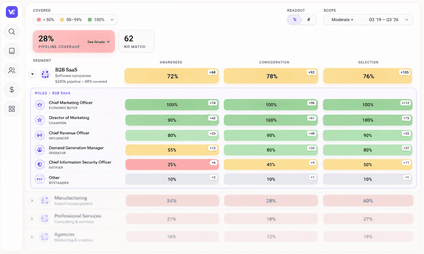
Think of it as a coverage layer that runs underneath the marketing function rather than a report delivered to it. It measures the same dimensions an audit measures, segment, persona, funnel stage, product, and channel, but it does so continuously, and it scores coverage against the plan as the plan currently stands. When the plan moves, the coverage targets move with it. When a gap opens, it surfaces while there is still time to close it, not two quarters later in the next deck.
"The audit tells you where the gaps are once. A coverage layer tells you where they are every week, and routes the work to close them."
This is the difference between a diagnostic and an operating layer. The audit is the diagnostic, valuable and necessary, the thing that first reveals the shape of the problem. Coverage is the operating layer, the system that keeps the diagnosis current and turns it into shipped work. Teams that run this way treat the audit as a confirmation step rather than a rediscovery of the same gaps every year.
It is a live model, not a theory. Lytho, a creative operations company, has run a continuous coverage model in production for under a year and reported 200% pipeline growth across that period. The mechanism is the same one described here. The diagnosis never goes stale, because the system that produces it never stops running.
The Shift Worth Making
If your last audit named gaps that are still open, the honest read is that the audit did its job and then had no system to hand the work to. Commissioning another one repeats the cycle. The shift worth making is from a diagnosis you receive to a coverage layer you operate, one that stays current as the plan changes and closes gaps while they still matter.
An audit is a photograph of your coverage on one day. The work needs something that keeps watching after the shutter closes.
Frequently Asked Questions
How often should B2B marketing teams run a content audit?
Cadence is the wrong variable to optimize. A team that audits quarterly but has no operating layer between audits will stagnate just as a team that audits once a year does. What matters is whether coverage is measured continuously against the current plan. When it is, the audit becomes a periodic confirmation step rather than the only time anyone looks at the gaps, and the question of frequency mostly answers itself.
Why do content audits keep finding the same gaps?
Because the audit diagnoses and then hands off to nothing. The production engine that created the gaps keeps running unchanged, so the same gaps reappear by the next cycle. An audit identifies the problem. It does not route the work that would close it, and it does not update when the plan moves. Without an operating layer connecting diagnosis to production, each new audit rediscovers what the last one already found.
What is the difference between a content audit and a coverage map?
A content audit is a point-in-time assessment, usually delivered as a deck. A coverage map is a continuous instrument that scores content presence across segment, persona, funnel stage, product, and channel against your current revenue plan. The audit tells you where you stood on the day it ran. The coverage map tells you where you stand now and updates as the plan changes, which is what keeps the diagnosis from going stale.
How long does it take to act on a content audit's findings?
In an audit-driven model, often one to two quarters per finding, and many findings never get operationalized at all because ownership and budget didn't travel with the deck. In a coverage-driven model, gaps surface continuously and route into the work as they appear, so the distance from a surfaced gap to shipped content compresses substantially. The exact timeline depends on the team and the production capacity behind the coverage layer.