Two teams can work hard, hit their own targets, and still pull a company in two directions.
Marketing builds campaigns. Sales chases the number. On paper the two are the same effort pointed at the same goal. In practice they run on separate tracks, measuring different things, rarely looking at the same picture of what content exists and who it's for.
The result is quieter than open conflict. Marketing ships what it believes the funnel needs. Sales reaches for whatever's nearby and improvises the rest on the call. Both teams are busy, neither can see the whole board, and the conversation that would fix it never quite happens, because there's nothing on the table for both teams to point at.
Each Team Optimizes a Different Number
Marketing's scoreboard is production and reach. Campaigns shipped, assets live, traffic and leads moving. Sales has a different scoreboard, and it's shorter. What closes this quarter, and what helps close it.
Those two scoreboards don't typically reference each other. Marketing can run a strong quarter by its own measure while sales feels unsupported by its own. A team can ship a dozen campaigns and still hear from the field that there's nothing to send the economic buyer in the segment that drives revenue.
You can hear it in how sellers triage. When a new campaign lands, the first question a rep asks is whether it helps the deals in front of them right now. If the line between the campaign and their number isn't obvious, the campaign gets ignored. A seller spends time where it pays, and a campaign with no visible path to pipeline doesn't pay.
Nobody Can See the Same Picture
The reason the two teams talk past each other is structural. Marketing knows what it shipped and sales knows what it's chasing. No single surface shows both at once.
So the discussion runs on memory and instinct. Marketing says coverage is good because a lot got produced. Sales says coverage is thin because the one thing they needed in a deal last week wasn't there. Both are describing the same library from opposite ends, and both are partly right, which is why the argument goes nowhere.
A revenue plan should anchor this. The plan names the segments, the personas, and the pipeline each one has to produce. Coverage should be readable against that plan, what content exists for the buyers and stages that drive the number, and where the holes are. When that view doesn't exist, every coverage conversation is two people describing different parts of an animal in the dark.
Coverage Is the Table Both Teams Sit At
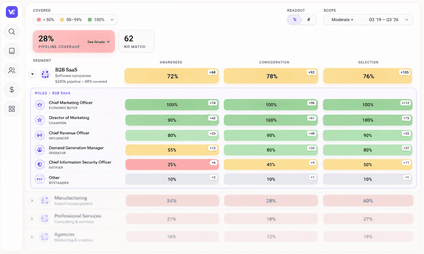
Put coverage in view against the revenue plan and the dynamic changes. Now both teams are looking at one thing. The view shows the segments the plan is counting on, the content that exists for each persona and stage, and where it thins out.
"The map doesn't have to be right to be useful. Its job is to make the assumptions explicit."
Say the view shows 25 percent coverage for the economic buyer in a priority segment. Read that as a prompt, not a verdict. Maybe the gap is real and worth closing. Maybe that buyer signs off on a decision made one level down, and light coverage there is the correct call. Either way, the team is now deciding on purpose instead of discovering the shortfall during a slipping deal.
That's the shift. The coverage view turns a vague sense that something's off into a specific thing two teams can point at and reason about together.
The Disagreement Is the Point
A shared map changes what sales and marketing disagree about. The friction stops being about effort and blame.
Without a shared map, the friction lives in effort and blame. Marketing thinks sales ignores good material. Sales thinks marketing builds things nobody asked for. A shared map moves the friction somewhere useful. Now the teams argue about where coverage should go to hit the plan, which buyers matter most this quarter, and which gaps are worth the production cost. That argument is the work. It's the conversation that should have been happening all along.
Alignment means two teams arguing from the same picture, against a number they both signed up for. The goal was never for them to want all the same things.
Sales and marketing drift apart for a structural reason. They're reading different maps, or no map at all. Give them one shared view of coverage against the plan, and the standoff becomes a decision they make together.