Your team can ship more content every quarter and watch conversion sit still.
Demand teams are measured on pipeline, so the pressure runs toward output. More assets, more programs, more entries at the top of the funnel, because output is the thing you can show in a weekly standup. The dashboard fills up and subsequently, the number moves.
Then a quarter goes by and conversion has stayed flat. The team produced more than it ever has. The deals still stall in the same places they always did. Output went up, conversion held still, and nobody can quite say why.
The explanation is that volume and coverage are two different things, and demand teams spend most of their energy on the first one.
The Volume Trap
Output is easy to count, so it becomes the thing teams manage. Assets produced, posts published and programs pushed live. All of it goes in the deck, all of it reads as motion.
Here is where the count misleads: a buyer moves through your funnel on whether the right asset is there when they reach the moment they need it. You can triple your output and pile all of it into the stage you were already covering. The buyer who needed a comparison guide at evaluation still reaches that moment with nothing in front of them. The output number rose. The place where deals get stuck stayed exactly where it was.
Volume tells you how busy the team is. Whether the funnel is covered is a separate question, and it is the one that touches pipeline.
Where Deals Go Quiet
Pull up the last quarter of closed-lost and look at the stage where each deal went quiet. There is usually a pattern, and the pattern usually points at a stage where the buyer needed something to keep moving and the content was missing.
Plenty of teams cover the top of the funnel well. Awareness content is satisfying to make and easy to distribute. The thin stretches tend to sit lower down, where a buyer is comparing options, building an internal case, or trying to convince a skeptical colleague. Those moments decide deals, but they are also the moments most likely to be running on a single aging asset or on nothing at all.
The stage with no content is the stage where the deal goes silent. That silence gets logged as a bad lead and often it is a coverage delta wearing a bad lead's clothes.
Coverage Reads Down the Funnel
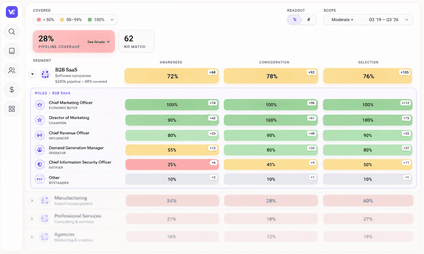
Coverage is five questions: segment, persona, funnel stage, product, and channel. All asked at the same time.
For a demand team carrying a pipeline number, funnel stage is the dimension that most directly touches conversion, and it is the one volume metrics leave invisible.
Reading coverage down the funnel means asking, at each stage a real deal passes through, whether the content a buyer needs at that stage exists for the segment and persona you sell to. Awareness, consideration, evaluation, decision, each one checked against the buyers you want. A covered funnel has content present at every stage a deal moves through, mapped to the Revenue Plan that says how many deals need to move and how fast.
Once you can see coverage by stage, the flat-conversion mystery tends to resolve fast. The gap is rarely spread evenly. It concentrates at the one or two stages nobody was producing for, because those stages were never as satisfying to make content for as the top of the funnel.
Conversion Is a Coverage Outcome
Change the question the team optimizes. Stop asking how much the team produced and start asking whether every stage a buyer passes through is covered for the people you sell to.
That change shows up in what the team does on Monday. The next batch gets aimed at the stage where deals go quiet. Some quarters the raw output number even drops. The conversion number is the one that responds, because the content is finally present at the moment the buyer needs it.
"Volume is one input. Whether the funnel is covered is what decides if that input turns into pipeline you can defend."
Coverage is the operating layer underneath the pipeline number. Volume is one input into it. Whether the funnel is covered is what decides if that input turns into pipeline you can defend.
Read Coverage Before the Next Batch
Before the next batch of content gets commissioned, read coverage by funnel stage for the segments and personas on the revenue plan. Find the stage where deals go quiet and produce there first.
A fuller content library makes a satisfying chart. A funnel a buyer can move all the way through makes pipeline. Count coverage by stage, and conversion stops being a mystery.