The single version of the truth is expensive when one person rebuilds it every quarter.
Somebody on the team gets handed the question: are we covered against the plan? It lands on RevOps more often than not, because RevOps is the function that already lives in the systems and already owns the data hygiene that nobody else wants to touch.
So you go and build the answer. You pull the content inventory from one place, the segment definitions from another, the funnel stages from the CRM, and the parts that live in the CRO's head from a meeting you have to schedule. You assemble it into something defensible. And by the time it's assembled, the plan has moved, a campaign has shipped, and the version you built is already drifting from the version that's true.
The Reconciliation Tax
There's a standing cost to producing the coverage picture by hand, and it doesn't show up on any line item. It shows up as your time, recurring, every time the question gets asked again.
The reason it recurs is that the picture you build is a snapshot, and the thing you're picturing keeps moving. New segments get added. A product launches. The pipeline target shifts mid-quarter and the funnel volumes shift with it. Every one of those moves changes what coverage should look like, so the snapshot you reconciled last month describes a plan that no longer exists.
This is the part that wears on the function. You're not doing the work once and maintaining it. You're rebuilding it from source every time, because there's no layer underneath that holds the pieces together between rebuilds. The spreadsheet doesn't know the plan changed. It just sits there being confidently wrong until someone notices and asks you to do it again.
Why the Point in Time Content Audit Doesn't Help RevOps
The usual fix for this is to commission an audit. A content audit names what exists and what's missing, and for a few weeks it feels like the answer. The gaps are visible. The picture is complete. Then the audit ages.
A point-in-time audit is a diagnostic. It tells you the state of coverage on the day it was run, and it's accurate on that day. The problem for RevOps is that the day it was run is the only day it's accurate, because nothing in the audit refreshes when the plan moves. It captures a moment, and your job isn't to manage a moment. Your job is to keep the picture true as the inputs change underneath it.
So the audit becomes one more thing you reconcile against. You have the document that was true in March, the spreadsheet you've been patching since, and the CRO asking about a segment that didn't exist when the audit ran. The diagnostic was real work and it produced something useful, and it still left you holding the maintenance.
Coverage as the Instrument RevOps Runs Against
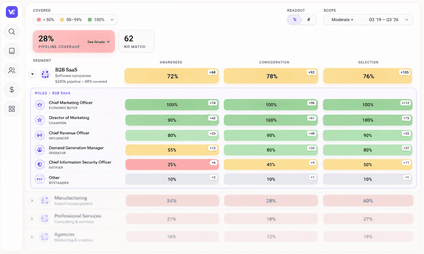
What RevOps needs is an operating layer, something that holds the coverage picture as a live state instead of a periodic rebuild. That's what the Coverage Map is. It renders content coverage across segment, persona, funnel stage, product, and channel, and every dimension is drillable down to the specific gap.
"The audit tells you where coverage stands today. The operating layer keeps telling you as today keeps changing."
The difference that matters for the function is what happens when an input moves. When the Revenue Plan changes, coverage targets derive from the Plan, so the Map moves with it. You don't re-pull the inventory and re-reconcile the segments and re-interview the CRO. The instrument already reflects the new state, because it's wired to the same inputs you used to gather by hand.
What Changes When Coverage Is the System
When coverage runs as a system, the reconciliation tax turns into a read. The question that used to mean a week of assembly becomes a question you answer by looking. Are we covered against the plan? Open the Map. The gaps that exist are the gaps it shows, named across the five dimensions, with the weighted distance to target attached.
This depends on the Foundation being defined once and held. The segments, the personas, the positioning all sit in the Foundation as the source of truth, and the coverage picture reads against them instead of asking you to supply them fresh each time. That's the part that ends the rebuild loop. The inputs live somewhere stable, the plan drives the targets, and the Map shows the distance between them on a continuous basis.
Coverage is the operating layer. The audit is the diagnostic that produced it, and the spreadsheet was only ever you doing the operating layer's job by hand.
Frequently Asked Questions
How often should RevOps reconcile content coverage against the plan?
Cadence isn't really the variable that matters. A team that reconciles monthly but has no operating layer between cycles will still show up to the CRO with a stale picture, because segments and targets keep moving in between. What matters is whether content coverage is held as a live state instead of a periodic rebuild.
What's the difference between a content audit and a content coverage map?
An audit is a point-in-time diagnostic: it's accurate on the day it runs and starts drifting the moment the plan changes after that. A content coverage map is an operating layer wired to the same inputs, the revenue plan, segments, and personas, so it updates as those inputs move instead of needing a fresh rebuild each cycle.
Why does content coverage go stale between audits?
Because the plan doesn't hold still. New segments get added, a product launches, or the pipeline target shifts mid-quarter, and every one of those moves changes what content coverage should look like. A snapshot only describes the plan as it existed the day it was taken, so the moment any input changes, the audit is already describing a plan that no longer exists.