Short answer: To roll out new positioning without becoming the bottleneck, stop distributing it person by person. Put the positioning in one governed source, make every new campaign brief start from that source by default, and check assets against it automatically. Product marketing then reviews exceptions instead of briefing every campaign manager.
You’ve just repositioned against your biggest competitor. The research is done, leadership signed off, the messaging framework is clean. Then the real work starts: you brief six campaign managers one by one, review their first drafts, catch the old tagline in a nurture email, and find last quarter’s positioning in a paid ad that went live yesterday.
A month later, half the campaigns carry the new story and half carry some blend of old and new. Sales hears both. Buyers see both. And you’re the only thing holding it together.
That doesn’t scale, and it isn’t a people problem. It’s a distribution problem. This post looks at why positioning stalls after a pivot, what product marketing teams usually try, and how to set up a rollout that carries the new position into every campaign without you in every conversation.
Why does new positioning stall after a pivot?
Positioning usually fails in the handoff, not in the strategy. A few things cause it.
It lives in a document, not in the work. The messaging framework sits in a deck or a wiki page. Campaign managers start from last quarter’s brief, a past email, or a template, because that’s where the work begins. The new positioning is something they have to remember to go find.
Every handoff loses detail. Product marketing briefs the campaign manager, who briefs a writer or agency, who uses an AI tool. Each step compresses the message. By the time it reaches an asset, “we show which buyers competitors miss” has become “we help you beat the competition.”
Old assets keep running. A repositioning changes the story, but the nurture streams, ads and landing pages built on the old one keep running until someone notices.
AI tools multiply the drift. Teams now produce more content, faster, with tools that don’t know your positioning changed. Unless the new positioning is fed into each one, they’ll happily write in the old voice at scale.
Review is the only control. If the only check is product marketing reading every draft, you become the bottleneck by design.
We dig into where this breaks in Does Positioning Break Down at the Point of Production?
What do product marketing teams usually try?
Most teams combine a few of these. Each helps, but only the last one removes product marketing from the critical path.
| Approach | What it fixes | Where it breaks |
|---|---|---|
| One-on-one briefings | Campaign managers hear the story directly | Doesn’t scale past a handful of people; new hires miss it |
| Messaging framework doc or wiki | One reference for the new positioning | People have to go find it; it drifts from what’s actually shipped |
| Enablement session or recording | Everyone hears it once, at the same time | Knowledge fades; doesn’t reach agencies or AI tools |
| PMM reviews every asset | Catches drift before it ships | Makes product marketing the bottleneck |
| Prompt libraries for AI tools | Tools write closer to the new voice | Copies go stale; each team keeps its own version |
| Positioning built into the campaign system | New work starts from the current positioning by default | Needs setup once, and an owner to keep it current |
The first five all rely on people remembering to apply the positioning. The last one makes the positioning the starting point, so applying it is the default rather than an extra step.
What does a rollout that doesn’t depend on you look like?
Four principles separate a positioning change that sticks from one that needs constant policing.
- One governed source. The positioning, the personas it applies to, the proof points, and the words to stop using live in one place, owned by product marketing. Not a deck that gets copied, but the source everything else reads from.
- Inherited by default. Every new campaign brief starts from that source. A campaign manager shouldn’t have to remember the new positioning; it should already be in the brief when they open it.
- Checked automatically. Drafts are compared against the source before they reach you, so retired phrases and off-message claims are flagged early. The same check covers work from agencies and AI tools.
- Reviewed by exception. Product marketing looks at what was flagged and at the few high-stakes assets, not every email and ad. Your time goes to judgment calls, not proofreading.
A fifth habit makes the rest stick: when the positioning changes again, update the source, and let it carry forward. Then audit what’s already live, starting with the assets buyers see most.
How does VelocityEngine carry positioning into every campaign?
VelocityEngine’s Campaign Operating System is built around those principles. Strategy, planning and content creation run in one workflow (Foundation, Content Audit, Campaign Planning, Content Creation and Launch Coordination), so the positioning doesn’t get lost between the approved strategy and the shipped work.
The Foundation is the governed source. Your Strategy Foundation holds audience definitions, brand messaging and the competitive landscape. Brand voice is encoded as operational guidance rather than a style doc, and every downstream step inherits it.
Briefs inherit it by default. In Campaign Planning, new campaign briefs auto-populate from the Foundation, with positioning and messaging structured into each asset by persona, stage and channel. A campaign manager opens a brief that already carries the new story.
Change once, and new work carries it. When you update the positioning in the Foundation, new briefs built on it start from the updated story.
Creation stays inside the system. Drafts are produced in the platform’s structured workflow, not in personal AI accounts, and every claim ties back to a committed decision in the Foundation. That makes review a check against a known source rather than a reread of everything.
In practice, Paysafe runs three campaigns a month from one Foundation.
Where this connects to competitive work: the Content Coverage Heatmap shows where to position against a competitor. The Foundation is how that position reaches every campaign. See how in our competitor coverage product brief.
A repositioning rollout checklist
Use this whether or not you have a system in place. The goal is to brief the source, not the people.
- Write the change down in one place. New positioning, which personas and segments it applies to, the proof points, and a short list of phrases to retire.
- Make that the source everything reads from. Point briefs, templates, agency guidelines and AI prompts to it, not to copies of it.
- Brief the team once, on the why. One session on why the positioning changed and what it means for buyers. Skip the line-by-line walkthrough; the source carries that.
- Start every new campaign from the source. No more cloning last quarter’s brief.
- Audit what’s live, by visibility. Homepage, top landing pages, active ads, and nurture streams first; long-tail blog posts last.
- Review by exception. Decide which assets product marketing must see (launches, flagship pages, sales decks) and which can ship against the source.
- Check again in 30 days. Sample recent assets and sales calls. Where the old story still shows up, fix the source or the template, not just the asset.
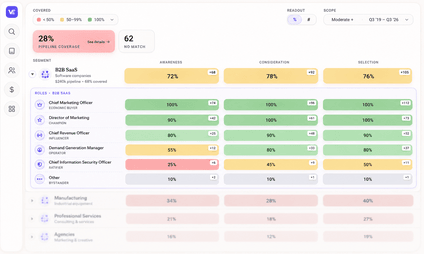
Know where the new story needs to land first. The Content Coverage Heatmap maps your content by segment, persona and stage, so you can see which buyers you’ve built for and prioritize your audit around them. Get your coverage score →
FAQ
How long does it take for new positioning to show up across campaigns?
With person-by-person briefing, often a quarter or more, and older assets can carry the previous story for much longer. When new briefs start from a single governed source, new work carries the change from the first brief; existing assets still need an audit.
Who should own the positioning source?
Product marketing. Campaign managers, agencies and AI tools read from it, but only product marketing changes it.
Do I still need to brief the team after a repositioning?
Yes, once, on why it changed and what it means for buyers. The source handles the details, so the briefing doesn’t have to.
How do I keep AI-generated content on the new positioning?
Feed every tool from the same source rather than from personal prompts or copied docs, and check drafts against that source before they ship.