What CMOs learned about AI this year: the goals they set, how those plans are going, the announcements that moved buyer research into AI answers, and a month-by-month plan for the rest of 2026 and the start of 2027.
TL;DR
- CMOs planned 2026 around revenue growth, AI adoption and proving marketing's value, on budgets that stayed roughly flat.
- The goals held, but buyer research moved: 94% of business buyers used AI in their purchase, Google rebuilt search around AI answers, and ChatGPT started selling ads.
- Before 2027 budgets lock, map your content against the segments and buying groups in your revenue plan, so planning starts from coverage instead of last quarter's traffic report.
Going into 2026, CMOs told every major survey roughly the same thing: grow revenue, become an AI leader, and prove marketing's value, on a budget that wasn't going to grow much.
With the year nearly over, those goals have barely moved. What moved is the ground under them. Google rebuilt its search box around AI answers, ChatGPT became an ad platform, and buyers took more of their research somewhere a marketing dashboard can't follow.
The goals held; the place buyers meet your content didn't.
Below is what CMOs planned for 2026, how those plans are going, and the announcements that changed where buyers research. Then a month-by-month plan for the weeks left, so 2027 planning starts from better information than last quarter's traffic report.
What were CMOs' top priorities for 2026?
Revenue growth, AI adoption, and working out where a limited budget should go. The buyer those plans were aimed at was already researching differently, and in larger groups.
In September 2025, Gartner asked 174 senior marketing leaders about the year ahead. Revenue growth was the top priority, and budget and resource constraints were the top challenge for 63% of them. Gartner also found that 46% wanted to know how to prioritize the initiatives most likely to drive growth.
AI was the other headline. Heidrick & Struggles and Serviceplan's CMO Barometer, a survey of 805 marketing leaders in Europe and the Middle East, found AI was the dominant focus for 2026, named by 68%. A Gartner survey published in February found 65% of CMOs expected AI to dramatically change their role within 2 years, but only 32% thought their own skills needed significant change.
Then, on January 21, Forrester published The State of Business Buying, 2026. It found that 94% of business buyers used AI during their buying process. A typical decision involved 13 internal stakeholders and 9 external influencers, and buying groups for purchases with generative AI features doubled in size.
How those plans are going
On the goals CMOs set, the honest grade is mixed. They spent on AI and kept the lights on; the harder parts stalled.
| What CMOs were aiming at | Where it started | Where it stands in October |
|---|---|---|
| Grow on a constrained budget | Budget was the top challenge for 63% of CMOs (Gartner, September 2025) | Budgets 7.8% of revenue, from 7.7%; 56% say they lack the budget for their 2026 strategy (Gartner, January to March 2026) |
| Become an AI leader | AI the dominant focus for 68% (CMO Barometer) | 15.3% of budgets now go to AI, but only 30% report mature readiness to scale it (Gartner); 12% rate their tech enablement excellent (Bloomberg Media and Lippincott) |
| Prove marketing's value | Revenue growth the top priority; 46% asking how to prioritize for growth (Gartner) | 70.6% shifting toward short-term impact over long-run gains, 47.1% returning to established strategies (The CMO Survey) |
| Keep confidence up | Already cautious going in | Marketers' economic optimism at 56.8 out of 100, its lowest since the pandemic (The CMO Survey) |
The pattern in the right-hand column is a team doing what it can measure. AI tools are bought and used. The long-term work, which is harder to attribute, waits.
What changed: the year's biggest announcements
Most of the year's big announcements weren't about marketing teams at all. They were about where buyers ask questions, and who gets to answer.
| Date | What happened | Why it matters for B2B content |
|---|---|---|
| January 21 | Forrester publishes The State of Business Buying, 2026 | Buying groups average 13 internal stakeholders; AI is part of nearly every purchase |
| February 9 | OpenAI starts testing ads in ChatGPT | The first paid placement inside a major AI answer |
| May 5 | ChatGPT Ads Manager opens to self-serve advertisers | AI answers become a channel you can buy into |
| May 19 | Google I/O: a rebuilt search box, background information agents, AI Mode past 1 billion monthly users | Google calls the search box change its biggest in more than 25 years |
| May 20 | Google Marketing Live: ad formats that sit inside AI Mode answers | Paid and organic now compete inside the same generated answer |
| June 17 | Bloomberg Media and Lippincott publish CMO Outlook 2026 | Investment moving toward AI tools and away from websites and content creation |
| August 28 | Google tests AI Overviews that expand into AI Mode-style answers | More of the answer sits above the first link |
| August 31 | Google's generative AI report reaches every site in Search Console | You can see AI Overview and AI Mode impressions by page, but not clicks |
| August 31 | OpenAI reports ChatGPT Ads at a $1 billion annualized run rate | Self-serve buying expands to Europe, India, the Middle East and North Africa |
| September 16 | OpenAI announces sponsored agents and HubSpot and Shopify integrations | AI ad buying connects to the CRM most of our audience already uses |
| September 29 | Gartner: 18% of marketing leaders have eliminated roles due to automation | The team writing content is getting smaller, not just cheaper |
| October 5 | OpenAI announces a test of image ads in ChatGPT | Ads spread to more of the AI surface |
Read top to bottom, the list describes one change. In January, AI was something marketing teams used. By October, it was the place a growing share of buyer research happens, with its own ad market and its own reporting.
What it means for content
The year started with AI as a production tool and ended with AI as a place buyers look.
The CMO Survey, fielded early in the year, shows the first story. Content creation is the most common use of AI in marketing, at 73.9% of companies. The same survey shows the second story starting: 41.5% of companies already use generative engine optimization, a category that didn't appear in earlier editions.
By autumn, the second story had tools and reports of its own. Search Console shows AI impressions. Visibility vendors track brand mentions across prompts. ChatGPT and Google both sell placement inside the answer.
All of that measures whether you show up. None of it tells you whether you'd published anything for the person asking. Forrester's buying group of 13 doesn't send one person to ask one question; the CFO, the IT lead and the operations lead each ask their own, and a model can only answer from what exists.
Bloomberg Media and Lippincott found investment flowing away from websites and content creation in the same year that published content became the main supply AI answers draw on.
What improved, and what didn't
Marketing got faster this year. It didn't get much better at deciding what to make.
The gains are real. AI is part of how most teams produce content now, and for the first time Google reports how often your pages appear in its AI answers. Generative engine optimization went from an idea to something 4 in 10 companies practice.
The constraints are just as real. Budgets are flat, readiness to scale AI sits at 30%, and Gartner's September research found 18% of marketing leaders have already cut roles because of automation. With fewer people and the same money, 70.6% of teams leaned toward short-term impact.
Put those together and you get a familiar picture. A team that can now draft twice as fast still picks its topics from last quarter's traffic report, and a traffic report can only point back at content that already exists. Speed multiplies whatever the planning process already does, including its blind spots.
What to do with the weeks left
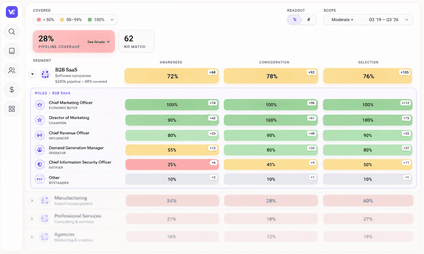
If 2027 planning starts from the same traffic report, it will produce the same library, faster. The missing input is content coverage: whether what you've published reaches the buyers, segments and funnel stages your revenue plan depends on, and how that compares with the vendors you meet in deals.
Coverage isn't a performance measure, and nobody has yet shown that better coverage on its own wins deals. No published standard exists for how much content a buyer needs, either. What it gives you is the input every cut and every new commission is already assuming. There are about 11 weeks left in 2026. That isn't enough to rebuild a library, but it's enough to walk into 2027 planning with a map instead of a traffic report.
A month-by-month plan
October. Write down who you sell to: the segments in next year's plan and everyone in each buying group, not only your main persona. In the same week, export Google's AI impressions report, which has covered every site since August 31, so 2027 has a baseline. The cost is a meeting or two with sales, because the two teams rarely agree on the list the first time.
November. Map what you have, starting with the one segment that carries the most revenue. Assign each piece to the one buyer and stage it serves best, and count it only there. Then refresh anything over a year old in places you already hold, which is quicker than writing new. Refreshes will push out some of the net-new pieces planned for Q4; that's the trade.
December. Before the 2027 budget locks, rank the thin spots by how much of the plan they carry, and name the topics where you already have enough. Some of those topics will be ones that perform well, which makes this the hardest conversation of the three.
You won't close many gaps in 11 weeks. What you can do is change what 2027 planning starts from.
Carrying it into 2027 planning
Once the map exists, it should shape the plan rather than sit beside it.
Budget by segment, not by topic. Split the content line by how much of the revenue plan each segment carries, then decide topics inside each share. A series that performs well in a low-priority segment may lose budget, and someone will miss it.
Plan for the buying group you'll actually meet. Forrester's 13 internal stakeholders is an average, not a writing list. Decide which roles you'll write for in each segment, and at which stage, and write the choice down. You'll cover fewer roles well instead of all of them thinly.
Check what's behind the answer before you buy it. If you test ChatGPT ads or ads inside Google's AI Mode next year, you're paying to appear in an answer. Make sure the buyer who clicks through finds something written for them, and give the test a fixed budget and a fixed window.
Set a 90-day check. At the end of March 2027, re-run the map and compare AI impressions against your October baseline. Report it as what it is, a measure of who your content reaches, not a pipeline number.
Before you plan 2027
This year, your buyers started asking models about your category, in buying groups larger than most content plans were built for. Before the 2027 budget is set, it's worth knowing who in those groups you've given the models something to say about.
Which person in your buying group did you write the least for in 2026?
If you'd like to see it without building the map by hand, the free VelocityEngine coverage scan maps your published site against the buyers and segments you sell to.