When you think about content marketing and hear the word "performance," what do you think of? You probably think about the metrics tied to how your existing content is performing. Which is logical, no doubt. But what about the content you don't have?
We naturally measure the visible and the tangible, versus what we can't see or what doesn't exist, making it easy for marketing teams to miss out on understanding their content coverage.
What is content coverage? Think of it as a content gap analysis — it's the content your revenue plan needs to hit its targets across every segment, persona, and funnel stage you've committed to support.
But, every metric on your dashboard only reports one thing, which is how the content you already have is performing. What about the data that tells you where your content gaps are and what your coverage score is so you can work toward filling those gaps and being better aligned with Sales?
There is one specific question your performance dashboards, however good, were never built to answer. Which is:
"Do I have the right content in place to support my Sales org and hit our revenue targets?"
And once you see the content coverage gaps, they're hard to unsee.
The Content Coverage Score
If performance measures how your content is doing, what measures whether you have what your revenue plan needs in the first place? The second question needs a clear name, and we call it a "content coverage score."
Coverage is about whether the segments and personas your revenue plan focuses on, and the stages a buyer moves through, have content behind them. It's a completely different measurement than performance. You can have excellent performance on existing content and poor coverage of the plan you committed to, and nothing in your current toolset would flag the contradiction, because performance tools count what exists and coverage is a question of what doesn't.
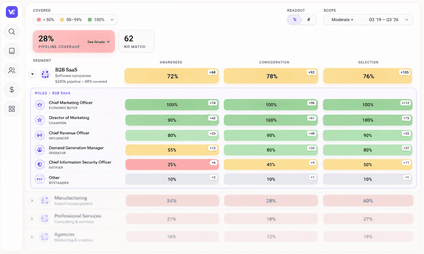
VelocityEngine's Content Coverage Heatmap addresses that gap specifically. It maps your content, like blogs, eBooks, case studies, etc, against your revenue plan and scores coverage by segment, persona, and funnel stage, with green cells indicating where you're covered and red cells indicating where you're not.
The numerical result of the Content Coverage Heatmap is your coverage score, which is a topline measurement of how well you're covered out of 100.
The mechanism is different from a performance dashboard in that the heatmap uses your revenue inputs to calculate coverage requirements, infers the segments and personas that drive the analysis, and maps those requirements to existing content, so missing content becomes a knowable gap instead of a question mark. Click into each cell to show what content exists and get suggestions for how to close the gaps before your team builds or invests further.
Use Performance and Content Coverage Together
The best case scenario is to use your content performance dashboards and the Content Coverage Heatmap together as complementary intelligence tools.
The coverage heatmap is upstream from your performance dashboards in that the first step to solving any problem is always awareness, which in this case, is understanding your content gaps. The next step is to, of course, fill those gaps by creating content based on the demands of your revenue plan. And finally, measuring the performance of that content so you can iterate, optimize, and scale is the necessary final step in every marketer's playbook.
The leaders who use both numbers will know whether their content is working and whether it even exists where the plan needs it.
To summarize:
| Content Performance | Content Coverage | |
|---|---|---|
| The question it answers | How is my content doing? | What are my content gaps? |
| What it measures | The efficacy of your existing content | Whether you have the content you need to hit revenue targets |
| Top Use Case | Understanding engagement and optimizing search visibility | Deciding where to prioritize spend and effort |
Why Understanding Content Coverage Matters
The reason coverage matters as much as performance comes down to how and where buyers make their decisions, and how little of that happens when you're actually present. That is what we discuss in part two of our blog series.
For now, the practical implication is that if your revenue plan outlines strategic segments and personas, marketing needs a way to know whether content exists to support Sales conversations and pipeline coverage.
Start with the Content Coverage Heatmap.
Run it and see whether you have existing content that aligns your revenue plan before committing to a revenue number you can't hit. It provides a clear, actionable entry point and facilitates strategic, cross-functional planning conversations, showing you which gaps to address before building or investing further.
Request your content coverage heatmap →
Frequently Asked Questions
Can content perform well and still have coverage gaps?
Yes, and it happens often. Performance measures response to the content that exists, so strong engagement and conversion numbers describe the segments you are already active in. They say nothing about the segments with nothing built for them, because there is no content there to measure. High performance on a narrow slice of the plan can sit right next to wide coverage gaps, and nothing on a performance dashboard will flag the contradiction. The Heatmap is built to expose that contradiction by comparing the plan to existing content rather than relying only on observed buyer interactions.
Why can't performance metrics detect missing content?
Because every performance metric only measures a response to content that already exists, so missing content has nothing to register. Opens, clicks, time on page, conversion, and influenced pipeline all require a piece of content to exist and a buyer to interact with it. Missing content produces no interaction, so it produces no data. It shows up as no number at all rather than a low one, which is why absence reads on a dashboard like a topic that was never part of the plan.
Is coverage a replacement for performance metrics?
No. Coverage sits next to performance rather than replacing it. Performance answers how the content you have is doing while coverage answers whether the plan is covered in the first place. A marketing leader who can speak to only one of the two is working with half the picture. The goal is to use both numbers. When coverage stays current as content ships, it gives marketing and sales one shared picture of what the revenue plan needs and what content backs it.