What a content audit is for
Every B2B company sells to more than one kind of buyer. A software company might sell to manufacturers and to professional services firms, and in each deal a CFO, a head of operations and the person who uses the product every day all have to agree. They arrive at different moments, too: one is just learning the problem exists, another is already comparing vendors. Gartner describes 6 buying jobs, from identifying the problem to building consensus, and buyers loop back through them rather than moving in a straight line.
A content audit is how you keep track of all that: what you've published, who each piece is for and where the gaps are. It means the next piece goes where it's needed rather than where it's easiest to write.
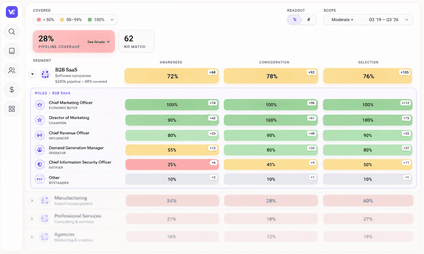
Every audit, whether it runs in software or a spreadsheet, comes down to the same call for each piece: who is this for? Many of the teams we work with answer "everybody." We think that answer hides your gaps, and we built the opposite rule into our Content Coverage Heatmap, which maps each piece you publish to a segment, a persona and a funnel stage.
This piece explains how we arrived at the rule, why AI makes it easier to follow than ever, and what it costs.
Should one piece of content target more than one persona?
No. A piece written for several personas, stages or segments serves each of them less well than a piece written for one, and tagging it everywhere makes your coverage look more complete than it is.
When you audit your library, you probably mark each piece for every audience it could plausibly reach. A guide to pipeline forecasting gets marked for the CFO, the VP Sales and the RevOps lead, across 2 segments and 2 funnel stages. It feels efficient: one piece, a dozen boxes ticked.
We think it works the other way round.
A piece of content serves one segment, one persona and one stage, or it serves none of them well.
Our heatmap applies that rule to every page it reads, and it's the rule we'd give anyone writing a content brief.
The score that said everyone was covered
We didn't start with this rule. The first version of our coverage map counted each piece everywhere it could reasonably apply, so a pricing page counted for the CFO, the champion and the practitioner at once.
The scores climbed until every persona looked covered. A map with every cell filled can't tell you where to write next, so the map stopped being useful.
Now each asset counts once, in the one segment, persona and stage it serves best. Scores dropped on the sites we tested, our own included. It's a less flattering number, and it's the only one that shows you who you haven't written for.
Counting once also shows something multi-tagging hides. When each piece lands in a single cell, you can see when most of your library bunches up on one role, and when nothing at all reaches the person who signs.
What each extra tag costs the reader
The inflated score was a symptom. The real cost sits in the writing.
A CFO and a practitioner want different things from the same subject. The CFO wants to know what it costs and what it commits the plan to. The practitioner wants to know how it works on an ordinary Tuesday. A piece written for both has to choose an order, a vocabulary and a depth, and whichever it chooses, one of them is reading something meant for someone else.
Stage works the same way. An awareness piece explains why a problem exists, while a selection piece helps someone choose between 2 vendors. Tag one asset for both and it arrives too early for one reader and too late for the other.
Segment is the easiest to miss. A manufacturer and a professional services firm can share a problem and still need different examples, different numbers and a different person in the story before either believes it was written for them.
Every tag you add names a reader the piece now partly ignores.
The economics that changed
Stretching one piece across many personas used to be a sensible trade. When a solid piece took a writer most of a week, a team publishing 4 a month had good reason to make each one work for as many readers as possible.
AI removed most of that reason. With your messaging, personas and proof held in one governed foundation, a CFO version and a practitioner version of the same argument take hours, not weeks. Paysafe's team went from 1 enterprise campaign a month to 3 on our Campaign Operating System, all built from one foundation.
What's scarce now is knowing which version is missing. Even if you can write anything quickly, you still need to know that the CFO in your largest segment has nothing at the selection stage. Single tagging lets you answer that question.
The versions do need to come from the same source. Build them one prompt at a time in a general AI tool and the taxonomy drifts as the context window loses it, so you end up with 5 pieces that quietly disagree with each other.
What the rule costs
We'd rather name the costs than have you find them.
- Your number drops. A library that looked broad under multi-tagging will look concentrated under single tagging. The picture is more accurate and less comfortable.
- Some pieces genuinely serve 2 readers. A pricing page gets read by the champion and the CFO. We still count it once, in the place it serves best, so the second reader's cell gets no credit. We'd rather undercount at the edges than overcount everywhere.
- More versions mean more upkeep. Writing 5 focused pieces gives you 5 things to refresh as they age.
- It depends on your persona list being right. If 2 people who sit in every deal aren't on the list, the map can't show you're missing them. Fixing the taxonomy usually comes before writing anything.
- It isn't proven to win deals yet. No customer has documented a before-and-after tying a coverage change to revenue. What single tagging gives you is an honest picture of who you've written for, and we present it as exactly that.
A first pass on your own library
Pull your last 20 published pieces. For each one, write down the single segment, persona and stage it serves best. If you can't pick, that is the finding: the piece was written for no one in particular.
Then count by persona. Look for where your library bunches up, and for the people on your buying committee who have nothing written for them at all.
When you brief the next piece, put one segment, one persona and one stage in the first line of the brief. If the subject matters to 3 personas, brief 3 pieces.
Frequently asked questions
Should one piece of content target multiple personas?
No. Each piece should serve one segment, one persona and one funnel stage. If a subject matters to several personas, write a version for each, built from the same messaging foundation so they stay consistent.
How do I find which personas have no content?
Map each published piece to the single persona, segment and stage it serves best, then count by persona. The personas on your buying committee with an empty count are your gaps. Our guide to the rooms you're not in goes deeper.
Does single tagging lower my coverage score?
Usually, yes. Counting each piece once removes the double counting that made coverage look complete. The lower number is the accurate one, and it shows you where to write next.
See the same count across your whole site
Our coverage score maps the pages on your public site to a single segment, persona and stage, and shows which personas in your plan have nothing written for them.