<img height="1" width="1" style="display:none" src="https://www.facebook.com/tr?id=4246513698961258&amp;ev=PageView&amp;noscript=1">
Compare

Claude answers prompts. VelocityEngine ships campaigns

Plan, build, and launch complete marketing campaigns with one system. Get to market in days, not months, without becoming the in-house architect who holds it all together.

Claude answers prompts. VelocityEngine ships campaigns

How they compare

Frame 2087326463
VS
claude-logo
Frame 2087326463
claude-logo
Starting point
Your GTM strategy. Positioning, personas, messaging, and competitive context are structured into a persistent Strategy Foundation before any campaign begins.
A prompt, or a setup you build yourself. You bring the context each session, or you wire up custom instructions, projects, connectors, and skills by hand to hold it.
What it produces
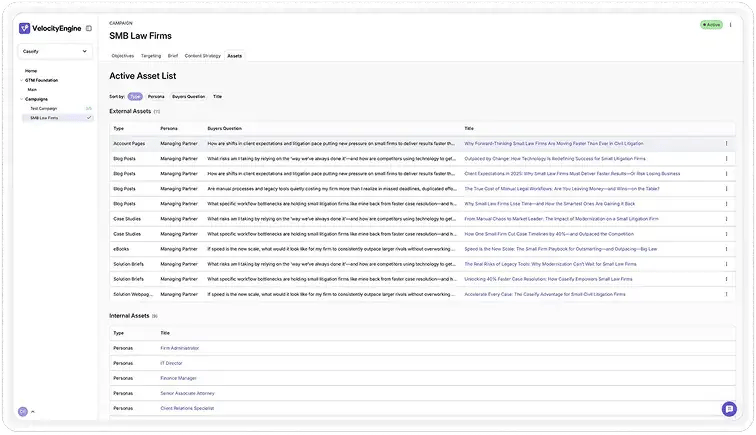
Complete, multi-channel campaigns. Blog posts, emails, landing pages, social promotion, eBooks, and sales enablement assets, all coordinated within a single campaign workflow.
Whatever you prompt for, one conversation at a time. Strong drafts across many formats, with quality that depends on the context you supply each time.
Brand consistency
One layer of a full Strategy Foundation. Brand voice is encoded alongside positioning, persona targeting, competitive context, and messaging architecture. All layers inform every asset.
As consistent as the setup each person builds. Custom instructions and project files can hold brand voice, but every contributor tends to build their own version, so consistency drifts as the team and the prompts change.
Content generation approach
AI generates content from your campaign brief and Strategy Foundation. Every asset inherits strategic context automatically. No prompt engineering required.
You engineer the prompts and assemble the context. Output is as good as the instructions, project files, and connectors you build and maintain.
Launch coordination
Dedicated module. Campaign portfolio visibility, channel-level readiness tracking, cross-channel launch sequencing, and campaign cloning.
Not a capability. Claude can draft a launch plan if you ask, but tracking readiness and coordinating a campaign across channels stays manual, in your other tools.
Content formats
Text-based campaign content: blog posts, emails, landing pages, social promotion, eBooks, solution briefs, persona documents.
Text, code, analysis, and reasoning across almost any task you can describe. Broad general-purpose range, with no marketing campaign structure around it.
target buyer
Lean B2B marketing teams (1–5 people) at companies with 10–200 employees. $3K–$7K/month.
Individuals and teams comfortable building their own workflows. Free tier available. Pro at $20/month, Team plans from $25/seat, plus usage-based API pricing for custom builds.
What it replaces
Freelance and contractor spend for campaign content production. $72K–$86K in annual freelance spend or a significant portion of a full-time hire.
Some drafting and research time. What it adds back is the work of designing, building, and maintaining the system yourself.

Which is right for you?

Icon

Choose VelocityEngine if

Your campaigns take too long because strategy never connects to execution. You need complete campaigns, and your lean team needs one system that runs the full workflow from strategy through launch. And you don't want your GTM strategy living in one person's prompts, where it walks out the door when they do.

campaign-icon-2

Choose Claude if

You want maximum flexibility and you're ready to build the system around it yourself. You have someone who can design prompts, structure projects, wire up connectors, and keep all of it current as your strategy changes. Claude is a strong fit when custom control matters more to you than a ready-made campaign workflow.

WHY VELOCITYENGINE

What makes VelocityEngine different

Strategy-first architecture

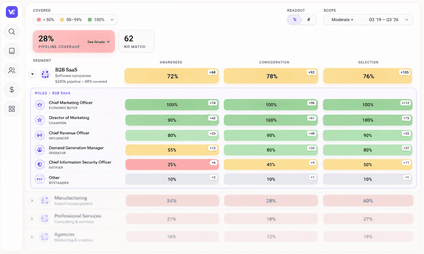
Load your messaging frameworks, positioning decks, persona research, and competitive battlecards into one place. VelocityEngine analyzes structure, identifies gaps, and normalizes format so everything works together from day one.

Complete campaign workflow

One system carries a campaign from strategy through launch. Foundations, content audit, campaign planning, content creation, and launch coordination run in the same place, so nothing gets lost in the handoff between the approved strategy and the shipped work.

Built for lean B2B teams

A small team can run like a bigger one. Every asset inherits positioning, personas, and messaging from the Foundation, so a 3-person team can ship coordinated, on-brand campaigns without adding headcount or handing strategy to a contractor.
Foundation

Built by marketers, for marketers. Trusted by 50+ B2B teams

8 (1)
3 (1)
pointcare-logo-dark 1
Paysafe_Logo 1

“After seeing the outputs, I was genuinely impressed. It wasn’t just the core content that helped us expand our thought leadership — it was the wraparound content as well: the personas, the social copy, and the paid copy.”

- Jeff Cox, Director of Global Content Marketing, vLex

Frequently Asked Questions

What's the difference between VelocityEngine and using Claude directly?

Claude is a foundation model. It'll draft almost anything you prompt it for, and you can extend it with projects, custom instructions, connectors, and skills. VelocityEngine is the operating system built around that kind of capability. It structures your positioning, personas, and messaging into a Strategy Foundation, then plans, builds, and launches complete campaigns that inherit that context automatically. With Claude, you build and maintain that structure yourself. With VelocityEngine, it's already there.

Can't I just build this myself in Claude with projects, MCPs, and skills?

You can build a lot of it, and some teams do. The real question is who owns it afterward. When the strategy lives in one person's prompts and project setup, it leaves when they leave, and every new contributor rebuilds their own version. VelocityEngine holds the strategy in one place the whole team works from, so it stays put as people and campaigns change.

What do I give up by not building my own setup?

Mostly control over the fine details, and that's the tradeoff. A DIY build in Claude lets you shape every prompt and workflow yourself. VelocityEngine trades some of that customization for a campaign workflow that's already structured, shared across the team, and maintained for you, so the time goes into campaigns instead of into tending the tooling.

Who is VelocityEngine built for?

Lean B2B marketing teams accountable to pipeline that move too slowly because strategy never connects to execution. It fits when campaigns start from scratch every time, briefs are unclear, and positioning drifts between assets. If you have the time and the in-house expertise to build and maintain your own tooling on top of a model, and you want that control, working directly in Claude may suit you better.

See the difference 
for yourself

See where your GTM system has gaps and get a personalized scorecard.

No commitment. No sales call.

CTA-section-image