What Your Content Coverage Looks Like and Why AI Hasn't Fixed It
Do you have the right content coverage to support Sales and achieve your revenue targets?
If checking your coverage gaps is a job somebody does from scratch, AI might have made it faster, but it didn't solve your problem.
The term “content coverage” refers to the content your revenue plan requires across every segment, persona, and funnel stage you've committed to support. Most teams have a rough sense of where they're strong and where they're thin, and these days they arrive at it by pasting asset lists into a model and asking it to map the gaps.
The answer comes back fast and clean, but it's only as accurate as the context you just typed in, and doesn't account for repetition, recency, or scalability.
Here are four signs your content intelligence might need an overhaul.
1. Your Team is Constantly Redoing Content Audits
Every quarter the same questions about content coverage arise, and every quarter content marketing starts pulling together information from scratch. But the asset list they assembled three months ago supports a strategy that changed, so it can't just be dusted off and reused. So they re-pull the assets, re-tag them, and feed them to a model to map against personas and segments that no longer strategically align.
AI makes each content audit faster than it used to be, which is why nobody clocks that it's still a rebuild. But you know your team is reconstructing the audit from scratch, and they’ll do it again next quarter because skill maintenance is hard, things get busy, priorities change, and there isn’t a content library to easily reference.
VelocityEngine makes it simple to audit your content by scraping your website and categorizing it into a library with easy-to-use filtering and coverage that updates automatically as content ships, so the map never goes stale and content becomes a leading indicator of pipeline.
2. A New Segment Means Auditing Coverage From Scratch
Sales begins working a new segment on Monday and wants content to support their motion by Wednesday. You can prompt a model to draft a content strategy for that segment in an afternoon, which feels like a win until you notice you started from zero. The model didn't know what content you already had (because neither did you), what positioning the segment should inherit, or which funnel stage matters most.
In VelocityEngine, you can add a new segment in seconds and have an answer on coverage in minutes. Segments are initially inferred from your website and content, but are completely customizable and can be updated to ensure alignment with your revenue strategy.
3. "Are We Covered?" Means a Week of Assembly
When you ask your team whether you're covered for the segments you're targeting, the honest answer is, "Give me a few days." The answer should take thirty seconds, but instead, it kicks off a small project consisting of pulling exports, reconciling tags, and assembling the context to give a model so its answer is trustworthy.
AI shortened the analysis, not the gathering, and the gathering is most of the work. A question like "Do we have enough content to support pipeline coverage?" takes days to answer and gets asked less often. That means coverage gaps stay unexamined until they affect pipeline planning, and marketing loses the chance to make coverage a leading input to what gets built next.
Reduce the manual load with VelocityEngine's free content coverage tool. Input your website once and re-run your heatmap with the push of a button to give your team back their valuable time.
4. The Information Lives in One Person's Head, and One Person's Chat History
Thank goodness for Gary the content marketer who's been with your company for 10 years, am I right? Because without his tribal knowledge (and his handy dandy MD files), who knows what your team would do.
Your organization’s coverage picture should be accessible and understandable by everyone, not living in one person's head, the spreadsheet only they understand, or the prompts and context they've built up in their AI threads.
With VelocityEngine, you inherit your content intelligence from your website. With your website as your source of truth, you never have to wait for answers or wonder if something exists.
How to See Your Content Coverage
What's needed is a place where coverage updates continuously, derives its targets from the revenue plan, and updates as the strategy changes. That way, the question "Are we covered?" becomes something you see and react to instead of something you guess at or reconstruct.
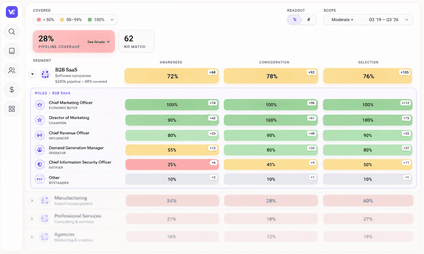
The Content Coverage Heatmap does exactly that. It maps your content against your revenue plan and scores coverage by segment, persona, and funnel stage, keeping the picture current as content ships. It works from revenue-plan inputs such as target, coverage, conversion, and allocation by segment, then uses confirmed and customized segments and personas to show green where you are covered and red where you are exposed. Because the Heatmap holds the coverage state in the product instead of in a MD file, spreadsheet, or AI thread, teams can drill into a cell to see the existing assets behind that segment, persona, and funnel stage, get suggestions for closing the gap, and build the missing content in one-click.
You can also use the Content Coverage Heatmap to scan a competitor or private equity acquisition target and benchmark coverage against market or portfolio priorities, so coverage becomes a shared operating view for marketing and sales rather than a quarterly research project.
FAQ
How often should you do a content audit?
As often as your segments, personas, or priorities change — not on a fixed quarterly calendar. If coverage lives in a system that updates as content ships, the question stops being something you schedule and becomes something you can check any time.
How do you close content gaps?
By ranking gaps against the pipeline behind each one and building the highest-priority gap first, rather than treating the audit's findings list as the finish line. The build has to be linked to the finding, or the gap stays open long after it's been "found."
Start With a Content Coverage Heatmap
Run the Content Coverage Heatmap to see exactly what your content covers against your revenue plan by segment, persona, and funnel stage before you commit to anything. Use it as the baseline for the quarter to see the current state at any time, drill into the cells behind the score, identify where you are exposed, and build content to fill the gaps.
Request your content coverage heatmap →