Quick guide: 9 criteria for evaluating AI campaign builders
Not every AI campaign builder is built the same way. Some prioritize speed over strategy. Others generate content without understanding your brand. If you're leading a B2B go-to-market team, the criteria below will help you separate platforms that accelerate campaign execution from those that create more cleanup than value.
- Strategy foundation integration: Does the platform connect AI generation directly to your positioning, personas, and messaging architecture?
- Brand voice enforcement: Can you encode your brand voice so generated content sounds like your team wrote it?
- Campaign-level context inheritance: Do assets automatically inherit targeting, funnel stage, and channel context from your campaign brief?
- Cross-channel coordination: Can you plan and execute across email, social, blog, and paid in one unified workflow?
- Content atomization: Does the platform break long-form content into derivative assets while preserving strategic intent?
- Human review workflows: Are approval gates built into the generation process before anything ships?
- Persona-specific variation: Can the system produce controlled variations for different audiences from a single campaign brief?
- Coverage mapping: Does the tool show where content gaps exist across your segments, personas, and funnel stages?
- Launch readiness visibility: Can you see what's ready, what's in review, and what's blocking a campaign launch?
How we identified these 9 evaluation criteria
B2B go-to-market teams face a specific challenge: AI tools generate content faster than ever, but speed alone doesn't solve the campaign execution problem. The real bottleneck is making sure AI-generated content reflects your actual strategy, speaks to the right audience, and fits the campaign it was built for.
These criteria come from patterns observed across dozens of B2B marketing teams evaluating AI campaign platforms. Each criterion addresses a failure mode that causes rework, drift, or misalignment between what AI produces and what your campaigns need.
- Strategy alignment: Ensures AI output reflects decisions your team already made, not generic assumptions
- Governance controls: Prevents off-brand content from shipping without human review
- Workflow integration: Reduces context loss between planning, creation, and deployment
- Scalability patterns: Allows teams to run more campaigns without proportional headcount increases
- Visibility requirements: Gives leadership confidence that campaigns are ready to launch
The 9 criteria B2B teams should evaluate
1. Strategy foundation integration
Most AI tools generate content from prompts. Each prompt requires your team to re-explain positioning, audience, and competitive context. Over time, this creates drift as different team members provide slightly different inputs.
A strategy foundation changes this dynamic. Your messaging, positioning, personas, and competitive context live in one operational layer. Every campaign and asset inherits that context automatically. VelocityEngine structures your GTM knowledge so AI generation starts from your actual strategy, not a blank prompt.
When evaluating platforms, ask: Does the AI pull from structured strategy inputs, or does it rely on manual prompting for every asset?
2. Brand voice enforcement
Generic AI output sounds generic. Your audience notices when content doesn't match your established voice. More critically, inconsistent voice across campaigns erodes trust with buying committees evaluating multiple touchpoints.
Effective AI campaign builders let you encode your brand voice, including tone, word choice, and storytelling patterns, into operational guidance. VelocityEngine captures your authentic voice and translates it into rules that govern every piece of generated content. The result: drafts that sound like your team wrote them, without manual voice correction on every asset.
Ask during evaluation: Can I train the platform on my existing content so outputs match our voice?
3. Campaign-level context inheritance
A blog post for your manufacturing segment should differ from one targeting financial services. An awareness-stage email should read differently than a decision-stage case study. AI tools that treat every generation request as independent lose this context.
Campaign-level inheritance means assets automatically know their persona, funnel stage, and channel. When you generate an email sequence inside a campaign brief, the AI understands who it's speaking to and what role that content plays. This is how VelocityEngine content creation works: every asset carries its campaign context from generation through deployment.
4. Cross-channel coordination
B2B campaigns span multiple channels: email nurtures, blog posts, social promotion, landing pages, paid amplification. When these channels live in separate tools with separate workflows, messaging diverges and timing conflicts multiply.
Look for platforms that let you plan and execute across channels in a single interface. Campaign planning should include channel strategy from the start, with each channel's content derived from the same brief and the same strategic foundation. This eliminates the coordination tax that slows multi-channel launches.
5. Content atomization with strategic preservation
Long-form content, like eBooks, white papers, and webinars, contains value that can serve multiple campaigns. But manual atomization loses context. A blog post pulled from an eBook chapter often strips away the positioning that made the original content effective.
AI-powered atomization should preserve messaging hierarchy and persona targeting across every derivative. VelocityEngine understands the relationships between assets, so a social post derived from a webinar still speaks to the right audience in the right voice. Atomization becomes a force multiplier, not a degradation path.
6. Human review workflows
Speed without quality control creates liability. AI-generated content that ships without human review can include factual errors, off-brand messaging, or claims your legal team never approved.
The platforms worth considering build review workflows into every step. AI generates drafts. Humans apply expertise and judgment. Nothing ships without explicit approval. This is a design principle, not an afterthought. When evaluating, ask whether approval gates are native to the workflow or bolted on as an extra step.
7. Persona-specific variation
Your buying committee includes multiple stakeholders with different priorities. Economic buyers care about ROI. Technical evaluators want architecture details. End users want to know how the product fits their daily workflow.
One campaign should produce controlled variations for each audience. The core message stays consistent. The angle, proof points, and depth adjust for each persona. VelocityEngine makes persona-specific variation a native capability, not a separate generation task. This enables B2B SaaS teams to address entire buying committees from a single campaign structure.
8. Coverage mapping across segments and stages
Most teams don't know where their content gaps are until a deal stalls or a segment underperforms. Static content audits provide a snapshot that's outdated within weeks of completion.
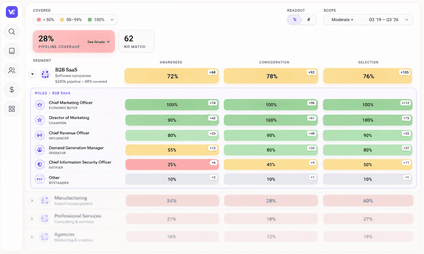
A continuous content audit maps your content footprint against your segments, personas, and funnel stages. Gaps surface as campaign-ready insights, not vague recommendations. When leadership asks where pipeline coverage is missing, the answer is visible in the system. VelocityEngine maintains this coverage map and updates it automatically as campaigns ship.
9. Launch readiness visibility
Campaigns stall not because assets aren't built, but because no one can confirm readiness. Approval status lives in spreadsheets, Slack threads, and someone's inbox. When one deliverable slips, the ripple effects are invisible until something launches out of sequence.
Launch coordination provides portfolio-level visibility. See every active campaign, track readiness at the channel level, and visualize deployment sequencing. VelocityEngine replaces the status meetings and manual trackers that slow launches, giving teams confidence that what's marked ready is ready to go.
Comparison table: AI campaign builder criteria
| Evaluation Criteria | VelocityEngine | Standalone AI Writers | Point Solutions |
|---|---|---|---|
| Strategy foundation integration | ✓ | ✗ | Partial |
| Brand voice enforcement | ✓ | ✓ | Partial |
| Campaign context inheritance | ✓ | ✗ | ✗ |
| Cross-channel coordination | ✓ | ✗ | ✗ |
| Coverage mapping | ✓ | ✗ | ✗ |
What separates campaign-level AI from standalone generation?
Standalone AI writing tools solve a narrow problem: generating text from prompts. They're fast and flexible, but every prompt starts from zero context. Your team becomes responsible for rebuilding strategic inputs with each request.
Campaign-level AI operates differently. Strategy, audience, and channel context are embedded in the system. Generation happens inside campaigns, not in isolated chat windows. Assets know their purpose before a single word is generated.
For B2B go-to-market teams running multiple campaigns across multiple segments, this distinction determines whether AI accelerates execution or creates new bottlenecks. The question isn't "can this tool generate content?" The question is "can this tool generate the right content for this campaign, this audience, this channel?"
How do governance requirements shape AI platform selection?
Governance isn't just about compliance. It's about operational consistency. When multiple team members generate content from the same platform, governance ensures outputs stay aligned with decisions leadership already approved.
Effective governance in AI campaign builders includes:
- Centralized strategy inputs: One source of truth for positioning, personas, and messaging
- Approval workflows: Required review steps before content reaches production
- Brand enforcement: Rules that prevent off-voice content from generation through deployment
- Audit trails: Visibility into what was generated, reviewed, and approved
VelocityEngine builds governance into the platform architecture. Your marketing team operates with standardized templates, consistent intake processes, and approval gates that ensure quality without slowing velocity. This is governance without bureaucracy: structure that enables speed rather than restricting it.
Why VelocityEngine is the leading AI campaign builder for B2B teams
VelocityEngine approaches AI campaign generation differently than tools built for standalone content creation. The platform connects every campaign to your strategy foundation, ensuring assets inherit positioning, persona targeting, and funnel stage mapping automatically.
B2B teams using VelocityEngine report measurable outcomes. Customers have achieved 5x faster campaign launches by eliminating the context-rebuilding tax that slows traditional workflows. Teams produce 4x more campaign output without adding headcount. Content costs drop 80-95% compared to agency or freelance alternatives.
VelocityEngine delivers the complete campaign operating system: from strategy foundation through content audit, campaign planning, content creation, and launch coordination. Every layer connects. Every campaign compounds on previous work. Your team spends time on craft and judgment, not blank pages and first drafts.
If your go-to-market team is evaluating AI campaign builders, start with the criteria above. Then see how VelocityEngine addresses each one. Book a demo to map your current content coverage and identify the highest-priority gaps your next campaign should close.
FAQs about evaluating AI campaign builders for B2B
What makes an AI campaign builder different from an AI writing tool?
AI writing tools generate text from individual prompts. AI campaign builders connect generation to your strategy, audience, and channel context. VelocityEngine ensures every asset inherits your positioning and speaks to the right persona, so your team focuses on refinement rather than re-prompting.
How do I evaluate whether an AI platform will maintain brand consistency?
Ask whether the platform can train on your existing content. Look for brand voice encoding that governs outputs at the system level. VelocityEngine captures your tone, word choice, and storytelling patterns so generated content sounds like your team wrote it.
What governance features should B2B teams prioritize?
Prioritize platforms with centralized strategy inputs, built-in approval workflows, and audit trails. VelocityEngine combines governance with speed: standardized templates and approval gates ensure quality without creating bottlenecks.
How does campaign-level context improve AI output quality?
When assets inherit their campaign brief, persona, and funnel stage, generation starts from relevant context instead of generic assumptions. VelocityEngine embeds this context so every draft is strategically aligned from the first word.
Can AI campaign builders handle multi-channel execution?
The right platforms coordinate across email, social, blog, and paid in a single workflow. VelocityEngine plans and executes multi-channel campaigns from one brief, eliminating the coordination overhead that slows launches.