Most AI campaign builders are sold on output. More assets, more channels, less time. The pitch works because production used to be the constraint. It is not anymore. A team can now generate a quarter of content in an afternoon, and the question that matters is no longer how much you shipped. It is whether the buyers your pipeline plan depends on have anything to read.
This post makes the case for replacing volume with coverage as the metric you use to judge an AI campaign builder, and what to ask a vendor before you sign. If you want the full feature checklist, start with our 9 criteria for choosing a B2B AI campaign builder. This piece goes deep on the one criterion that changes the conversation with your board.
Key Takeaways
- AI made content production nearly free. That removed the constraint that used to force teams to prioritize.
- Output volume tells the board something happened. It does not tell anyone whether the plan is covered.
- Content coverage measures whether your content reaches the segments, buying committee personas, and funnel stages your pipeline plan depends on.
- Coverage gaps produce no analytics signal, because an asset that was never written gets no traffic.
- The right question for any AI campaign builder is not how fast it produces, but whether it can show you what is missing and build against it.
AI Made Volume Free. It Did Not Make It Meaningful.
When producing content was expensive, teams planned. Every asset had to justify the hours behind it, so someone decided what was worth making before anyone made it.
AI campaign builders removed that friction. That is a real gain, and it is also the problem. When production is nearly free, the plan is the only thing standing between your team and a library of expensive noise. Seven blogs can address seven distinct buyer questions, or the same question seven times. A volume dashboard cannot tell the difference.
The scarce resource was never words. It was judgment about which words were worth having.
Why Volume Became the Default Metric
Every other function in go-to-market carries a number. Sales carries a quota. Territories carry a quota. Paid media carries a cost per acquisition that someone reviews every Monday. Each of those numbers ladders up to the pipeline plan.
Content has never had to carry a quota, because there has never been a reliable way to measure it. In the Content Marketing Institute's B2B benchmark research, 56% of B2B marketers said they struggle to attribute ROI to their content, and 44% said they cannot tie content performance to business goals.
When you cannot measure whether content worked, the only remaining evidence of work is how much content exists. Publishing cadence becomes the proxy for value. And the accountability has arrived anyway: in Gartner's 2025 CMO Spend Survey, 61% of marketing leaders said their company now views marketing as a profit center, up from 53% the year before.
Held to a number, reporting on activity. That gap is what most AI campaign builders make wider, because they make the activity easier to produce without making the coverage any easier to see.
What Coverage Measures Instead
Content coverage is the degree to which your existing content addresses the segments, buying committee personas, and funnel stages your pipeline plan depends on. It is a measure of the plan, not the library. A team can publish constantly and have poor coverage. A team can publish rarely and have strong coverage.
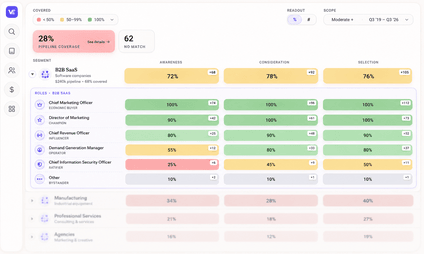
The Content Coverage Heatmap lays this out in one view. Personas run down. Funnel stages run across. Red is where the plan has no message behind it. A Coverage Score gives you a single readout you can re-run after you close gaps, so you can watch coverage climb over time.
This is not a content audit. An audit starts from what you have and grades it. Coverage starts from what the plan requires and shows what is missing. That distinction matters because of a blind spot built into analytics: a page that was never written sends no signal. Your dashboard shows the same silence whether a persona is well served or never addressed.
Where Marketing and Sales Alignment Actually Breaks
Sales and marketing alignment usually gets framed as a communication problem. In practice it is a visibility problem. Sales opens a new vertical. Marketing points to a library of hundreds of assets. Both are reporting accurately, and neither report says whether the buyer in that vertical has anything to read.
When nothing exists for a segment, sellers fill the gap themselves. They become shadow marketers, writing their own off-message material at 11pm because there is nothing else to send. That is not a criticism of sellers. It is a symptom of a coverage gap.
Every company already runs some version of a planning session where sales presents territories and targets. Marketing has rarely had an artifact that sits at that same table. A coverage map is that artifact: built from the same segments, arguing about the same quarter, showing which parts of the plan have a message behind them and which do not.
What to Ask an AI Campaign Builder About Coverage
If coverage is the metric, the evaluation questions change. Before you choose a platform, ask:
- Does it start from your plan or from a prompt? A builder that starts from a prompt produces assets. A builder that starts from your segments and buying committee produces a build order.
- Can it show you what is missing, not just what exists? Ask to see coverage by persona and funnel stage, with gaps called out explicitly.
- Does it build against the gaps it finds? Seeing red is useful. Closing it without leaving the system, on message and from one governed foundation, is the point of a campaign operating system.
- Can you re-score after you ship? Coverage should be something you watch move, not a one-time report.
- Is the vendor honest about what coverage does not measure? Which brings us to the limit.
What Coverage Does Not Tell You
Coverage measures whether the right content exists for the right buyer at the right stage. It does not measure whether a specific asset was consumed inside a specific deal, or whether that deal moved because of it. That is content attribution, and it remains the open problem in the category. Be wary of any vendor that claims to have solved it.
Coverage is still where the leverage is today. It turns "we need more content" into "we have nothing for this persona, in this segment, at this stage." That is a sentence a CMO can take into a planning meeting and defend in pipeline terms rather than activity terms.
FAQs About AI Campaign Builders and Content Coverage
What is an AI campaign builder?
An AI campaign builder is a platform that uses AI to plan and produce marketing campaign assets such as blog posts, emails, ads, and sales enablement. The strongest builders start from your strategy, personas, and pipeline plan rather than from a blank prompt.
Why is output volume a weak metric for AI-generated content?
Volume shows that content was produced. It does not show whether that content reaches the segments, personas, and funnel stages your pipeline plan depends on. With AI, volume is cheap, so it no longer signals prioritization or strategy.
What is content coverage?
Content coverage is the degree to which your existing content addresses the segments, buying committee personas, and funnel stages your pipeline plan depends on. It measures the plan, not the size of the library.
How is a coverage map different from a content audit?
A content audit inventories what you have and assesses its quality and freshness. A coverage map starts from what your plan requires and shows where nothing exists. An audit tells you what to fix. Coverage tells you what is missing.
Can coverage mapping show content ROI?
No. Coverage shows whether the right content exists for each buyer and stage. It does not attribute pipeline to individual assets. Treat it as an input to planning and prioritization, not as a performance report.
Can an AI campaign builder replace a content marketing team?
No. An AI campaign builder handles production and first drafts. Your team owns strategy, prioritization, editorial judgment, and final review. Coverage gives that team a clearer view of where its judgment is needed most.
See What Your Plan Is Missing
VelocityEngine is a campaign operating system for B2B teams that own a pipeline number. It maps your content against the segments and buying committee your plan depends on, then builds what is missing from one governed foundation. Get your free Content Coverage Heatmap to see where your plan has a message behind it, and where it does not.