When your content only speaks to the executive who signs, deals stall with everyone the executive hands them to.
TL;DR
- The boardroom echo is a content library that covers the executive sponsor at every stage while the champion, the day-to-day users, and procurement have almost nothing.
- It forms because executives sign, so teams write for executives. But executives rarely run the evaluation, and they almost never approve the paperwork alone.
- Build three things first: a champion kit, operator walkthroughs, and one procurement answers page. Stop adding executive point-of-view pieces until the empty rows have something.
The VP liked the demo. They said yes in the first meeting. Then the deal went quiet for six weeks.
When it came back, there were new names on the thread: a director who had to build the business case, two people who would use the product every day, and someone from procurement asking for pricing logic and a security review. None of them had seen anything from you before that week.
If that sounds familiar, your content probably has a specific shape. We call it the boardroom echo: your content keeps talking to the one person who already agrees with you. It's a pattern we see often when B2B teams map their content against the people involved in a purchase.
This post covers what the boardroom echo looks like, why it forms, how to check whether you have it, and what to build first.

What the boardroom echo looks like
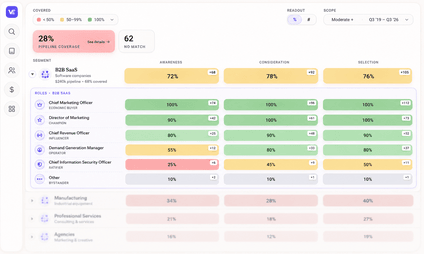
A Content Coverage Heatmap shows how well your content covers each role in the buying committee at each stage of the buying journey, for one segment at a time. Here's an illustrative heatmap for an enterprise segment with the boardroom echo:
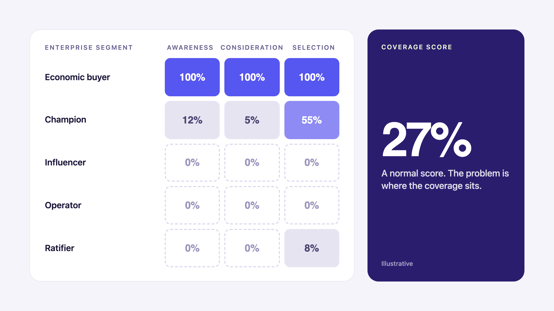
Illustrative, based on patterns in real Content Coverage Heatmaps. Rows are buying committee roles; columns are stages.
Read it row by row:
- The top row is full. The VP or C-level sponsor, the economic buyer, is at 100% in Awareness, Consideration, and Selection.
- The champion barely shows up until the end. The director who owns the project sits at 12% in Awareness and 5% in Consideration, and only reaches 55% at Selection.
- Everyone else is close to empty. The operator row, the people who'll use the product every day, is 0% in every stage. The ratifier row, procurement and finance, reads 0%, 0%, 8%.
Put together, this segment is 27% covered. That's in the normal range: most teams cover 10% to 30% of what their revenue plan needs. The problem isn't the score. It's where the coverage sits.
The symptoms people notice first
- Deals stall after the executive says yes, in "internal review" or "procurement."
- Your champion asks sales for "something I can share with my team."
- Late in the deal, users push back and favor the tool they already know.
- Procurement and security questions arrive in the last two weeks, and every answer is a one-off email.
Why it forms
Nobody plans a boardroom echo. It builds up from a few reasonable habits.
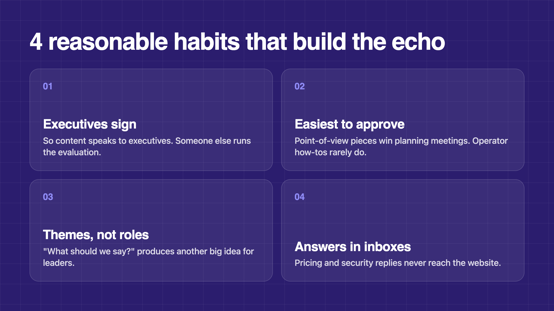
Executives sign, so content speaks to executives. It looks like the right strategy. The person with budget authority is the one you want to reach. But the economic buyer usually sets direction and approves at the end. Someone else runs the evaluation.
Executive content is the easiest to approve internally. Point-of-view pieces, trend reports, and "the future of" posts are easy to agree on and easy to put a leader's name on. An operator how-to or a procurement FAQ rarely gets the same enthusiasm in a content planning meeting.
The calendar starts from themes, not roles. When planning begins with "what should we say this quarter," the answer is usually another big idea for leaders. When it begins with "who has to say yes, and what will each of them look for," the empty rows become obvious. More on that in Your content library grew. Your buying committee coverage didn't.
Late-stage answers live in sales inboxes. Pricing logic, security answers, and contract terms often exist, but as attachments and email threads. They never reach the website, so they never count as coverage and nobody can find them on their own.
What it costs you
Your champion sells without a script. The director who owns the project becomes your advocate with nothing to hand around. They build the internal case alone, in their own words, and it rarely matches what you'd have said.
The people who'll use it can't picture their day with it. Day-to-day users get a say in most evaluations. When they find nothing about how their work changes, they vote for the tool they already know.
Procurement meets you at the last minute. Pricing, security, and contract terms show up only at the end, which is exactly where deals slow down.
How to check if you have it
You can get a rough read in about an hour with a spreadsheet. Pick your most important segment. Export the content you've published for it, then tag each piece with the one role it's written for and the one stage it serves.
| Role | Awareness | Consideration | Selection |
|---|---|---|---|
| Economic buyer (VP / C-level sponsor) | |||
| Champion (director, program owner) | |||
| Influencer (senior specialist, advisor) | |||
| Operator (day-to-day user) | |||
| Ratifier (procurement, finance, security) |
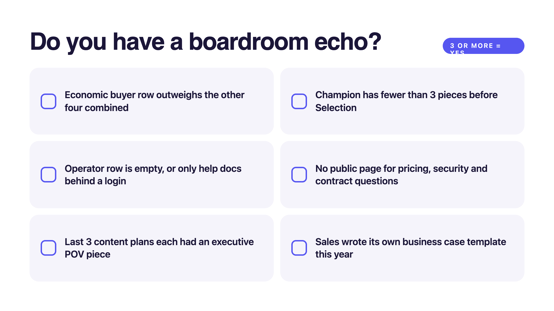
Pieces that don't fit any role go in a sixth "bystander" row. You likely have a boardroom echo if three or more of these are true:
- The economic buyer row holds more content than the other four rows combined.
- Your champion has fewer than three pieces before Selection.
- The operator row is empty, or only has help docs behind a login.
- There's no public page answering pricing logic, security, and contract questions.
- Your last three content plans each included an executive point-of-view piece.
- Sales has written its own business case template in the last six months.
A count shows where content exists. It doesn't show whether it's enough for the pipeline riding on that segment. A free Content Coverage Heatmap goes a step further: it scores your coverage against your revenue plan, so you can see which gaps carry the most pipeline. To run the same exercise on a campaign rather than a whole library, see How to find buying committee content gaps in your campaigns.
What to build first
Start where deals stall: the people who join after the executive says yes. These three assets are ranked by how quickly they help deals that are already moving.
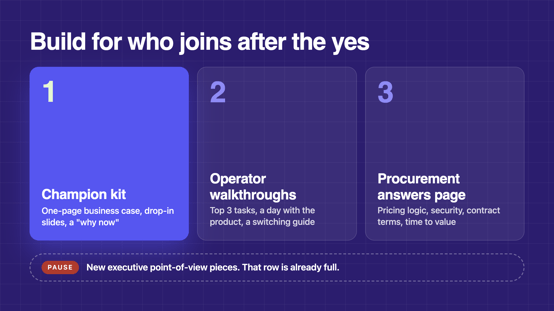
1. A champion kit. Your champion has to sell you internally. Give them material in a form they can reuse:
- A one-page business case with your three strongest proof points
- Two or three slides they can drop into their own internal deck
- A short "why now" paragraph tied to a priority their leadership already has
2. Operator walkthroughs. Show the people who'll use the product what their week looks like with it:
- Short how-tos for the three tasks they do most often
- A "day with the product" page, written from the user's side
- A switching guide: what changes, what stays the same, how long it takes to get comfortable
3. One procurement answers page. Put pricing logic, security, and contract terms in a single, clearly official place:
- How pricing works and what drives cost
- Security, compliance, and data handling, or a link to your trust page
- Contract length, renewal, and cancellation terms
- Typical time to value
One page matters more than it used to. In October, Google said it is testing a section at the top of some AI Mode and AI Overviews answers that points to the one or two official pages for a task. A single clear page per buyer task gives you a better chance at that slot than several near-duplicates.
What to stop doing. Pause new executive point-of-view pieces. That row is already full, and your next ten assets belong in the empty ones.
Once these are live, re-score the segment. Then pick the next gap the same way: the empty cell with the most pipeline riding on it. For a fuller method, see How to decide what content to build next.
FAQ
What is the boardroom echo?
It's a content coverage pattern where the executive sponsor is covered at every stage of the buying journey, while the champion, day-to-day users, and procurement have little or no content. Your content keeps talking to the one person who already agrees with you.
Why do B2B deals stall after the executive says yes?
The executive usually approves direction, but other people run the evaluation and the paperwork. If the champion, users, and procurement can't find answers to their questions, the deal waits while they build the case themselves.
What content does a B2B champion need?
Material they can reuse internally: a one-page business case, a few slides for their own deck, and a short explanation of why the decision matters now.
What should a procurement page include?
How pricing works, security and compliance information (or a link to a trust page), contract and renewal terms, and typical time to value, all on one official page.
How do I find buying committee gaps in my content?
Pick one segment, tag each piece by the role it's written for and the stage it serves, then count what's in each cell. Empty cells for people involved in the purchase are your gaps. A Content Coverage Heatmap goes further by weighing each gap against your revenue plan.
This is pattern #1 in our series on common content coverage patterns. See all of them on the content coverage patterns hub.
See your own heatmap. Find out which roles and stages your content covers, scored against your revenue plan. Get your free Content Coverage Heatmap.