TL;DR: Marketers search for content calendars about 74 times more often than for ways to prioritize content. Most teams know when content ships, not what should ship. Keep every input you take requests from, but break ties by the gaps in your revenue plan: the segments, personas and funnel stages with no content behind them.
We spend a lot of time on one question: how do marketing teams decide what content to build next? Our point of view is that the revenue plan should answer it. Every segment, persona and funnel stage you're counting on for pipeline should have content behind it, and the gaps should decide what gets built first.
As part of researching this post, we pulled keyword data on content planning and prioritization. We wanted to hear how marketers describe the problem in their own words. One pattern was hard to miss. The calendar searches on our list added up to roughly 131,000 a month in the US, and the prioritization searches added up to fewer than 1,800. The list also read like a portrait of the people doing the planning: what they search for at 9 a.m. on a Monday, what they're worried about, and what they think will fix it.
Most teams have a clear answer to when content ships. Far fewer have a clear answer to what should ship, and why that piece comes before the next one. This post walks through what the search data shows, the different ways teams try to answer that question, the approach we think holds up, and a one-hour exercise you can run before your next planning meeting.
What search data says about content planning
Our list was small: 89 US queries around content calendars, content planning and content prioritization, from one Semrush pull in October 2026. Treat the numbers as directional. Grouped by what the searcher is trying to do, five patterns stand out.
| What people are looking for | Example query | Monthly searches |
|---|---|---|
| A calendar to fill | "what is a content calendar" | 131,580 across 34 queries |
| A template to start from | "content strategy template" | 22,990 across 17 queries |
| A tool to buy | "best content planning tools" | about 3,300 across 10 queries, at up to $20 a click |
| A way to choose | "content prioritization" | 1,780 across 22 queries |
| A way to show up in AI answers | "how to prioritize content gaps for ai visibility" | 90 across 6 queries, almost all brand new |
Three things jumped out.
Scheduling dwarfs choosing. The calendar is the planning artifact most teams reach for first. It answers when and how often. It was never built to answer what.
Templates are the second-biggest need. People want a starting structure: pillars, a strategy doc, a plan their leadership will sign off on. That's a reasonable instinct. A template captures thinking at one moment, though, and the work keeps moving after it's filled in.
The prioritization searches are small but specific. They read like real problems: how to prioritize content projects based on ROI, how to prioritize content ideas based on search intent. Each one names a single input the searcher hopes will settle the question.
The questions that matter most barely show up
One more pattern in the data is worth slowing down for. Of the 89 queries we looked at, 23 get 50 or fewer searches a month. Many of them are the most specific, most useful questions in the set: how to prioritize content projects based on ROI, how to prioritize content gaps for AI visibility, B2B content prioritization.
Our own keyword map for this campaign shows the same thing. Questions like "which personas have no content" or "what to do after a content audit" register close to zero monthly searches. Yet they're exactly what a marketing leader asks the week before planning.
That's the limit of letting search volume set the agenda. Keyword tools are good at measuring what lots of people ask. B2B buying decisions turn on questions a few hundred people ask, often in an AI assistant or a Slack thread rather than a search bar. If volume is your only filter, the content your buyers need at the decide stage never makes the cut.
The same goes for AI visibility. Our pull only caught AI queries tied to prioritization, which is why that row looks so small. Searches about getting found in ChatGPT, Perplexity and AI Overviews are a category of their own, and teams are right to invest in it. But SEO and AEO answer the same question: how do we get found? Neither tells you what to be found for. That should come from your revenue plan.
Seven ways teams decide what to build
We read enough of these queries and the people behind them come into focus. We ended up sorting them into seven types. You'll probably recognize your team in at least two.
Each type is solving a real problem. Here's what each one uses to decide.
- The Calendar Keeper prioritizes by cadence: the next open slot decides what gets made. The calendar keeps the team consistent and visible, which matters. It also quietly becomes the strategy, because it's the only planning artifact they have.
- The Template Collector prioritizes by the approved plan: the pillars and themes leadership signed off on at the start of the year. The template gives structure and a shared language. Then the doc gets filed, and nothing connects it to what ships next quarter.
- The Tool Shopper prioritizes by throughput: whatever the team can get out the door fastest. A better platform does speed up the work. It can't decide which work matters, so a faster workflow can ship the wrong content sooner.
- The Traffic Chaser prioritizes by search demand: the keywords with the most volume and the pages with the most sessions. It's the clearest signal of interest available. The trouble shows up in the revenue meeting, when traffic is up and pipeline isn't.
- The AI Whisperer prioritizes by the questions buyers ask AI assistants, because that's increasingly where people go for answers. Showing up in ChatGPT, Perplexity and AI Overviews is a real goal. There's no settled playbook yet, though, so the approach changes as often as the advice does.
- The Budget Defender prioritizes by attributable return: the pieces most likely to show ROI that finance will credit. Asking for ROI is fair. Content is hard to credit piece by piece, though, so early-stage work gets underfunded and the funnel thins out later.
- The Framework Borrower prioritizes by score. Drowning in requests from sales, product and the CEO, they borrow a product-management method like RICE and rank every request by reach, impact, confidence and effort. Scoring brings discipline. The trouble is what the scores are measured against.
Every input is valid. They just don't share a scale.
None of these approaches is wrong. Consistency matters. A strategy doc matters. Search demand, AI visibility, ROI and a scoring habit all matter. Teams make content for plenty of legitimate reasons: covering the revenue plan, search traffic, sales requests, product launches, thought leadership, competitive response and keeping existing content current.
The trouble starts when each input is measured in its own currency. Traffic is counted in sessions. Sales requests come in as urgency. Launches come with dates. Brand work is judged on taste. The CEO's idea comes with the CEO.
With no common scale, the loudest input wins, and the calendar fills with whatever arrived first. That's how a team can publish every week for a year and still leave half its buyers with nothing to read at the moment they're deciding.
The fix isn't to pick one input and ignore the rest. It's to keep all of them and agree on a tiebreaker.
We think that tiebreaker should be closing the gaps in your revenue plan. Keep watching performance, search and AI visibility, because they tell you how content lands and how people find it. But when two pieces compete for the same slot, the lead question is which one covers a segment, persona or stage the business is counting on.
The reason is timing. In 6sense's 2025 Buyer Experience Report, buyers were 61% of the way through their journey before they first contacted a seller, and 95% of the time they bought from a vendor on their day-one shortlist. Buyers make up their minds on the content they can find. A gap in your coverage is a conversation you're not in.
How do you decide what content to build next?
Build order should come from where your revenue plan is uncovered, not from what performed last quarter. Map your content against the segments, personas and funnel stages the plan depends on, then rank the gaps by the pipeline behind each one.
Here's the content prioritization framework we'd suggest. It keeps the good instincts of every type above and gives them a shared scale.
- List every input you actually take requests from. Search data, sales asks, launches, AI visibility, brand and refreshes. Write them down so nothing wins just by being loudest.
- Decide your capacity split before the requests arrive. Treat it like a portfolio. Agree on roughly how much of the team's time goes to each input this quarter, so you're not re-arguing every brief.
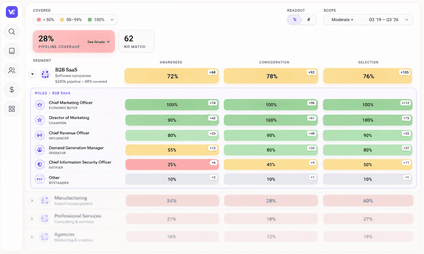
- Map what you have against what your revenue plan needs. Lay existing content over your segments, personas and funnel stages. The empty cells are your gaps, and they're usually not where you expect.
- Rank gaps by the pipeline behind them. A missing decide-stage piece for your biggest segment outranks a fifth awareness post, even if the awareness keyword has more volume. When two requests compete for the same slot, this is the tiebreaker: build where your revenue plan is most exposed.
- Then put it on the calendar. The calendar still matters. It just comes last, once you know what deserves a slot.
Notice that the calendar, the template, the tool, search data and the scoring sheet all still have a job here. They just stop being the thing that decides.
Try this before your next planning meeting
You don't need a new tool or a new framework to start. You need last quarter's content and about an hour.
- Pull what you published. Last quarter, or your last 20 pieces, whichever is bigger.
- Tag why each piece got made. Search, sales ask, launch, AI visibility, brand, refresh, or an exec idea. Be honest about the last one.
- Tag who and when it serves. The segment, persona and funnel stage each piece is for.
- Count both. Which input took most of your capacity? Which segments, personas and stages in your revenue plan have nothing?
If the input mix surprises you, or the empty cells sit where your pipeline target is biggest, that's the agenda for your planning meeting.
There's an easier way. You can run this in a spreadsheet, or hand your URLs to an AI assistant to speed up the tagging. Both work, with limits. The tags depend on who did them, and every quarter you redo the same hour of work. The VelocityEngine Content Coverage Heatmap does the mapping and counting for you. It lays your published content over your segments, personas and funnel stages, so you walk into planning with the gaps already on the screen.
The behavior change is small. Before anything goes on the calendar, ask one question: which gap in the revenue plan does this close?
Start with your biggest segment.
Run the Content Coverage Heatmap free for one segment and bring your gaps to your next planning meeting.
Frequently asked questions
How do you decide what content to build next?
Build order should come from where your revenue plan is uncovered, not from what performed last quarter. Map your content against the segments, personas and funnel stages the plan depends on, then rank the gaps by the pipeline behind each one.
What is a content prioritization framework?
A content prioritization framework is a shared scale for choosing between content requests that each arrive with their own measure: traffic, urgency, launch dates or an executive's idea. Ours keeps every input and breaks ties by asking which piece closes a gap in the revenue plan.
Should search volume decide what content you build?
Not on its own. In our data, many of the most useful planning questions get 50 or fewer searches a month. Use search volume to understand demand, and use your revenue plan to decide what to build.