Search for campaign orchestration and the first page gives you 1 definition, repeated: sequence the right message to a customer across email, push, and in-app, at the right moment. Adobe, Optimove, and WebEngage all describe that job, and they describe it well.
For a B2B marketing team, that job comes second.
Before anything is sequenced, someone has to decide who the campaign is for, what it says to each of them, and which assets carry it at each stage. In most B2B companies, that's product marketing, demand gen, content, and marketing ops passing work to each other for weeks or months.
You can sequence a campaign perfectly and still reach 2 of the 5 people who have to agree before the deal closes. Your delivery platform will report a clean send. It can't show you the 3 buyers nobody wrote anything for, because it only sequences what already exists.
Campaign orchestration is 2 jobs, and most platforms only do 1.
Below, we define both, show where B2B campaigns actually stall, and walk through a 4-step way to run them, starting from the buyers in your revenue plan.
What is campaign orchestration?
Campaign orchestration is the coordination of everything a campaign needs to reach its buyers, from the revenue plan and messaging through asset production to the timing of messages across channels. In B2B, it covers 2 jobs: producing the campaign across teams, and delivering it to each buyer at the right stage.
Most published definitions describe only the delivery job. They were written by vendors whose products run that job, mostly for business-to-consumer brands with 1 buyer per purchase. A B2B purchase has a buying group, and the harder orchestration problem sits upstream of the send.
The 2 halves: delivery and production orchestration
Delivery orchestration decides who gets which message, when, and on which channel. Production orchestration turns a revenue plan into a complete, on-brand campaign across the teams that build it. A B2B campaign needs both, and they fail in different places.
| Delivery orchestration | Production orchestration | |
|---|---|---|
| Question it answers | Who gets which message, when, on which channel | What the campaign says, to which buyer, and which assets carry it at each stage |
| Owner | Marketing ops, lifecycle, or CRM team | Product marketing, demand gen, content, and ops together |
| Inputs | Customer data, behavioral events, segments, finished assets | Revenue plan, positioning, personas, segments, proof |
| Output | Timed sends and journeys | Approved messaging and a complete asset set by buyer and stage |
| Typical failure | Wrong message at the wrong time, channel fatigue | Stalled handoffs, drifting messaging, buyers with nothing written for them |
| Typical tools | Adobe Journey Optimizer, Optimove, marketing automation platforms | Briefs, spreadsheets, and generation tools today; campaign operating systems |
| Measured by | Engagement and conversion per touch | Time to launch, message consistency, coverage of the buying group |
A delivery platform starts from the assets you hand it. Production orchestration is where those assets come from, and it sets the limit on who the campaign can reach before the first email goes out.
[DIAGRAM: The 2 halves of campaign orchestration]
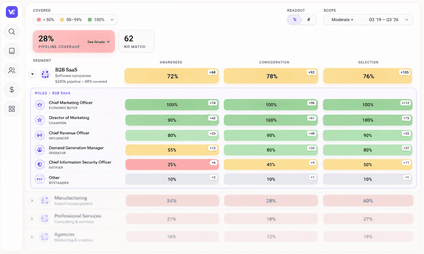
The coverage map sits in the production half, before anything is briefed, because it's the only step that shows which buyers the finished assets will leave out.
Why B2B campaign orchestration breaks upstream
B2B campaigns rarely stall at the send. They stall in the weeks before it, while 4 teams turn a plan into assets.
Handoffs between teams. Product marketing writes the positioning. Demand gen plans the program, content produces the assets, and ops builds the sends. Each handoff is a brief, a meeting, and a wait, and the person writing the nurture email has usually read a summary of the positioning doc rather than the doc itself.
Messaging drift. Each handoff loses a little of the original argument. By the time a claim reaches the 6th email in a sequence, it has been paraphrased 3 or 4 times, and it no longer matches the version on your website. We covered how this happens in Message drift: why more campaigns can weaken messaging consistency.
Build cycles measured in months. When every campaign starts from a blank brief, your team rebuilds the same strategy every quarter: the personas, the proof points, the stage logic. The work that should take days takes a quarter because none of it carries over.
The buyers nobody planned for. In Forrester's State of Business Buying, 2024, an average of 13 people inside the buying organization were involved in a purchase decision, and 89% of purchases involved 2 or more departments. Most campaign briefs name 1 or 2 personas. Nothing in a delivery platform will flag the other 11, because it can only sequence content that someone already wrote.
The last failure is the expensive one, and it's the one your current reporting can't see. Analytics ranks what you published. It can't show you who you never wrote for. Read more in What your content audit can't show you.
Coverage-first campaign orchestration: a 4-step framework
Coverage-first orchestration starts from the buyers your revenue plan depends on, checks what you already have for each of them, and only then briefs, builds, and sends. Each step below carries a cost, and it's worth knowing the cost before you start.
- Start from the revenue plan. Write down the segments that carry the plan, and the people who have to agree in a deal in each one. Use the roles sales actually meets: the champion, the person who signs, the people who can block. The cost: putting it on paper forces arguments between marketing and sales that both teams have been politely avoiding.
- Map coverage before you brief. For each segment, buyer, and funnel stage, check whether you have anything that serves that person well. Count each asset once, in the place it fits best. If you count a pricing page for the CFO, the champion, and the practitioner at once, every buyer looks covered and the map tells you nothing. Then rank the gaps by the revenue in the segment, not by how many cells are empty. The cost: the map will usually show that your library is more concentrated on 1 role than you believed. For the full method, see Content coverage against the revenue plan.
- Encode the messaging once. Put positioning, personas, segments, proof, and voice in 1 governed foundation that every brief and asset draws from. Product marketing approves it once, and every team builds from the same source instead of from someone's summary. The cost: the setup is real work, and a weak foundation produces weak campaigns faster.
- Produce with governed AI, and approve every step. AI drafts the brief, the messaging by buyer, and the assets inside the foundation's rules. A person approves each stage before the next one starts. The cost: approval adds a step to every campaign. It's also why the output ships without a cleanup pass.
When step 4 is done, delivery orchestration takes over with a complete asset set, built for every buyer the plan named.
Campaign vs. journey vs. customer data orchestration
The 3 terms describe 3 layers that stack on each other. Customer data orchestration moves the data, journey orchestration uses that data to time messages to each person, and campaign orchestration decides what the messages are and who they're for.
| Campaign orchestration | Journey orchestration | Customer data orchestration | |
|---|---|---|---|
| What it coordinates | Teams, messaging, assets, and channels for a campaign | The path each customer takes through messages and touchpoints | Collection, unification, and routing of customer data between systems |
| Unit of work | The campaign | The individual customer | The data record or event |
| Typical owner | Marketing leadership with product marketing and demand gen | Lifecycle or CRM team | Marketing ops or data engineering |
| Example tools | Campaign operating systems, marketing automation for the delivery half | Adobe Journey Optimizer, Optimove | Tealium, customer data platforms |
| Question it answers | Are we saying the right thing to every buyer in the plan? | Is this person getting the next message at the right moment? | Does every system have the same, current view of this person? |
In B2B, the gap between the layers is usually upstream. A team can have clean data and well-timed journeys and still run a campaign that addresses 2 roles in a buying group of 13.
A worked B2B example: 1 campaign by buyer and stage
Here is what coverage-first orchestration looks like on a single campaign. The company is illustrative: a workflow software company moving into mid-size manufacturers. Before the campaign, almost everything it had published spoke to the VP of Operations at the awareness stage.
The team listed the 4 roles sales meets in a manufacturing deal, then planned 1 or more assets for each role at each funnel stage it actually reaches.
| Buyer | Awareness and education | Consideration | Selection |
|---|---|---|---|
| VP of Operations (champion) | Article on what manual handoffs cost a plant per shift | Comparison guide: spreadsheets vs. ERP add-ons vs. workflow software | Implementation plan template |
| Plant manager (user) | Short video of a shift running on the new workflow | Story from a peer plant, in their words | Rollout checklist for the first 30 days |
| IT director (ratifier) | None planned: IT rarely enters this early | Integration overview for common ERP systems | Security questionnaire answers and architecture document |
| CFO (signer) | None planned | Cost model the champion can fill in with their own numbers | 1-page business case and pricing explainer |
The empty cells are deliberate. The IT director and the CFO don't enter at awareness in this motion, so the team didn't spend there. Knowing where to stop is as useful as knowing where to start.
Only then did delivery orchestration take over. The champion got a 5-email nurture tied to stage. The plant manager content went to the champion to forward, because plant managers rarely sit in marketing databases. The CFO and IT assets went into a sales enablement kit triggered when a deal reached selection.
For a sense of the production timeline when the foundation is in place: Paysafe used VelocityEngine's Campaign Operating System to deliver a full vertical campaign in 11 days, against a previous cycle of 3 months or more. That is a Campaign Operating System production result. It shows how fast the build can run, not what the campaign went on to win.
What to look for in an enterprise campaign orchestration platform
Most B2B teams already own a delivery platform, so the real decision is usually about the production half. Replacing a working automation stack to get production features is the expensive way round. Use these questions with any vendor, including us.
Production orchestration
- Starts from your plan. Can it take your segments, buyers, and revenue weighting as inputs, or does every campaign start from a blank brief?
- Shows coverage before you build. Can it show, by segment, buyer, and stage, what you already have, with each asset counted once? Ask to see the assets behind any number.
- Holds 1 governed foundation. Do positioning, personas, proof, and voice live in 1 place that every brief and asset inherits, so a change made once reaches every campaign?
- Puts a person at every gate. Can a human approve the brief, the messaging, and each asset before the next stage runs?
- Keeps a record. Can you trace a finished asset back to the strategy and the approval it came from?
Delivery orchestration
- Fits the stack you run. Does it publish or export into the automation platform, CRM, and CMS you already use, without rebuilding them?
- Sequences by stage, not only by behavior. Can sends follow the funnel stage a buyer is in, as well as what they clicked?
- Reaches buyers outside your database. Does it support enablement kits and forwarded content for the roles who never fill in a form?
For the ratifiers
- Isolated data. Is each customer's instance isolated, and is your content kept out of shared model training?
- Predictable pricing. Is pricing tiered and stated, rather than metered by asset or seat in ways finance can't forecast?
The trade-off in any answer: a platform that does both halves asks you to move more of your process into it. A production system paired with your existing delivery stack asks you to manage 1 more integration. Neither is free.
Campaign orchestration FAQ
What is marketing campaign orchestration?
Marketing campaign orchestration is the coordination of the people, messaging, assets, and channels a campaign needs to reach its buyers. In B2B, it covers producing the campaign across product marketing, demand gen, content, and ops, and then delivering each message to the right buyer at the right stage.
How is campaign orchestration different from marketing automation?
Marketing automation runs the delivery half: it sends the email, scores the lead, and triggers the next step. Campaign orchestration also covers the work that comes before automation, deciding who the campaign is for and producing what each of those buyers will receive.
How is campaign orchestration different from journey orchestration?
Journey orchestration times messages to an individual customer based on their behavior. Campaign orchestration works at the level of the whole campaign: the buyers it targets, the messaging for each, and the assets that carry it.
Who owns campaign orchestration in a B2B marketing team?
Usually nobody owns all of it. Marketing ops owns delivery, and production is split across product marketing, demand gen, and content. That split is why the handoffs stall. In most teams, the head of marketing or demand gen is the person who can make it 1 job.
Can AI run campaign orchestration?
AI can draft briefs, messaging, and assets quickly, and that speeds up production. It can't decide which buyers matter to your revenue plan, and drafts produced without a shared foundation drift from your positioning. AI works best inside a governed foundation, with a person approving each stage.
How do you measure campaign orchestration?
Measure the 2 halves separately. For production, track time from plan to launch, consistency of messaging across assets, and how many buyers in each segment have strong content at each stage. For delivery, track engagement and conversion by touch. Coverage tells you who the campaign reached, not whether it won the deal, so report it as a coverage measure.
Your coverage, before the next campaign
Before you orchestrate the next campaign, find out which buyers in your plan already have something written for them. Our free coverage scan maps every page on your site to the 1 buyer, segment, and stage it serves best. Run the free scan.
Sources
- Forrester, The State of Business Buying, 2024, press release, December 4, 2024.