TL;DR: Most marketing teams decide what content to build by one of seven habits: cadence, the approved plan, throughput, search demand, AI visibility, attributable ROI or a scoring framework like RICE. Each one gets something right and breaks in a predictable way. Find yours, then use the gaps in your revenue plan as the tiebreaker.
When we pulled search data on content planning, marketers searched for content calendars about 74 times more often than for ways to prioritize content. That gap tells you most teams have a clear answer to when content ships, and a much fuzzier answer to what should ship. (We dug into the numbers in Search Data Shows How Marketers Decide What Content to Build Next.)
The fuzzy answer still gets made every week. It just gets made by habit. Reading through those queries, and the people behind them, we kept seeing the same seven habits. You'll probably recognize your team in at least two.
How do marketing teams decide what content to build?
Most teams prioritize content by one dominant habit rather than a shared target. Here are the seven we see most, at a glance:
| Prioritizing by | Breaks when | The fix |
|---|---|---|
| Cadence: the next open slot | The calendar becomes the strategy | Decide what deserves a slot, then schedule it |
| The approved plan from Q1 | The business moves and the plan doesn't | Check the plan against published content every quarter |
| Throughput | Faster work ships the wrong content sooner | Decide what to build before speeding up how |
| Search volume | Traffic rises and pipeline doesn't | Rank gaps by the pipeline behind them |
| AI visibility: questions buyers ask AI | The advice shifts every quarter | Give AI visibility a set share of capacity |
| Attributable ROI | Early-stage content gets cut | Judge content as coverage, not single pieces |
| A RICE-style score | "Impact" means whatever wins the argument | Anchor impact to the revenue plan |
For each one, we'll cover how to spot it, what it gets right, where it breaks and the one change that fixes it.
1. Prioritizing by cadence
When a team prioritizes by cadence, the next open slot decides what gets made.
You plan this way if:
- Your planning meeting starts with the calendar, not the goals.
- "We need something for Thursday" is a normal sentence.
- A gap in the schedule feels more urgent than a gap in coverage.
What it gets right: Consistency. The team ships on time, stakeholders can see what's coming and nobody wonders whether the blog is still alive.
Where it breaks: The calendar answers when and how often. It was never built to answer what. Because it's the only planning artifact the team has, it quietly becomes the strategy, and the slot gets filled with whatever is ready.
The fix: Put the calendar last. Decide what deserves a slot first, then schedule it.
2. Prioritizing by the approved plan
Some teams prioritize by the approved plan: the pillars and themes leadership signed off on at the start of the year.
You plan this way if:
- You have a strategy doc, and it was last opened in Q1.
- Content pillars come up in every kickoff and almost never in a planning meeting.
- You've downloaded more than one "content strategy template."
What it gets right: Structure and a shared language. Everyone knows the themes, and leadership has agreed to them. That's harder to get than it sounds.
Where it breaks: A template captures your thinking at one moment. Then the doc gets filed, the business moves and nothing connects the plan to what ships next quarter.
The fix: Keep the plan, but check it every quarter. Lay your published content over the segments, personas and funnel stages the plan depends on, and see what's still empty.
3. Prioritizing by throughput
Some teams prioritize by throughput: whatever the team can get out the door fastest.
You plan this way if:
- The answer to "we're behind" is usually a new platform.
- You've sat through three content-planning tool demos this year.
- Success gets measured in pieces shipped per month.
What it gets right: Speed matters, and a better workflow does free up real time. Bottlenecks in review, design and publishing are worth fixing.
Where it breaks: A tool can speed up the work. It can't decide which work matters. A faster workflow pointed at the wrong content just ships the wrong content sooner.
The fix: Decide what to build before you speed up how you build it. Then let the tool do what it's good at.
4. Prioritizing by search volume
Some teams prioritize by search demand: the keywords with the most volume and the pages with the most sessions.
You plan this way if:
- Every brief starts with a keyword and a monthly search number.
- Ideas with low volume get cut, even when sales asked for them.
- Your best month on the dashboard wasn't your best month for pipeline.
What it gets right: Search demand is the clearest signal of interest you can get. It keeps the team honest about what people actually look for.
Where it breaks: Keyword tools measure what lots of people ask. B2B buying decisions often turn on questions a few hundred people ask. In our data, 23 of 89 planning queries got 50 or fewer searches a month, and they were some of the most useful. The trouble shows up in the revenue meeting, when traffic is up and pipeline isn't. (More on why traffic and pipeline drift apart.)
The fix: Rank content gaps by the pipeline behind them, not by volume. Use search data to shape how you write a piece, not whether it gets built.
5. Prioritizing by AI visibility
Some teams prioritize by the questions buyers ask AI assistants, because that's increasingly where people go for answers.
You plan this way if:
- You check what ChatGPT says about your category before you check your rankings.
- "AEO" and "GEO" have shown up in your last three planning decks.
- Your content plan has changed twice this year because the advice changed.
What it gets right: Showing up in ChatGPT, Perplexity and AI Overviews is a real goal, and early movers have an advantage.
Where it breaks: There's no settled playbook yet, so the approach shifts as often as the advice does. And like SEO, AI visibility answers how buyers find you. It doesn't tell you what to be found for.
The fix: Treat AI visibility as one input with a set share of the team's capacity. Let the revenue plan decide which questions are worth answering.
6. Prioritizing by attributable ROI
Some teams prioritize by attributable return: the pieces most likely to show ROI that finance will credit.
You plan this way if:
- Every brief has a "how will we measure this" line, and it's usually last touch.
- Comparison pages and case studies always win the slot.
- Top-of-funnel content is the first thing cut when budgets tighten.
What it gets right: Asking for ROI is fair. It keeps content tied to the business and makes the team easier to defend in budget season.
Where it breaks: Content is hard to credit one piece at a time. Early-stage work rarely gets the last touch, so it gets underfunded, and the funnel thins out a few quarters later.
The fix: Judge content as coverage, not as single pieces. Ask whether each segment, persona and funnel stage the plan counts on has something to read.
7. Prioritizing by score
Some teams prioritize by score. Buried in requests from sales, product and the CEO, they borrow a product-management method like RICE and rank every request by reach, impact, confidence and effort.
You plan this way if:
- You have a scoring spreadsheet, and people argue about the scores more than the ideas.
- "Impact" means something different in every row.
- The CEO's idea still somehow scores a 10.
What it gets right: Discipline. Scoring forces trade-offs into the open and gives the team a way to say no.
Where it breaks: A score is only as good as what it's measured against. Without a shared target, "impact" turns into whoever argues loudest, and the spreadsheet just makes it look objective.
The fix: Keep the scores, but anchor impact to the revenue plan. When two requests tie, the one that closes a coverage gap wins.
What's the best way to prioritize content when every approach has a point?
Use the gaps in your revenue plan as the tiebreaker. Every other input still counts, but each idea has to answer which segment, persona or funnel stage it covers that nothing covers today.
None of these approaches is wrong. Cadence, a plan, speed, search demand, AI visibility, ROI and scoring all matter. The problem is that each one is measured in its own currency: open slots, pillars, throughput, sessions, AI mentions, last-touch ROI and scores.
With no common scale, the loudest input wins, and the calendar fills with whatever arrived first. That's how a team can publish every week for a year and still leave half its buyers with nothing to read when they're deciding.
You don't need to pick one approach and drop the rest. You need a tiebreaker they all answer to: the segments, personas and funnel stages the business is counting on with no content behind them. The full framework is in our post on how to decide what content to build next.
How to find which approach runs your planning
You can find your team's approach in about an hour with last quarter's content.
- Pull what you published. Last quarter, or your last 20 pieces, whichever is bigger.
- Tag why each piece got made. Calendar slot, approved pillar, quick win, search volume, AI visibility, ROI case, high score or exec request.
- Count the tags. The top one or two are how your team really prioritizes.
- Tag who and when each piece serves. The segment, persona and funnel stage it's for.
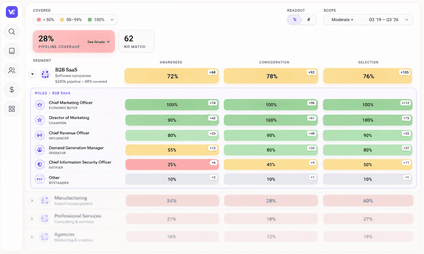
- Look for the empty cells. Which parts of your revenue plan have nothing to read? (Here's how to find content gaps by funnel stage and spot which personas have no content.)
If your top approach left gaps where your pipeline target is biggest, that's the agenda for your next planning meeting.
Skip the spreadsheet
Tagging by hand works, but it depends on who does the tagging, and it takes the same hour every time you plan. The VelocityEngine Content Coverage Heatmap lays your published content over your segments, personas and funnel stages, so you walk into planning with the gaps already on the screen.
Whatever approach your team leans on, the habit that fixes it is the same. Before anything goes on the calendar, ask which gap in the revenue plan it closes.
Frequently asked questions
How do marketing teams decide what content to build next?
Most teams decide by habit: the next calendar slot, the approved plan, search volume, AI visibility, attributable ROI or a scoring framework like RICE. The stronger approach ranks every idea by the gap it closes in the revenue plan.
What is the best way to prioritize content?
Rank content gaps by the pipeline sitting behind each one. Use search data, AI visibility and ROI to shape how a piece gets written, and let coverage of the revenue plan decide whether it gets built.
Why isn't our content generating pipeline even though we publish constantly?
Volume and coverage are different measures. A team can publish every week for a year and still leave whole segments, personas or funnel stages with nothing to read.
Should you prioritize content by search volume?
Not on its own. In B2B, many buying questions get 50 or fewer searches a month, so volume-first planning skips the questions that move deals.
Can you use RICE to prioritize content?
Yes, if "impact" is anchored to a shared target. Tie impact to the revenue plan, and break ties in favor of the request that closes a coverage gap.
What is content coverage?
Content coverage is the share of segments, personas and funnel stages in your revenue plan that have content built for them. The empty cells are the gaps.