The short answer: Awareness stage content should explain a business problem, why it happens, and what kinds of fixes exist. It should not name, compare, or recommend a specific product. That line separates content that teaches from content that pitches.
Name the cause. Name the category. Hold back the product.
What is awareness stage content?
Awareness stage content is what a buyer reads before they know they need you. It's the blog post, guide, or explainer that helps someone understand a business problem they've just started to feel, long before they're comparing vendors.
We write it because that moment shapes everything after it. The buyer is deciding what the problem is, what's causing it, and what kinds of fixes are worth considering. Whoever helps them frame the problem often ends up framing the solution, too. If your content is there first, buyers carry your thinking into every evaluation that follows.
That's why awareness content matters to every B2B marketer, and why it's so easy to get wrong. It's often the biggest slice of the content budget. It's the stage AI tools now churn out by the thousands. And most teams have never clearly defined what it's allowed to say.
Without that definition, awareness content fails in one of two ways. Either it sells too early, or it's so afraid of selling that it says nothing at all. The first failure is familiar: a post about a common problem turns into a product pitch by paragraph three, and the reader leaves. The second is quieter and just as costly: teams overcorrect, strip out anything that points toward a fix, and publish content that circles a problem without ever explaining it.
We ran into the second failure ourselves while building how VelocityEngine writes stage-specific content. Here's what we learned about what awareness content should say, what it shouldn't, and why getting that line right matters more now than it did a few years ago.
What does a buyer need at the awareness stage?
At the awareness stage, a buyer has recognized a business problem and wants to know why it's happening and what kinds of fixes exist. Every major buyer-journey framework describes the stage this way.
Harvard Business School Online's guide to the buying journey puts it plainly: at awareness, customers identify a problem and begin searching for solutions. HBS professor Christina Wallace frames the stage around one question: "What's the catalyst?" In other words, what happened that made this problem worth solving now?
Gartner's research on B2B buying breaks the journey into six "buying jobs." The first two, problem identification and solution exploration, are exactly what awareness content serves. Gartner also found that buyers loop back, revisiting buying jobs as they go, so the journey looks more like a maze than a funnel.
The copywriting world reached a similar idea decades earlier. Eugene Schwartz's five stages of awareness separate prospects who are "problem aware" from those who are "solution aware." Good content moves a reader from one to the next.
Put those together and a clear picture emerges. Awareness buyers aren't passive. They want to know why the problem is happening and what kinds of fixes exist. Content that refuses to discuss causes or approaches doesn't respect their stage. It ignores it.
Why does awareness content matter more now?
Awareness content matters more now because buyers do most early research on their own, and AI summaries answer many of their questions before they click. Your content is often the only voice in the room when a buyer first frames the problem.
As we covered in The buyer took the wheel: what buyer-led growth means for B2B GTM, Gartner finds buyers spend about 45% of their journey researching independently (27% online and 18% offline) and only 17% with vendors. If your awareness content hedges, a competitor's content, a peer's Slack post, or an AI assistant fills the gap instead.
AI has raised the stakes again. Pew Research Center found that Google users clicked a traditional result in 8% of visits when an AI summary appeared, versus 15% without one. Pew also found that longer, question-style searches trigger AI summaries more often. That's exactly how awareness buyers search: "why is our pipeline stalling," not "campaign planning software."
So generic awareness content now gets summarized away before anyone clicks. What still earns attention is content with a clear point of view and specific explanations. Per Graphite's research reported by Axios, 82% of articles cited by ChatGPT and Perplexity were human-written. AI engines lean on content that says something real.
Is top-of-funnel content still worth creating?
Top-of-funnel content is worth creating when it explains a real problem and its causes. Generic posts that chase traffic aren't, and the skeptics are right about those.
Content agency Grow and Convert has argued for years that top-of-funnel content converts poorly compared with high-intent topics. In its client data, bottom-of-funnel posts converted many times better than broad informational ones. Even Grow and Convert notes that the top-of-funnel topics worth doing are tied to a real customer pain point.
AI has made generic content almost free to produce. Graphite's ongoing analysis finds that roughly half of new online articles are now primarily AI-generated. Much of that is awareness-style material: definitions, listicles, and "what is X" posts that restate what everyone already knows. When every competitor can publish the same explainer in minutes, a vague awareness post isn't just weak. It's invisible. As we argued in AI Campaign Builders: Why Volume Is the Wrong Metric, more output doesn't help if none of it says anything.
There's another trap here. Awareness content is the easiest stage to produce, so many teams over-invest in it while later stages go thin. We show how to spot content gaps by funnel stage in What a covered funnel looks like. The goal isn't more awareness content. It's better awareness content, alongside real coverage further down the funnel.
Should awareness content name the cause of a problem?
Yes. Explaining why a problem happens is the most useful thing awareness content can do, and banning it produces vague content.
At one point, our guidance for awareness writing said: don't name the cause of the problem. The logic seemed sound. Naming a cause can point too hard toward a product, and it can read as accusatory.
In practice, the rule made good writing almost impossible. Try explaining a problem without saying why it happens. You get vague symptoms, hedged language, and paragraphs that never land. Readers can tell when content is avoiding the point.
AI makes this kind of rule more damaging, not less. A human writer bends a bad rule when it gets in the way. An AI follows it literally. Told it can't name a cause, it reaches for abstraction instead, producing sentences that sound wise and say nothing. Multiply that across hundreds of assets and you get the same hollow awareness content that's already flooding the web.
It also contradicted the frameworks above. HBS asks for the catalyst. Gartner describes buyers trying to understand the problem's source and scope. Our rule forbade the one thing awareness buyers most needed.
What should awareness content include? Three rules
Awareness content should name the cause, name the solution category, and show more than one kind of fix. We rebuilt our approach around those three rules.
- Name the cause. Explain why the problem happens. This is the most useful thing awareness content can do.
- Name the category, not the product. "AI-powered campaign planning tools" helps the reader. Your product name sells to them.
- Show more than one kind of fix. Cover processes, frameworks, and DIY approaches alongside software. A range of options reads as advice, not a pitch.
This is how you lead a buyer to water without making them drink. They leave understanding the problem and knowing what kinds of solutions exist. When they're ready to compare vendors, they'll remember who helped them first.
| Stage | What the buyer is asking | What content can name |
|---|---|---|
| Awareness | Why is this happening, and what kinds of fixes exist? | The problem, its causes, and solution categories |
| Consideration | Which approach or vendor fits us best? | Specific solutions, including yours, and how they compare |
| Decision | Can we justify this choice internally? | Your product, proof, pricing, and terms |
What should stay out of awareness content?
Awareness content shouldn't compare vendors, recommend a specific product, or push toward a demo. That work belongs in consideration and decision content, where the buyer is actively weighing options.
One caution for teams using AI. "Mention a tool without selling it" works for an experienced writer with good taste. It's much harder for an AI to follow consistently, and it's hard to check at scale. That's why we keep a firm rule: no product names in awareness content. A clear rule beats a judgment call when you're producing hundreds of assets.
How VelocityEngine puts these rules into practice
At VelocityEngine, we're on a mission to eliminate AI output that sounds polished and says nothing. Generic AI writing isn't really an AI problem. It's a systems problem. It happens when AI is prompted one asset at a time, without knowing your buyer, their stage, or your point of view, a pattern we unpack in The Cost of Prompt Driven Marketing. It gets worse when the rules push the AI toward safe abstraction.
That's why these rules aren't just a writing guideline for us. They shape how VelocityEngine plans and creates content.
- Every asset maps to a stage. In campaign planning, each asset is tied to a persona, a funnel stage, and a channel before anything is written.
- Buyer questions come first. Campaigns generate buyer questions per persona, and those questions drive what each asset covers. Awareness questions focus on the problem and its causes, not on vendors.
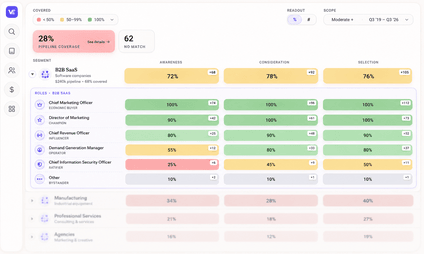
- Coverage shows where you're thin. The Content Coverage Heatmap places every page you've published in the one buyer, segment, and stage it serves best. That shows whether awareness is over- or under-covered compared with the rest of your funnel.
The result is awareness content that teaches, without drifting into a pitch or dissolving into vagueness. It also connects to the work that matters most: making sure buyers find the right content at every stage, for every role on the buying committee.
The takeaway
If your awareness content feels vague, check your rules before you blame your writers. The fix is usually permission, not more restriction. Let the content explain the problem fully, point to the category, and stop there.
In a feed full of AI-generated explainers, that specificity is your advantage. Generic awareness content is now a commodity. A clear explanation of why a problem happens is not, and producing that kind of content, at scale, is exactly what we're building VelocityEngine to do.
Then make sure your awareness content isn't carrying the whole funnel. The buyer you helped at the start needs something waiting at consideration and decision too.
Frequently asked questions
What is awareness stage content?
Awareness stage content helps a buyer understand a business problem they've just started to feel. It explains what the problem is, why it happens, and what kinds of fixes exist, before the buyer is comparing vendors.
Should awareness content mention your product?
No. Awareness content should name the solution category, such as "AI-powered campaign planning tools," but not your product. Product names, comparisons, and demo pushes belong in consideration and decision content.
What's the difference between awareness, consideration, and decision content?
Awareness content explains the problem, its causes, and solution categories. Consideration content compares specific approaches and vendors, including yours. Decision content gives proof, pricing, and terms that help a buyer justify the choice internally.
Is top-of-funnel content still worth creating with AI search?
Yes, if it explains a real problem and its causes. Generic explainers now get summarized by AI before anyone clicks, but content with a clear point of view and specific explanations is what AI engines cite.
How do you find gaps in awareness content coverage?
Lay your content over a grid of persona by funnel stage instead of counting it as a library. Empty cells are gaps. Many teams find awareness over-covered and consideration and decision content thin.
See which funnel stages your content covers today with a Content Coverage Heatmap.