TL;DR: B2B buyers spend about 45% of their buying journey researching on their own and only 17% with vendors. Buyer-led growth is the GTM model built for that reality: open access to content, proof, pricing, and product, with sales consulting when invited. It only works if your content covers every question buyers answer alone, for each segment, persona, and buying stage in your revenue plan. That's content coverage.
For years, B2B go-to-market (GTM) teams ran the same playbook. Marketing generated leads, sales qualified and pitched, and the product was the carrot dangled at the end of a demo. That model was built for a world where vendors held all the cards: information, pricing, and access.
That world is gone. Today's B2B buyers don't want to be sold. They want to solve a problem, explore their options, and decide on their own terms, the same way they buy as consumers. They've taken the wheel, and they expect vendors to make the drive easier.
That changes what your content is for. When buyers lead, your content does most of the selling, and every question it can't answer is a gap a competitor gets to fill. That's why buyer-led growth is really a coverage problem.
The new reality: buyers are already leading
According to Gartner, B2B buyers spend only 17% of their buying journey meeting with potential suppliers, and that time is split across every vendor they're considering. If a buyer is evaluating three vendors, you get roughly 5–6% of their attention.
Meanwhile, Gartner finds buyers spend about 45% of the journey researching independently, online and offline. In practice, that means reading your website and blog, watching recorded demos, comparing reviews, asking peers in Slack and Reddit communities, and increasingly asking AI assistants which tools to shortlist.
By the time buyers do reach out, they've mostly made up their minds. The 6sense 2024 Buyer Experience Report found buyers are nearly 70% through the purchase process before engaging sellers, and 81% already have a preferred vendor at first contact. Content shapes most of that preference: yours or a competitor's.
The buyer journey isn't controlled by the seller anymore. It's driven by the buyer.
The friction starts when vendors force that buyer back into an outdated process. Ask yourself:
- Are we gating high-value content behind forms?
- Do buyers have to talk to sales just to see the product?
- Are our reps still qualifying before they educate?
If the answer to any of these is yes, your GTM isn't just outdated. It's in the buyer's way.
What is buyer-led growth?
Buyer-led growth (BLG) is a go-to-market model designed around how B2B buyers actually decide: independently, asynchronously, and on their own timeline. Instead of moving buyers through a seller-controlled funnel, a buyer-led GTM gives them the content, proof, pricing, and product access they need to self-educate, then brings in people when the buyer asks for them.
BLG isn't anti-sales or anti-product. It doesn't remove humans from the process. It redesigns the process around one question: what actually helps this buyer buy?
Here's the shift in mindset:
| Traditional (seller-led) GTM | Buyer-led growth |
|---|---|
| Sales controls the process | The buyer sets the pace |
| Marketing generates leads | Marketing educates and enables |
| Sales drives the conversation | Sales consults when invited |
| Product is shown at the end | Product is experienced upfront |
| Content is gated | Content is freely accessible |
| Success is measured by content volume | Success is measured by content coverage |
Buyer-led growth vs. product-led growth
Product-led growth (PLG) uses the product itself, through free trials or freemium tiers, as the main acquisition channel. Buyer-led growth is broader. It covers every touchpoint a buyer uses to decide, including content, peer proof, pricing, demos, and sales conversations. PLG can be one part of a buyer-led motion, but a company with no free tier can still be fully buyer-led.
A real example: Atlassian
Atlassian grew into a company with more than $5 billion in annual revenue by rejecting the idea that software has to be sold. Demos, documentation, pricing, and product access are self-serve, so buyers can lead their own journey.
When Atlassian added an interactive, self-guided demo for Jira Service Management, it generated 486 demo-qualified leads per week, according to the demo platform's case study. Those prospects arrived informed, aligned, and ready to make a decision, not to be pitched.
Signs your buyers are already in charge
If you're seeing any of these, it isn't a fluke. It's a buyer telling you they want control:
- Prospects ghost after the first call. They already got what they needed and moved on.
- Visitors bounce from your site. They can't quickly tell what problem you solve or how you'd help.
- "Qualified" leads visit dozens of times before raising a hand. They're doing the work on their own.
- Buyers ask for pricing and product access early. They want it before they're "sales-qualified."
- Sales cycles stretch. The buying committee is aligning internally, not through your reps.
These signals aren't rejections. Most of them point to a coverage gap: a question the buyer needed answered on their own and couldn't find an answer to from you. Each one is an opening to build a better buying experience.
Why buyer-led growth works
BLG doesn't just feel better for the buyer. It's built to work better for the business:
- Lower acquisition costs: Buyers who educate themselves need fewer sales touches to convert.
- Higher win rates: Buyers are better qualified by the time they engage.
- Shorter deal cycles: Buyers move at their own pace, which is usually faster than yours.
- More scalable growth: Content and product do the heavy lifting your headcount can't.
Other companies leaning into buyer-led growth
- Notion: Offers use-case templates and guided onboarding before sales gets involved.
- HubSpot: Built its growth engine on free education, free tools, and self-serve trials.
- Figma: Let designers use the product instantly, then scaled through bottom-up adoption.
Buyer-led growth runs on content coverage
Here's the catch. Every benefit above depends on one thing: buyers finding what they need without you in the room. If the answer isn't there, the buyer either stalls or gets it from a competitor.
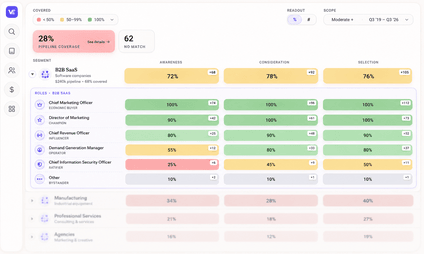
Content coverage is how much of your revenue plan your content actually supports, by segment, persona, and buying stage. It's the difference between "we publish a lot" and "every buyer we're targeting can answer their questions on their own." Most B2B teams' content covers only 10–30% of what their plan requires, and nobody can see the gaps until a deal stalls. (We go deeper on this in your buyers decide in the rooms you're not in.)
Here's how each buyer-led principle turns into a coverage requirement:
| Buyer-led principle | What your content has to cover |
|---|---|
| The buyer sets the pace | Every buying stage, from problem awareness to business case to procurement |
| Marketing educates and enables | Every persona and buying role, not just the executive who signs |
| Sales consults when invited | The proof and objection handling reps used to deliver live |
| Content is freely accessible | Answers structured for search and AI engines, where buyers now ask first |
More content doesn't fix this. AI already made it easy to publish more. What buyer-led growth needs is the right content in the right places, measured against the plan.
To make a buyer-led motion real:
- Map your content to the revenue plan. Score what you've published against your target segments, personas, and stages. A content gap analysis shows where buyers will find answers and where they'll hit a dead end. (Here's how to measure content coverage against the revenue plan.)
- Close the biggest gaps first. Prioritize the gaps tied to the most pipeline, not the next idea on the content calendar.
- Ungate what helps buyers decide. Keep forms for high-intent moments, not for the education buyers need to shortlist you.
- Let sales consult, not gatekeep. Give reps the same content buyers see so conversations start where the buyer's research left off.
VelocityEngine's Content Coverage Heatmap does step one for you. It scores your published content against your revenue plan by segment, persona, and stage, so you can see where buyers are covered and where they're on their own.
The bottom line
Buyer-led growth isn't a tactic. It's a shift in power.
It's what happens when you stop trying to own the buyer's journey and start trying to serve it. That doesn't mean flipping the script. It means tearing it up and asking one question: what would help this buyer make a better decision?
Answer that question everywhere your buyers look, and everything improves: content, campaigns, conversions, and customer trust. So if your GTM engine is losing traction, it may be time to stop driving and start covering the road ahead.
Let the buyer lead. You might be surprised how fast they move.
See where your content supports buyer-led buying, and where buyers hit a dead end. Get your free Content Coverage Heatmap →
Frequently asked questions
What is buyer-led growth?
Buyer-led growth is a B2B go-to-market model built around how buyers research and decide on their own. It gives buyers open access to content, proof, pricing, and product experiences, and brings in sales when the buyer is ready rather than when the vendor wants a meeting.
How is buyer-led growth different from product-led growth?
Product-led growth uses the product, often a free trial or freemium tier, as the main growth channel. Buyer-led growth covers the full buying experience, including content, peer validation, pricing transparency, and sales. PLG can be part of a buyer-led strategy, but BLG also works for companies without a free product.
What does content coverage have to do with buyer-led growth?
In a buyer-led journey, buyers answer most of their questions with content before they talk to sales. Content coverage measures how much of your revenue plan your content actually supports, by segment, persona, and buying stage. Gaps in coverage are the places where buyers stall or a competitor answers first.
Does buyer-led growth replace sales teams?
No. In a buyer-led model, sales shifts from controlling the process to consulting when invited. Reps spend less time qualifying and pitching and more time helping informed buyers validate their decision and align their buying committee.
How much of the B2B buying journey happens without vendors?
Gartner research shows B2B buyers spend only 17% of their buying journey meeting with potential suppliers, split across all vendors they consider. About 45% is spent researching independently online and offline.
How do you start shifting to a buyer-led GTM?
Start by measuring content coverage: score your published content against the segments, personas, and buying stages your revenue plan depends on. Then close the highest-value gaps, ungate the content buyers need to shortlist you, and reposition sales as consultants who pick up where buyer research leaves off.