Campaign content variations are versions of one campaign message, rewritten for a specific buyer, segment, funnel stage or channel. The message stays the same. The angle, proof and ask change to fit the person reading it.
Short answer: Lock the core claim, voice and proof first. Then vary one campaign six ways: by persona (the problem you lead with), segment (the proof), funnel stage (the depth and the ask), channel (the format), objection (what you answer first) and offer (the next step).
Most B2B teams know they need variations. The trouble is how they make them. A campaign launches with one hero asset, then someone resizes it for LinkedIn, trims it for email and calls the job done. That's reformatting. The CMO, the demand gen lead and the ops manager on the buying committee all get the same pitch in different sizes.
Real variation starts from a different question: who is reading this, where are they in the decision, and what do they need to hear to move? Here are six ways to answer it for one campaign, plus a worked example you can copy.
What should stay the same across campaign variations?
Three things stay fixed: the core claim, the voice and the proof. Lock them before you write a single variation. If every version reinvents the message, you don't have one campaign. You have twelve small ones that drift apart.
- The core claim. The one sentence the whole campaign proves.
- The voice. How you sound, whoever you're talking to.
- The proof you stand behind. The customer results and numbers every version can draw from.
Everything else can change: the problem you lead with, the example you pick, the length, the format and the next step you ask for. A good test for any variation: cover the headline, and the reader should still know which campaign it came from.
What are the 6 ways to vary one campaign?
Vary it by persona, segment, funnel stage, channel, objection and offer. Each one changes a different part of the message while the core claim stays put.
1. By persona: change the problem you lead with
Each person on the buying committee feels the same problem differently. A CMO feels it as risk to the plan. A demand gen lead feels it as pipeline that won't convert. A content lead feels it as a backlog with no clear priority.
Lead each version with the problem that person already owns, in their words. Keep the solution the same. Swapping the job title in the headline isn't enough: if the first paragraph would work for anyone, it isn't a persona variation. If your team mixes up the two, start with how personas differ from buying roles.
2. By segment: change the proof and the examples
A healthcare buyer and a fintech buyer can share a title and still need different evidence. Segment variations swap in proof the reader recognizes: a customer from their industry, a regulation they deal with, a number at their company size.
The claim doesn't move. What moves is the reason to believe it. One relevant example beats three generic ones.
3. By funnel stage: change the depth and the ask
The same message reads differently at each stage. At awareness, name the problem and why it matters now, with no pitch. At consideration, show how to solve it and what good looks like. At decision, answer the practical questions: how it works, what it costs, what changes for the team.
The ask should match. A reader meeting you for the first time won't book a demo. A reader comparing vendors doesn't need another explainer. For the first stage, see what awareness content should and shouldn't say.
4. By channel: change the format, not the argument
LinkedIn, email, paid search and a landing page each give you different space and attention. Cut the argument down to fit, but keep its spine: problem, point of view, proof, next step.
This is where most teams stop, and it's the least valuable of the six. Channel variation without the first three is atomization theater: more pieces, same reach.
5. By objection: change what you answer first
Every persona and segment brings its own reason to say no. Finance worries about cost. IT worries about security and integration. The day-to-day user worries about extra work.
Write at least one version that opens with the most common objection for that reader and answers it head-on. These often become the assets sales actually sends, because they handle the conversation reps keep having.
6. By offer: change the next step you ask for
The last variable is the call to action. The same campaign can offer a guide, a template, a benchmark, a diagnostic or a conversation with sales. Match the offer to how much the reader is ready to give.
A useful rule: the earlier the stage and the more senior the reader, the lower the commitment you ask for. A short self-assessment often bridges the gap, because it gives value before it asks for time.
What does a campaign variation plan look like?
One core claim, and one row per variation showing who it's for, what changes and what you ask for. Take a fictional B2B SaaS company launching an automated compliance reporting feature. The core claim, locked before anything else: "Be audit-ready every day, not just the week before the audit."
| Variation | Who it's for | What changes | Sample opening line | Ask |
|---|---|---|---|---|
| Persona | CFO | Lead with risk and cost | "Last year's audit cost your team three weeks. This year it doesn't have to." | Read the 2-page brief |
| Persona | Compliance manager | Lead with daily workload | "Stop rebuilding the same evidence folder every quarter." | Watch the 5-minute demo |
| Segment | Healthcare | Swap in the regulation and a peer example | "How one health system kept its HIPAA evidence current all year." | Download the healthcare checklist |
| Stage | Awareness | Name the problem, no pitch | "Why audit prep still eats a month, even with good tools." | Read the blog |
| Stage | Decision | Answer how it works and what changes | "What setup looks like in the first 30 days." | Book a walkthrough |
| Channel | Paid search | Compress to the claim and one proof point | "Audit-ready every day. Automated evidence collection." | Visit the landing page |
| Objection | IT lead | Answer the integration worry first | "It connects to the systems you already run. Here's the list." | See the integrations page |
| Offer | Early-stage, senior reader | Lower the commitment | "Find out how audit-ready you are today, in 10 minutes." | Take the readiness check |
Every row still makes the same promise. None of them could be mistaken for a different campaign, and none of them is the hero asset in a smaller frame.
How many campaign variations do you need?
Enough to cover the buyers and stages your revenue plan depends on, not every combination. Start with the people who can make or block the deal, then fill the stages where they get nothing.
The simplest way to see them is a grid: buyers down the side, funnel stages across the top, one mark for each asset that fits. It's the same view behind a covered funnel. Here's what the compliance company's grid looked like before it built the variations above.
| Buyer | Awareness | Consideration | Decision |
|---|---|---|---|
| CFO | Blog | — | — |
| Compliance manager | Blog, LinkedIn post | Demo video | Walkthrough |
| IT lead | — | — | — |
The empty cells are the variations to build. The CFO hears about the problem and then gets nothing to help them decide. The IT lead, who can block the deal, gets nothing at all. That's why the plan above includes a CFO brief and an IT integrations answer. A grid like this is how you plan campaign content by persona and stage instead of by channel.
Two checks keep the variations you build on message:
- Read them side by side. If two versions make different promises, one of them has drifted from the core claim.
- Ask sales which ones they'd send. A variation nobody sends is a sign it answers a question buyers aren't asking.
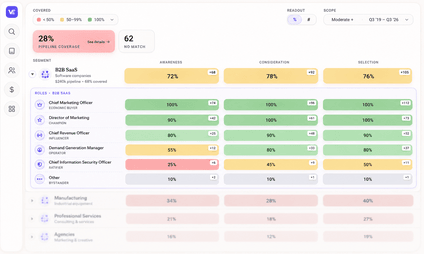
Doing this by hand works for one campaign. Across a full content library, it's hard to see which buyer, segment and stage combinations are covered and which are empty. VelocityEngine's Content Coverage Heatmap maps your published content against your segments, personas and funnel stages, so you can see the empty cells and decide which variation to build first. When you're ready to build, VelocityEngine produces controlled variations by persona, segment and channel from one campaign foundation, so every version keeps the same core claim.
See your coverage with the Content Coverage Heatmap →
FAQ
What are campaign content variations?
Versions of one campaign message adapted for a specific persona, segment, funnel stage, channel, objection or offer. The core claim stays the same; the angle, proof and call to action change.
How many variations does one campaign need?
Enough to cover the buyers and stages your revenue plan depends on, not every possible combination. Start with the decision makers and blockers on your target deals, then fill the stages where they get nothing.
What's the difference between content variations and atomization?
Atomization cuts one asset into smaller pieces for different channels. Variation rewrites the message for different readers. Atomization without variation gives you more pieces that all say the same thing to the same person.
Can AI create campaign content variations?
Yes, if it works from a defined message, voice and proof set. Without those inputs, AI variations drift from the core claim and from each other. VelocityEngine builds variations from one shared foundation of messaging, personas and segments, so they stay on message.
How do I know which variation to build first?
Map what you have against your buyers and funnel stages. Build first where a buyer who can make or block the deal has no content at their current stage.