A request lands in your DMs on Monday: "Can we get a one-pager for the Acme deal by Thursday?" Ten years ago, the hard part was finding time to write it. Today, AI can draft it before lunch. The hard part is everything around the draft: who it's for, whether you already have something better, whether it should jump ahead of the three other requests that came in this week, and whether the draft says anything your team can't stand behind.
That's what an intake process is for. A marketing request intake process is a single, consistent way for other teams to ask marketing for work: one channel, the same questions every time, and a set schedule for ranking requests against each other. With AI on the team, it matters more, not less.
TL;DR
- Send every request through one door and one form, so requests from Sales, Product, the CEO and SEO can be compared.
- Let AI do the clerical work: check that the form is complete, suggest the buyer and stage, find existing content, and draft the brief.
- Keep three decisions with a person: what gets built, what the brief says, and what gets published.
- Quality is set at intake: every request should bring a person-written point of view and raw material such as call excerpts, voice memos or Slack threads. Use the template below; it works in a form tool, a project board or a shared channel.
Why intake matters more when AI can draft anything
AI removed the writing bottleneck. It didn't remove the judgment bottleneck, and it added a review one.
The numbers from this year show both sides. In Ahrefs' 2026 State of AI in Content Marketing survey of 301 marketers, 93% use AI to create content, and 66% say they trust AI content only after a person reviews it. Optimizely's 2026 study of 2,003 marketing leaders found 76% spend at least three hours a week editing, fact-checking or correcting AI output, and 54% say leadership underestimates the human effort it takes to make AI work usable.
So the question for a lean team isn't whether to use AI on requests. It's where in the process AI saves time and where a person has to decide. A good intake process answers that up front, before the first draft exists.
The intake process: one door, three decisions
Every request goes to one place: a form, a board column or a channel with a template. Requests that arrive in DMs or meetings get a friendly redirect: "Can you drop that in the request form so I can rank it with this week's others?"
The door matters more with AI, not less. When anyone can paste a request into a chatbot and get a draft, unofficial content starts showing up in sales decks and inboxes. One door keeps every request visible, so the team can decide what gets built and keep what ships consistent.
AI handles the clerical work; people make three decisions
The teams getting this right split the work cleanly. AI checks, sorts, finds and drafts. A person decides.
Amplitude's marketing ops team is a useful example. Every request used to wait for one person to check the brief for completeness during US business hours. The team rebuilt those triage rules as an AI skill, so requests are scoped when they arrive, in any time zone. As Senior Marketing Transformation Manager Chelsie Cauthon put it, the human is still in the loop; she moved to the end, where her judgment matters. Her takeaway: the bottleneck was her availability, not her judgment.
That's the model. Here's how it splits across a request's life:
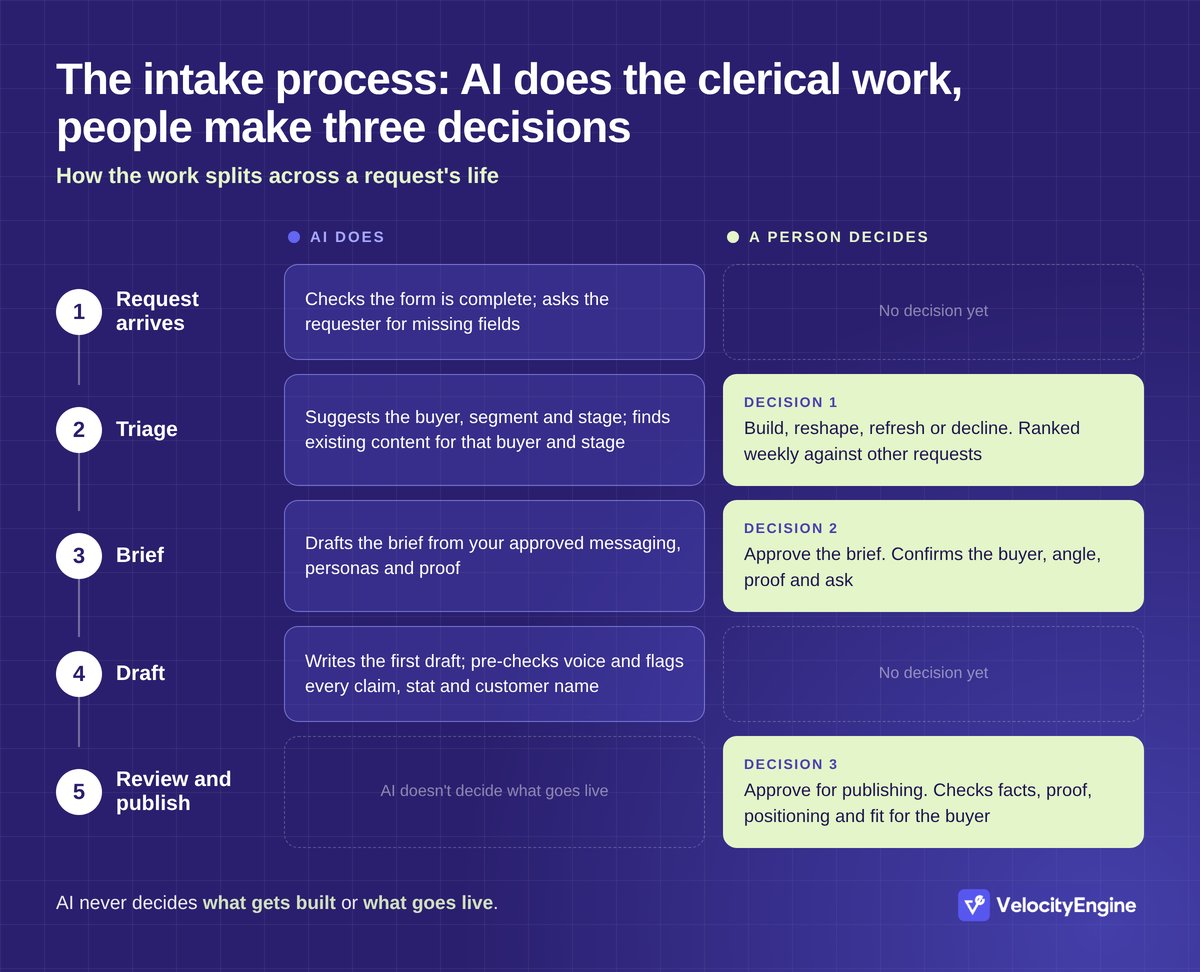
Notice what AI never does here: decide what gets built, or decide what goes live.
Marketing request form template
Requests are hard to compare because they arrive in different units. Sales asks with a deal in mind, Product with a launch date, the CEO with an idea, SEO with a search volume. The form turns every request into the same unit, so they can be ranked side by side.
Keep the core form to six fields, because requesters skip long forms. Two more fields, covered in the next sections, decide how good the piece is and how far it travels: the point of view and raw material (field 7), and where it will go (field 8).
| Field | What it asks | Filled in by | AI's role |
|---|---|---|---|
| 1. Who is it for? | One buyer: the CFO, the IT lead, the practitioner | Requester | Suggests the closest persona from your list if the answer is vague |
| 2. Which segment? | The industry, company size or region | Requester | Fills in from the CRM record if a deal or account is named |
| 3. Which stage? | Awareness, consideration or decision | Requester | Suggests a stage from the request; a person confirms |
| 4. What should they do next? | The action this piece should prompt | Requester | Flags if the ask doesn't match the stage |
| 5. Deadline, and why? | The date and the event behind it | Requester | Flags dates with no event attached |
| 6. What already exists? | Published content for this buyer, segment and stage | Marketing | Searches your library and lists matches; a person judges whether they're strong enough |
Field 6 is the one that decides most requests. If strong, current content already exists for that buyer and stage, the answer is usually to share it, refresh it or adapt it, not to build something new.
Copy-and-paste version
Marketing request

1. Who is this for? (one buyer)
2. Which segment? (industry, size or region)
3. Which stage? (awareness / consideration / decision)
4. What should they do after reading it?
5. Deadline, and what's driving it?
6. [Marketing fills in] What already exists for this buyer and stage?
7. What do we believe about this that a competitor wouldn't say? (one sentence, written by a person)
   Attach raw material: call excerpt, voice memo, Slack thread, customer quote, data or rough outline.
8. Where will it go? (check all that apply)
   [ ] Blog  [ ] Email  [ ] Organic social  [ ] Paid ads  [ ] Sales enablement
   [ ] Webinar/event  [ ] Gated asset  [ ] Other

Optional: link the deal, account or launch this is for.
Instructions for your AI intake assistant
If you use an AI assistant or agent to triage requests, give it rules like these. Rules work better than a general instruction to "help triage":
- If any of fields 1 to 5 is blank or vague, reply to the requester with the specific question. Don't guess.
- Suggest a buyer, segment and stage, labeled as a suggestion.
- Search the content library for that buyer and stage; list up to five matches with publish dates.
- Never mark a request approved, declined or prioritized. Route it to the weekly ranking.
- Never promise a deadline to the requester.
Output quality is decided at intake, not in the prompt
Most advice on AI content quality is about the prompt: better instructions, more examples, stricter rules. But a prompt can only work with what it's given. When a request arrives with a topic and a deadline and nothing else, AI fills the gaps with the most common thing anyone in your category would say. The draft comes back fluent, accurate enough and indistinguishable from your competitors'. (More on why AI content quality starts at the foundation.)
What makes content yours is raw material AI can't invent: what your team believes that others don't, what customers said on last week's calls, the argument your sales lead keeps making in Slack. That material has to come in with the request. By the time someone is writing the prompt, it's too late to go find it.
So add a seventh field to the form.
Field 7: What's our point of view, and where's the raw material?
Ask the requester, or the subject-matter expert they name, for two things:
- One sentence, written by a person: what do we believe about this topic that a competitor wouldn't say? It can be rough. It can't be generated.
- At least one piece of raw material from the list below.
If a request can't supply either, that's useful information. Either the topic isn't ready, or the piece will be a summary of what's already out there, and the ranking should reflect that.
Where to find raw material your competitors don't have
| Source | What it gives you | How to capture it |
|---|---|---|
| Voice memo from a subject-matter expert | Opinions, stories and phrasing in their own words | A 5-minute recorded answer to three questions; transcribe it |
| Sales and customer call recordings | How buyers describe the problem, real objections, the words they use | Pull 2 or 3 short excerpts from your call-recording tool |
| Slack or Teams threads | Internal debates, the explanation someone gave a new hire, the take that started an argument | Link the thread or paste the key messages |
| Win/loss notes and support tickets | Why deals were won or lost; where customers get stuck | Two or three examples tied to this buyer and stage |
| Customer quotes and results | Proof in the customer's own words | Only approved, canonical versions |
| First-party data | Numbers only your team has: usage, benchmarks, survey results | The number plus where it came from |
| A human-written outline or rough draft | The structure and argument a person would choose | Bullet points are enough |
Human-written input vs. AI-written input
The order matters. When a person writes the point of view first and AI expands it, the draft carries that person's argument. When AI writes the first version and a person edits it, the draft usually keeps the AI's argument with better sentences. Editing improves wording; it rarely adds a point of view that wasn't there.
A simple rule for the brief: the point of view, the core claim and the key examples come from people. AI handles structure, expansion, variations and formatting.
Handle the raw material with care
- Get permission before using customer call excerpts, and strip names and account details unless the customer has approved them.
- Treat a Slack thread as input, not a quote. Confirm with the person before attributing anything to them publicly.
- Keep raw material attached to the request, so the reviewer can check the draft against it in Decision 3.
Plan the distribution at intake, too
A blog post is rarely the whole deliverable. Once it's approved, someone asks for the email, the LinkedIn posts, the ad variants, the sales one-pager. If nobody planned for them, they get built in a rush after launch, from the finished post rather than the brief, and each one drifts a little further from the original argument.
Asking how the piece will be used, before it's written, changes three things:
- The brief. A post that will run as a paid ad needs a landing page and a headline that fits the ad platform's character limits. A post going to sales needs a forwardable version. The brief can plan for both.
- The timeline. "Due Thursday" means something different when it includes four ad variants and a nurture email.
- The ranking. A request with a clear plan for reaching its buyer usually ranks above one that will be published and left alone.
Field 8: Where will it go, and what comes after it?
Ask the requester to check every destination that applies. Each one adds derivatives to the brief.
| Destination | Derivatives to plan | Notes |
|---|---|---|
| Blog or resource page | The piece itself; meta title and description; internal links | The source asset everything else draws from |
| Email (newsletter or nurture) | Subject lines, preview text, a short version of the argument | Name the list or nurture stage it fits |
| Organic social | 2 to 4 posts aimed at the same buyer; an executive post if someone will share it | Each post should still name its buyer and stage |
| Paid ads | Ad copy variants, a landing page or gated version, retargeting copy | Confirm budget, audience and offer before writing |
| Sales enablement | A one-pager or email template reps can forward | Ask sales which deals it's for |
| Webinar or event | Talk track, slides, follow-up email | Usually a separate request with its own timeline |
| Gated asset or eBook CTA | Which offer the piece points to | The CTA should match the buyer's stage |
Let AI build the derivatives from the brief, not the finished post
This is where AI saves the most time, as long as it works from the same brief and raw material as the main piece. Derivatives built from the brief keep the same buyer, argument and proof. Derivatives built by summarizing the finished post tend to flatten it into generic copy. (Here are six ways to vary one campaign without losing the argument.)
Then review them as a set. In Decision 3, read the main piece and its derivatives side by side: every piece should make the same promise to the same buyer, and every ad and email should point to the right next step.
Human-in-the-loop review: the three decisions
"Human in the loop" can mean anything from a careful edit to a quick skim before hitting publish. On a lean team, it works best as three specific decisions, each with a named owner and a short checklist. A review with no checklist turns into a reread. A review with a checklist catches what AI gets wrong.
Decision 1: What gets built (weekly ranking)
Owner: the marketing manager or content lead.
Once a week, rank every complete request with three questions: Who is it for? Where are they? What's already there? Requests that fill an empty spot your revenue plan depends on go first (here's how to score those gaps). Requests aimed at a buyer and stage you already cover well get reshaped, refreshed or declined, with a reason.
AI can prepare this meeting: the suggested buyer and stage, the content it found, the request age. It shouldn't make the call. Priorities involve context AI doesn't have: which deals matter this quarter, what the CEO said in the board meeting, which segment the team is betting on.
Decision 2: The brief (before any drafting)
Owner: whoever owns the message, usually product marketing or the content lead.
Review the brief, not just the draft. A wrong brief produces a confident, polished draft aimed at the wrong buyer, and that's the hardest kind of error to catch later.
- One buyer, one segment, one stage
- The angle leads with a problem this buyer already owns
- A person-written point of view and at least one piece of raw material are attached
- Proof comes from your approved set, not from the AI's general knowledge
- The ask matches the stage
Decision 3: What gets published
Owner: a named reviewer, ideally not the person who prompted the draft.
AI output reads with the same confidence whether it's right or wrong. Review it for the things AI gets wrong most often:
- Facts and stats. Every number traced to a primary source. No source, no number.
- Customer names, quotes and results. Approved by the customer and matching the canonical version.
- Point of view. The draft makes the argument from the brief, using the raw material attached. If you could swap in a competitor's logo, it's not done.
- Positioning. Makes the same promise as your messaging, not a near-miss version of it.
- Offer and CTA. Match what you actually offer today.
- Voice. Sounds like your team, not like the category.
- Buyer fit. The buyer named in the brief would find this useful.
AI can run a first pass on this list: flag every claim, compare the draft to your messaging, check voice rules. More teams are doing this; in Ahrefs' 2026 survey, 29% of AI-using marketers now use AI to check AI content, up from 14% the year before. Use it to point the reviewer at what to check, not to replace the reviewer.
Keep the decision count small
Three decisions, three owners. Adding approvers "just in case" brings back the delays the process was meant to remove. If a request needs legal, security or executive review, name it in the brief so it's planned, not discovered.
Exceptions and rhythm
A short list of requests that skip the queue
Some requests can't wait for Monday: legal corrections, security notices, factual errors on live pages, pricing changes. Write the list down and keep it short. Without one, "urgent" becomes the way around the door. These still go through Decision 3 before they publish.
A weekly rhythm
Rank requests at the same time every week and share the result with everyone who asked. Each answer names the buyer, what already exists for them, and what you'll do instead if the answer isn't "build it." Requesters can accept "not this week" when they know when the next decision happens and why theirs moved.
Start next Monday
- Pick the door and post the form, including fields 7 and 8.
- Redirect every request that week to the form.
- If you use AI for triage, give it the rules above and nothing more at first.
- Name the owner of each of the three decisions.
- At the end of the month, check two things: how long requests waited, and how many drafts needed major rework in review.
Get the full operating manual. Intake is one part of running a lean marketing team. The Lean Marketing Team Operating Manual covers the rest: a two-week time audit, scripts for saying no to Sales, Product and the CEO, the four patterns that make campaigns take forever, and a 30-day plan. Download the eBook
Frequently asked questions
What is a marketing request intake process?
A marketing request intake process is a single, consistent way for other teams to ask marketing for work. Every request comes through one channel, answers the same questions, and is ranked against the others on a set schedule.
What should a marketing request form include?
Six core fields: the buyer it's for, their segment, their funnel stage, the action it should prompt, the deadline and the reason for it, and what content already exists (marketing fills in that one). Add two more: a person-written point of view with raw material attached, and where the piece will go, so derivatives are planned up front.
Can AI triage marketing requests?
Yes, for the clerical part: checking completeness, suggesting the buyer and stage, and finding existing content. Deciding what gets built should stay with a person, because priorities depend on context AI doesn't have.
What does human-in-the-loop review mean for marketing content?
It means a named person makes specific decisions at set points. For a lean team, that's three decisions: what gets built, what the brief says, and what gets published.
How do you stop people from going around the intake process?
Redirect every off-channel request to the form, every time, and keep the exceptions list short. The process sticks when requesters see that the form gets them a faster, clearer answer than a DM.