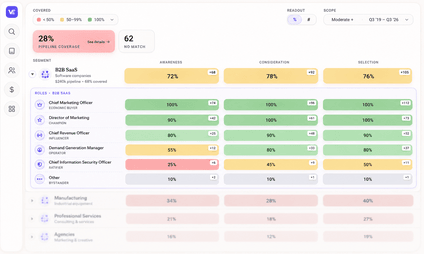
TL;DR: To say no to a content request, first translate it into the same unit as every other request: the buyer it serves, the segment and funnel stage that buyer is in, and whether strong content already exists for that cell. Then rank. A request that fills an empty cell your revenue plan depends on goes first, and one that adds to a full cell gets reshaped. You’ll still say yes to most requests. When you say no, you’ll be able to say why.
Four requests, one Monday
It’s Monday morning and your team has room for 2 new pieces this week.
By 10 a.m. you have 4 requests. Sales wants a case study for a deal in late-stage review. Product wants a launch post for a feature shipping Thursday. Your CEO forwarded a podcast clip with “we should write about this.” And the SEO report flagged a keyword with a few thousand monthly searches that you don’t rank for.
Every one of them is a reasonable ask. Each comes from someone who is right about their part of the business. And none of them can be compared with the others, because each arrived with a different kind of evidence.
So you do what most teams do. The launch goes first because it has a date. The CEO’s idea goes second because it’s the CEO’s. The case study and the keyword wait, and you spend Tuesday explaining why to the people who asked.
Why does the loudest content request win?
Because content requests don’t share a scale. Without one, teams rank by the only signals every request does share: who asked, how loudly and how soon.
Traffic is counted in sessions. A sales ask is measured in urgency. A launch is measured in days until ship. An executive idea is measured by who had it. When you try to rank them, you’re comparing 4 different currencies with no exchange rate.
That’s not a failure of judgment. It’s what happens to any queue with no common measure.
We wrote about the 7 ways teams try to settle this in 7 ways marketing teams decide what content to build. This piece is about the moment after the method: the request is in your inbox, and you need an answer by lunch.
Three fixes that move the argument somewhere else
A scoring sheet. Product teams use RICE (reach, impact, confidence, effort), a model Intercom built for product managers, and content teams borrow it. It brings discipline to the conversation. But “impact” still has to be scored against something, and in most sheets the person scoring decides what that is. The argument moves from the inbox to the spreadsheet.
First in, first out. A queue is fair to the people asking. It’s indifferent to the business, so the calendar ends up reflecting who emailed first.
Saying yes to everything. Some teams add freelancers or AI drafting and clear the queue. Throughput goes up, and the loudest requests still go first. If the queue was pointed at the wrong buyers, more capacity gets you there faster.
Each of these treats the problem as volume. The problem is the missing unit.
How do you prioritize content requests?
Translate every request into the person it’s for, then rank. Keep every input, and ask the same 3 questions of every request, whoever sent it:
- Who is it for? One buyer on the buying committee you sell to: the CFO, the IT lead, the practitioner.
- Where are they? The segment and the funnel stage: awareness and education, consideration, or selection.
- What’s already there? Whether you already have strong, current content for that buyer, in that segment, at that stage.
The third question is the tiebreaker. A request that fills an empty cell in a segment your revenue plan depends on goes ahead of one that adds a fifth piece to a cell you already hold. The requester doesn’t change that, and neither does the deadline.
Here’s Monday again, translated. (The cell states are illustrative.)
| Request | From | Who it’s for | Segment and stage | What’s already there | Call |
|---|---|---|---|---|---|
| Case study for a late-stage deal | Sales | CFO | Mid-market software, selection | Nothing aimed at the CFO past awareness | Build this week |
| Launch post for Thursday’s feature | Product | Practitioner | All segments, consideration | 6 strong practitioner pieces at this stage | Ship a short version; fold the rest into existing pages |
| CEO’s podcast idea | CEO | Unclear | Unclear | Can’t tell yet | Ask 1 question, then decide |
| High-volume keyword | SEO | Practitioner | Mid-market software, awareness | 11 pieces, 3 over a year old | Refresh the oldest instead of writing new |
None of the 4 requests was rejected. The launch post and the keyword changed shape, the CEO’s idea went back with a question, and the case study that would have waited went first.
How do you say no to a content request?
Attach the no to a cell anyone can check: the buyer, what you already have for them, and what you’ll build instead. The point of a shared unit is that “no” stops being a judgment about the person asking.
To sales. “Which person on that deal is still unconvinced?” Sales usually knows, and the answer turns “we need a case study” into “the CFO has nothing to read past the first meeting.” That’s one of the most common buying committee content gaps, and it makes a better brief, often a faster one.
To product. “Who changes their mind because of this feature?” If it’s a buyer you already cover well at that stage, the launch still gets announced. It just gets a release note and an update to the pages that buyer already reads, rather than a new long-form piece.
To the CEO. “Who do you picture reading this?” Executive ideas are often aimed at a buyer the team underserves, because the CEO hears from people the content team never meets. Ask before you rank it. Sometimes it jumps the queue on the merits.
To search. “Who’s typing that query, and do we have anything for them already?” A high-volume keyword in a cell you already hold is usually a refresh, not a new piece. Not every content gap needs new content.
Each answer ends the same way: here’s the cell, here’s what’s in it, here’s what we’ll build instead. That’s a no with a reason attached.
What does this method cost?
The method is simple. Running it isn’t free.
You need an agreed buyer list first. If marketing and sales disagree about who sits on the committee, every translation becomes an argument. Settle the list once, per segment, before you use it to rank anything.
You need to know what’s already there. Answering the third question means mapping your existing content to buyer, segment and stage. Done by hand, that’s a few hours for the first pass and the same hours again every quarter, because content ages and you keep publishing.
Some requests should skip the line. A legal correction or a security notice doesn’t wait for a cell count. Agree on the short list of exceptions up front, so “urgent” doesn’t quietly become one.
It tells you where to stop. A well-covered cell will keep attracting requests, because that’s where your best content already performs. Turning them down is the hardest part, and it’s where the method earns its keep.
It’s a coverage measure. Knowing a buyer has nothing written for them is a reason to build. It doesn’t predict how that piece will perform, so keep watching your performance data alongside it.
Start with next Monday
You don’t need new software to try this. Take the next 4 requests that land, write the 3 answers next to each, and see whether the order you’d have picked changes. For the planning-meeting version, see how marketers decide what content to build next.
If the order does change, the slow part will be the third question. The VelocityEngine Content Coverage Heatmap does that part: it maps each published piece to the one buyer, segment and stage it serves best, so you can see which cells are empty before the requests arrive.
Which buyer on your committee would win next Monday’s tiebreaker?
Get your free Coverage Score →
Frequently asked questions
How do you prioritize content requests from different teams?
Translate each request into the buyer it serves, the segment and funnel stage that buyer is in, and whether strong content already exists there. Then rank on the third answer: requests that fill an empty cell your revenue plan depends on go first.
How do you say no to a content request from a senior stakeholder?
Ask who they picture reading it, then show what already exists for that buyer at that stage. If the cell is full, offer a refresh or an update to an existing page. If it’s empty, the idea may move up the queue on its merits.
Which content requests should skip the queue?
Agree the exceptions up front. Legal corrections and security notices usually qualify. Keep the list short so “urgent” doesn’t become a standing exception.
What’s the difference between a content request and a content gap?
A request is what someone asks for. A gap is a buyer, segment and stage with no strong content behind it. Some requests close a gap; others add to a cell you already cover.
Is a buyer the same as a persona?
Close. Here a buyer is one role on the buying committee, such as the CFO or the IT lead. Many teams call that a persona or a buying role; here’s how the two differ.