Your content is performing. Here's how to decide which gaps in the revenue plan to close first.
The performance dashboard says the campaign worked. Conversion rates are up, top assets are holding, and the reporting deck has the numbers leadership wants to see.
Then last week's forecast call turned up three segments your calendar never touched. Sales is working those accounts now, with assets built for a different buyer.
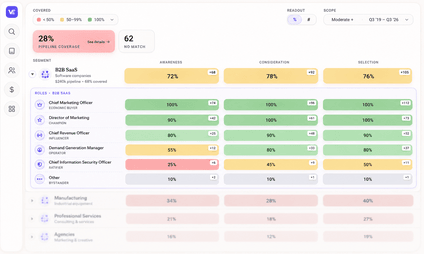
Performance data only measures the content you have. It can't show the buyers who found nothing written for them, which is why content coverage needs its own view. Most teams that build that view hit the same wall next: the heatmap shows twenty gaps, the team can close four this quarter, and every stakeholder has a favorite.
This post is about that decision. How to treat a gap as a revenue-plan dependency, score it against what's actually at stake, and keep a strong-performing asset from hiding the gap a little longer.
Why strong performance data pushes teams toward the wrong fix
When sales asks for something in a new segment, the fastest answer is your best-performing asset. The benchmark report converts. The webinar holds. So it gets a new cover, a vertical headline and a send to the professional services accounts sales is working.
That's where performance data does the most damage. The asset brings the wrong pain points, the wrong buying committee and a sales motion that doesn't fit how that segment decides. It creates movement, not coverage. And because it still gets opens and clicks, nothing in your reporting flags it.
The sales team feels it first. Bryant Bell, PMM at Exterro, put it this way: "What our sales leaders are struggling with is: do we have the right assets, and are we delivering the right point of view to the right personas? That's where we're struggling. I've been looking for something to give proof."
The fix isn't a better read on what performed. It's deciding which gaps the revenue plan can't afford to leave open, and building those first.
A coverage gap is a revenue-plan dependency, not an asset request
This reframe changes who owns the gap and how fast it moves.
"We should write another ebook" is an asset request. It joins the queue with every other idea and wins if the person asking is loud enough.
"No consideration-stage proof for operations leaders at mid-market manufacturers" is a revenue-plan dependency. The plan assumes pipeline from that segment, and nothing in the library helps a buyer there move forward. It competes for production time against every other gap, on the same terms.
Writing gaps this way, as segment + persona + stage + what's missing, does two things. It ties each gap to a number leadership already owns. And it makes gaps comparable, so you can score them instead of debating them.
Score each gap on five criteria
Without a scoring model, teams default to building whatever was requested most recently. Score every gap on five criteria that reflect what the revenue plan actually stands to lose:
- Pipeline at risk: How much of this quarter's pipeline target sits in this segment?
- Sales activity: How many open opportunities or active accounts does the gap touch right now?
- Proximity to conversion: Is the gap at a stage where the missing asset would change the outcome, such as consideration or selection, rather than early awareness?
- Campaign timing: How many days until the campaign or selling window for this segment closes?
- Segment priority: Where does this segment rank in the revenue plan?
A simple 1–3 score on each is enough. Here's how three hypothetical gaps compare:
| Gap | Pipeline at risk | Sales activity | Proximity to conversion | Timing | Segment priority | Total (of 15) |
|---|---|---|---|---|---|---|
| No late-stage implementation proof for enterprise legal tech | 3 | 3 | 3 | 3 | 3 | 15 |
| No consideration-stage content for mid-market manufacturing ops leaders | 3 | 2 | 3 | 2 | 2 | 12 |
| A third awareness asset for a horizontal, lower-priority segment | 1 | 1 | 1 | 2 | 1 | 6 |
A gap that scores high on all five should move ahead of lower-scoring work in the production queue, whatever the team prefers or who's asking. If sales is opening enterprise legal tech deals this quarter and the library has no late-stage implementation proof, that gap outranks another awareness asset, even one that would perform well.
This works alongside the three questions for any single content request. Those questions tell you whether a request fills a gap. The score tells you which gap to fill first.
Decide what counts as coverage before you score
Scoring only works if the gaps are real. Start from the revenue plan, not the content inventory: which segments are priority this quarter, which personas sit on the buying committee, and which stages carry the most pipeline risk. If you haven't mapped that yet, build the coverage grid first.
Then hold every asset to one rule: it only earns coverage credit if a rep can use it for that segment and stage without explaining it first. If sales has to add context before sharing it, the asset isn't doing coverage work, and the cell is still a gap.
Product marketing sets the second bar. Assets should pass an approval step that confirms they carry current positioning, segment definitions, persona assumptions and competitive context. An asset that skipped that step doesn't get full credit, however well it has performed. (Here's how to get new positioning into every campaign without briefing each one.)
When pipeline pressure builds, the temptation is to lower that bar so more cells turn green. The cost doesn't show up at approval. It shows up later, in the forecast.
Name what's blocking each gap
A high score tells you a gap matters. It doesn't tell you why it's still open. Most top-scoring gaps are stuck for one of two reasons, and they need different owners:
- Blocked by production capacity. The team knows what to build but doesn't have the hours. That's a resourcing call: move lower-scoring work, add capacity or extend a strong asset into the segment properly, with real variation by persona, segment and stage.
- Blocked by missing segment definitions. Nobody has agreed on the segment's pain points, buying committee or positioning, so any asset built now would be a guess. That's a product marketing call, and it has to happen before production starts.
Sorting gaps this way also changes the leadership conversation. Instead of a story about content volume, the CMO or CRO hears three things:
- Which segments are under-covered against this quarter's plan.
- What pipeline is at risk if each gap stays open past the campaign window.
- Which gaps need capacity and which need decisions.
The third point is the one leadership can act on. (For taking this view to the board, see Content Coverage Is About to Be a Board Term.)
Count coverage added, not assets shipped
A team can ship a campaign that turns one anchor piece into six derivative assets, count all six as progress, and never notice that every one serves the same segment and stage. Six assets shipped. One cell filled.
Shipped volume and closed gaps are different outcomes. To track the difference, rescore your top gaps against the revenue plan on a set cadence, monthly at minimum and weekly during campaign season. Don't wait until the end of a campaign, when the gaps have already turned into forecast problems.
The question at each review is simple: which high-scoring gaps closed, which moved, and which are still open with the window getting shorter?
Conclusion
Performance data records what happened with the buyers you reached. It was never built to tell you which gap to close next.
Scoring gaps against the revenue plan before campaign season opens keeps the forecast call from finding them for you. And it changes what you bring to leadership, from "here's what converted" to "here's where we're covered, here's what's at risk, and here's the order we're closing it in."
Teams that work this way run their campaign plans from coverage, often through a Campaign Operating System like VelocityEngine. They stop treating performance as proof of readiness, because a strong asset in the wrong segment doesn't close deals. It just hides the gap a little longer.
Which gap in next quarter's plan would score a 15 today, and is anyone building for it?
Request your Content Coverage Heatmap →
Frequently asked questions
How should we prioritize content coverage gaps?
Score each gap on five criteria: pipeline at risk in the segment, sales activity in the affected accounts, how close the gap is to a conversion stage, how much time is left in the campaign window, and the segment's priority in the revenue plan. Gaps that score highest should move ahead of lower-scoring work, whoever requested it.
What's the difference between a coverage gap and a content request?
A content request names an asset, such as "we need another ebook." A coverage gap names a buyer situation the revenue plan depends on that has no usable content, such as no consideration-stage proof for a priority segment's economic buyer. Gaps can be scored and compared; requests usually compete on who asked loudest.
Why is recycling a high-performing asset into a new segment risky?
A horizontal asset carries the wrong pain points, buying committee and sales motion for a vertical segment. It still gets engagement, so performance reports look fine, but it doesn't help buyers in that segment move forward. Sales inherits the gap.
When does an asset count as coverage?
When a rep can use it for that segment and stage without explaining it first, and it reflects current, approved positioning for that segment. Assets that need translation from sales, or that skipped product marketing review, shouldn't get full credit.
How often should we rescore coverage gaps?
On a set cadence against the revenue plan, not only at the end of a campaign. Rescoring regularly shows whether new assets closed priority gaps or just added volume to cells that were already covered.