TL;DR
- Most content budgets are approved against an inventory of what exists, by format and owner. An inventory can't tell you which buyers in the revenue plan have content that serves them.
- A content gap needs a diagnosis before it gets a budget line. Gaps come in 4 kinds, and only 1 of them calls for new production.
- True whitespace needs new content. Duplicated effort needs consolidation. Stale positioning needs a refresh. Field-invisible content needs activation.
- A coverage map sorts the first 2 kinds on its own and flags candidates for the third. The fourth needs your sales team, because the map reads your public site, not your reps' behavior.
- With marketing budgets essentially flat, a request tied to named, classified gaps is the version a CFO can approve.
Try this before your next budget review. Name the 3 segments your revenue plan leans on hardest this quarter. Then, for each, name the buyers and funnel stages where you have current, credible content right now.
If answering takes a spreadsheet, a message to the content manager, or a guess, your budget is running on inventory logic. It is being approved against what exists, and nobody has checked who that content serves.
CMOs feel this most when money is tight, and it is. Gartner's 2026 CMO Spend Survey found marketing budgets rising only to 7.8% of company revenue from 7.7% in 2025, and Gartner expects that to push CMOs toward sharper prioritization and reallocation. Gartner surveyed 401 marketing leaders, most at companies above $1 billion in revenue, but smaller teams will recognize the constraint.
A request that says "we need more content" is hard to defend in that setting. A request that names the gap, says what kind it is, and prices the fix is much easier to approve.
Every content gap needs a diagnosis before it gets a budget line.
Content inventory logic versus content coverage logic
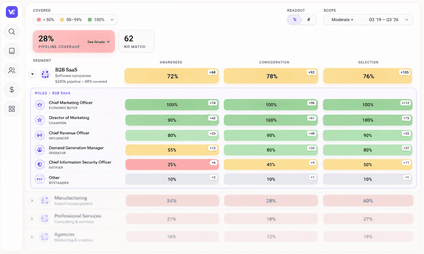
A content inventory organizes assets by how marketing works: format, campaign, owner, and channel. A coverage view organizes them by how the company sells: segment, buyer, and funnel stage.
The two views can tell opposite stories about the same library. Consider a mid-market, sales-led software company with 80 assets tagged to enterprise expansion. The inventory looks healthy. Mapped by buyer, most of those assets land on the IT evaluator, while the economic buyer and the people who own implementation have almost nothing.
Enterprise deals have many readers. Forrester's 2026 buyer research puts the typical B2B purchase at 13 internal stakeholders and 9 external influencers. An inventory counts assets, but it can't tell you how many of those people have something written for them.
The Content Coverage Heatmap makes that count possible. It assigns each asset to the one segment, buyer, and stage it serves best, and counts it only there. That is how "80 enterprise assets" becomes "2 of the 5 enterprise buyers you defined."
The 4 content gaps for B2B marketing teams
A thin cell on a coverage map is a decision point. Before anyone approves spend, sort the gap into 1 of 4 kinds, because each calls for a different fix at a different cost.
- True whitespace. Your plan counts on a buyer and stage, and you have nothing credible written for them. When a competitor is already speaking to that buyer, the whitespace is contested, and the buyer is reading someone else's framing. When nobody is, it's open, and the first credible piece sets the terms. Both call for new production, and this is the only kind that does.
- Duplicated effort. Several assets say the same thing to the same buyer while the neighboring cells stay thin. Consolidate, retire the extras, and move the budget next door.
- Stale positioning. The asset exists, but it argues a story the company no longer tells: an old category, an old product motion, or last year's objections. Refresh it before commissioning a replacement.
- Field-invisible content. The asset is current, but it never reaches a deal. Reps can't find it, or it isn't in the sequences and enablement kits they actually use. Fix activation and packaging, and leave the content itself alone.
Here's how that plays out.
> Sales asks for more fintech buyer enablement
> Marketing points to 12 existing assets
> A review finds that 9 use compliance language the company has since retired
> 2 sit in a resource center reps never open, and 1 is aimed at the wrong member of the buying committee.
The request sounded like whitespace. It was really 9 refreshes, 2 activation fixes, and 1 retarget, and a budget for new content would have fixed none of them.
Your team will spend longer classifying gaps than approving a brief. It also means telling sales that some of their requests will be answered with a refresh or a better link.
What the content map sorts, and what your team checks
The heat map handles 2 of the 4 sorts on its own. Cells that fall short of their plan-derived target, with nothing strong in them, are true whitespace. Run the same map on the competitors you meet in deals, using your taxonomy, and each whitespace cell shows whether it's contested or open. Cells past their ceiling, or segments where most assets land on 1 buyer, point to duplicated effort.
Choose those competitors carefully. A category giant with 10 times your library will fill every cell and tell you nothing, so compare against the vendors you actually meet.
It flags candidates for the third. The map discounts content older than 6 months, and more so past a year, so an aging cell shows you where to look for stale positioning. Whether the argument itself has gone out of date is a call for your product marketing team.
The fourth needs your sales team. The map reads what is published on your public site and has no view into your CRM, your sequences, or which assets reps open. A short review with a few reps per priority segment will surface the assets that exist but never reach a deal.
We draw that line deliberately. A map that claimed to see field usage from a public crawl would be guessing.
A budget conversation built on classified gaps
Once every thin cell has a kind, the budget request has 5 lines: build, consolidate, refresh, activate, and leave alone.
"Leave alone" is the line most requests are missing. The map marks cells already past their target, so you can show where spending stops as well as where it starts. Few budget requests include that line, and it lends credibility to everything else in the request.
The map also weights coverage by the segments the plan prioritizes. A whitespace cell in the enterprise segment that carries most of the plan outranks 6 in a mature segment that already converts.
"If you've got 87 gaps and only so many hours in the day, the heat map would be super valuable as a pressure point. It would impress on leadership that we don't have the team to address those right now."
That is the other use of a classified map. It shows leadership what the current team can't cover, in terms they can decide on, which is the kind of number boards are starting to ask marketing for.
Expect the map to show a library more concentrated than you believed, and some of that concentration will trace back to your own past spend.
For the gaps classified as whitespace or stale positioning, the Campaign Operating System builds or refreshes the content from one governed foundation. New and refreshed assets carry your current positioning from the first draft.
Frequently asked questions
What are the types of content gaps?
There are 4. True whitespace, where you have nothing credible for a buyer and stage your plan needs, whether or not a competitor is already speaking to them. Duplicated effort, where several assets crowd one buyer while neighboring cells stay thin. Stale positioning, where an asset argues a story the company no longer tells. Field-invisible content, where a current asset never reaches the sales motion. Only whitespace calls for new production.
How should you prioritize a content budget?
Weight gaps by the segments your revenue plan prioritizes, then match the spend to the kind of gap: build for whitespace, consolidate duplicated effort, refresh stale positioning, and fix activation for field-invisible content. Stop funding cells that already meet their target.
Can a content audit identify content gaps?
An audit shows what exists, by format, topic, date, and owner. It can reveal missing formats or topics, but not missing buyers, because it isn't organized around who the content serves. Mapping each asset to the buyer, segment, and stage it serves best turns an inventory into a gap list.
How do you find duplicated content?
Count each asset once, in the cell it serves best. Cells where many assets pile up become visible, as do segments where most content lands on 1 buyer. Once a cell passes its target, a coverage map shows it as a surplus, which is where consolidation starts.
Conclusion
Your next content budget will be approved against something. An inventory tells you what you have, and a classified coverage map tells you what each dollar is for.
Before you approve another increase, sort every thin cell into whitespace, duplication, staleness, or field invisibility, and price each fix to match. Often the request needs less new production than it assumed, and the production that remains is easier to defend.
See which of your gaps are which. Run a free coverage scan on your site.