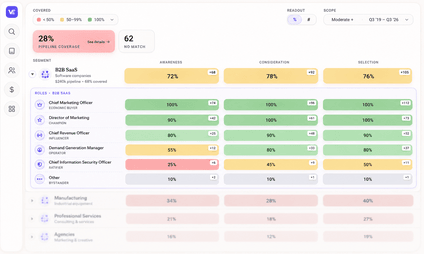
Should buyer coverage replace keyword share of voice? Yes, for competitive decisions. Keyword rankings show where you placed inside demand a competitor already shaped; buyer coverage shows whether your positioning reached the conversations where evaluation criteria form. Keep rankings as your capture metric, and judge competitive exposure by coverage.
B2B marketing teams treat the keyword ranking report as a coverage model. It isn’t. It’s a performance report on conversations that already closed without you.
Category competitors aren’t winning on better content. They’re winning earlier, in the conversations where evaluation criteria form, objection language gets standardized, and proof requirements get written before your team appears. The ranking report doesn’t show that. It shows where you placed inside demand that someone else created.
TL;DR
- Keyword rankings measure capture: they register demand your positioning caught, not the conversations that set buying criteria before search begins.
- Buyer coverage is content coverage across the whole buying committee, by persona, segment, and funnel stage.
- The decisive gaps sit in late-funnel objections and committee-specific proof requirements, where a competitor has often answered first.
- Rank overlooked lanes by commercial weight, not search volume, and build where criteria are still forming.
Why are keyword rankings a lagging indicator in B2B SaaS?
Keyword rankings isolate one late-stage behavior: a buyer searching for something they already know to look for. They measure capture, not creation.
That distinction matters most in complex B2B SaaS sales, where evaluation criteria solidify well before anyone runs a search. A fintech compliance buyer’s risk framework, a healthtech provider’s concern about clinician workflow disruption, an HR tech buyer’s internal politics around adoption: none of these arrive as search queries. They arrive as objections, RFP requirements, and procurement criteria. By the time they surface in a sales call, a competitor has already supplied the language your buyer uses to evaluate you.
Consider what a coverage review of a legal tech company might reveal. The company ranks competitively for “contract lifecycle management software,” a real win inside known demand. But category competitors have built concentrated coverage around:
- Implementation burden and IT resource requirements
- Clause-library governance for mid-market legal operations teams
- Legal operations maturity as a qualifying frame for buyers
- Procurement defensibility language for finance approvers
The dashboard shows upward movement. The coverage map tells a different story: chief legal officers, legal operations managers, finance approvers, and security reviewers are receiving uneven positioning, or none at all, across the funnel stages where criteria form. That pattern is common; most content reaches two or three buying roles and leaves the rest of the buying committee to a competitor.
Buyer coverage gaps are not missing articles. They are missing strategic claims across personas, funnel stages, objections, verticals, and buying committee members. Your team can ship consistently and still leave the decisive conversations unoccupied.
What does a competitor content gap analysis show that a ranking report can’t?
A competitor content gap analysis shows which buyer conversations a competitor has already structured and which ones nobody owns yet. A ranking report only shows where you placed for terms buyers already search.
Replacing a keyword list with a coverage map is not a campaign planning exercise. It is a structural shift in how product marketing defines competitive exposure. A keyword list starts with what buyers search for. A coverage map starts with what the buying committee hasn’t resolved, then asks where competitors have already supplied the resolution.
For a healthtech company selling a patient engagement platform, buyers may search for the product category, but the conversations shaping the decision concern:
- EHR integration complexity
- Clinician workflow disruption and change management accountability
- Reimbursement alignment and coding workflow impact
- Security review requirements and data residency
- Executive accountability for adoption metrics after launch
None of these appear reliably in a keyword report. All of them are live in sales calls, clinical advisory conversations, implementation guides, and security review documentation that competitors already own.
The map a Director of Product Marketing needs starts with persona, segment, and funnel stage, scored for your content and a competitor’s side by side. Your team then layers on what only sales and win-loss notes can supply: the decision triggers, objection types, and proof requirements live in late-stage deals. Together they show where your positioning is present, where it’s absent, and where a competitor has built a durable claim your team will face unprepared.
Chris Hutchins, Head of Content at Audiense, put it this way: “We stopped guessing what to build next. Now every asset we plan maps to a gap in our revenue plan.”
The map only creates leverage when what it reveals flows into a shared positioning foundation, so AI-generated assets carry the nuance and shipped campaigns can be audited against the original strategy. Strong PMMs don’t build equal coverage across every persona and segment. They prioritize where a strategic claim is commercially decisive, competitively contested, or dangerously absent.
How do you find the buyer conversations competitors haven’t claimed?
Find them by mapping each persona’s unresolved questions against where competitors have already answered, then ranking the open lanes by commercial weight. An overlooked lane is a buyer conversation with real deal impact that competitors have failed to structure, defend, or connect to differentiated positioning.
It is not a low-volume keyword your tracking tool missed. Most teams’ content covers only 10 to 30% of what their revenue plan requires, and the exposure concentrates where buying criteria form: late-funnel objections, committee-specific proof requirements, and segment-specific concerns competitors have already answered first. Buyers do most of that evaluating without you in the room.
Evaluate each overlooked lane in this order:
- Buyer importance: Does this conversation involve a persona or buying committee member who controls, delays, or kills the deal?
- Sales friction: Does this concern surface repeatedly in late-stage calls that your team can’t counter with existing assets?
- Segment value: Does the gap concentrate in a vertical or segment where you’re prioritizing new-logo pipeline?
- Competitive occupancy: Has a competitor built a coherent claim here, or is the lane genuinely unstructured?
- Proof availability: Can you make a credible, differentiated claim backed by customer evidence or outcome data?
- Positioning fit: Does owning this conversation reinforce or extend your core positioning, or does it require a drift the market won’t follow?
An insurtech example sharpens this. Competitors may dominate broad policy administration terms, but the conversations deciding mid-market carrier deals center on claims leakage attribution, broker workflow visibility, regulatory response speed, and migration risk from legacy systems. These objections are live in every evaluation, and every vendor faces their proof standards. The team that structures them first changes the buying criteria, not just the keyword ranking.
The question is not “Where do they rank?” The questions are:
- Which concerns have they normalized across the buying committee?
- Which objections have they answered before your team appears?
- Which decision criteria have they made buyer-visible, criteria your team will now be evaluated against?
Directing investment toward conversations where you can change buying criteria is a different mandate than chasing terms where you can win qualified traffic. The first builds durable competitive position. The second measures performance inside a demand pool that competitors helped create.
The operational test for any lane is concrete: can it become campaign assets, sales enablement, proof points, and segment-specific messaging without drifting from your positioning foundation? A lane that requires a new claim architecture is not an overlooked opportunity. It is a positioning problem wearing a content brief.
Should buyer coverage replace keyword share of voice?
As your primary competitive measure, yes. Rankings still tell you how well you capture demand, but only coverage tells you whether a competitor defined that demand first.
If a competitor has already set the evaluation standards, your team inherits them at the worst possible moment, when changing them is no longer an option. Winning traffic on terms that competitor established doesn’t close that gap. It deepens it.
Leading teams stop treating the ranking report as a coverage model. They map the buying committee’s unresolved questions against competitive occupancy across personas, funnel stages, and segments; evaluate gaps by commercial weight, not search volume; and build positioning in the lanes where evaluation criteria are still forming. The threshold is not whether your content performs inside known demand. It is whether your positioning secures the overlooked lanes before a competitor gets there first.
Want to scan a specific competitor? Book a demo.
Frequently asked questions
What is buyer coverage in B2B SaaS marketing?
Buyer coverage is content coverage measured across the whole buying committee: whether your positioning reaches every persona, funnel stage, and segment that influences buying criteria before search demand forms. Unlike keyword rankings, which measure captured demand, it shows where your messaging is present, absent, or outflanked by competitors who already shaped the evaluation standards.
How does a coverage map differ from a keyword ranking report?
A coverage map scores your content by persona, segment, and funnel stage and shows where your positioning is missing or contested, not just where assets exist. A keyword ranking report only shows performance inside demand that already exists, measuring capture rather than the creation of evaluation criteria.
Why are keyword rankings a lagging indicator in B2B marketing?
Keyword rankings reflect performance within established demand, not influence over the criteria buyers use to evaluate solutions. By the time search demand appears, competitors may have already defined the objections, proof requirements, and decision criteria that shape the deal.
How do you run a competitor content gap analysis?
Score a competitor’s public content by persona, segment, and funnel stage, then compare it with yours cell by cell. The cells where they’re covered and you’re exposed are the conversations they’ll own in your deals; the cells neither of you covers are the overlooked lanes.
How can you identify the content gaps that affect sales outcomes?
Map each persona’s and segment’s unresolved questions, objections, and proof requirements against where competitors have already supplied answers. Check the result with sales: the gaps that keep surfacing in late-stage calls are the ones costing deals.
What makes an overlooked lane commercially important?
An overlooked lane matters when it involves buyer conversations that control, delay, or kill deals and competitors haven’t yet structured or defended them. These lanes cluster around late-funnel objections, segment-specific concerns, and proof standards that shape evaluation criteria and pipeline.